

How Does Glance Know What to Suggest? Five AI Agents Explained
TL;DR
Most AI shopping tools recommend products based on what you have already clicked. Glance does something structurally different. Five specialised AI agents — each reading a different signal about you and your context — run simultaneously and are synthesised by one orchestration layer into a single output: a complete, styled look visualised on your actual body. Weather and location. Regional micro-trends. Upcoming occasions. Your physical features from a selfie. Your behaviour over time. Remove any one signal and the output changes. This article explains what each agent reads, what it changes, and why five specialised agents produce better results than any single model could.
When you open most shopping apps, a single model processes everything it knows about you — your past clicks, your purchase history, your stated preferences — and returns a ranked list of products it thinks you might like. This is recommendation. It is useful. It is also fundamentally limited by one constraint: it only knows the self you have already shown it.
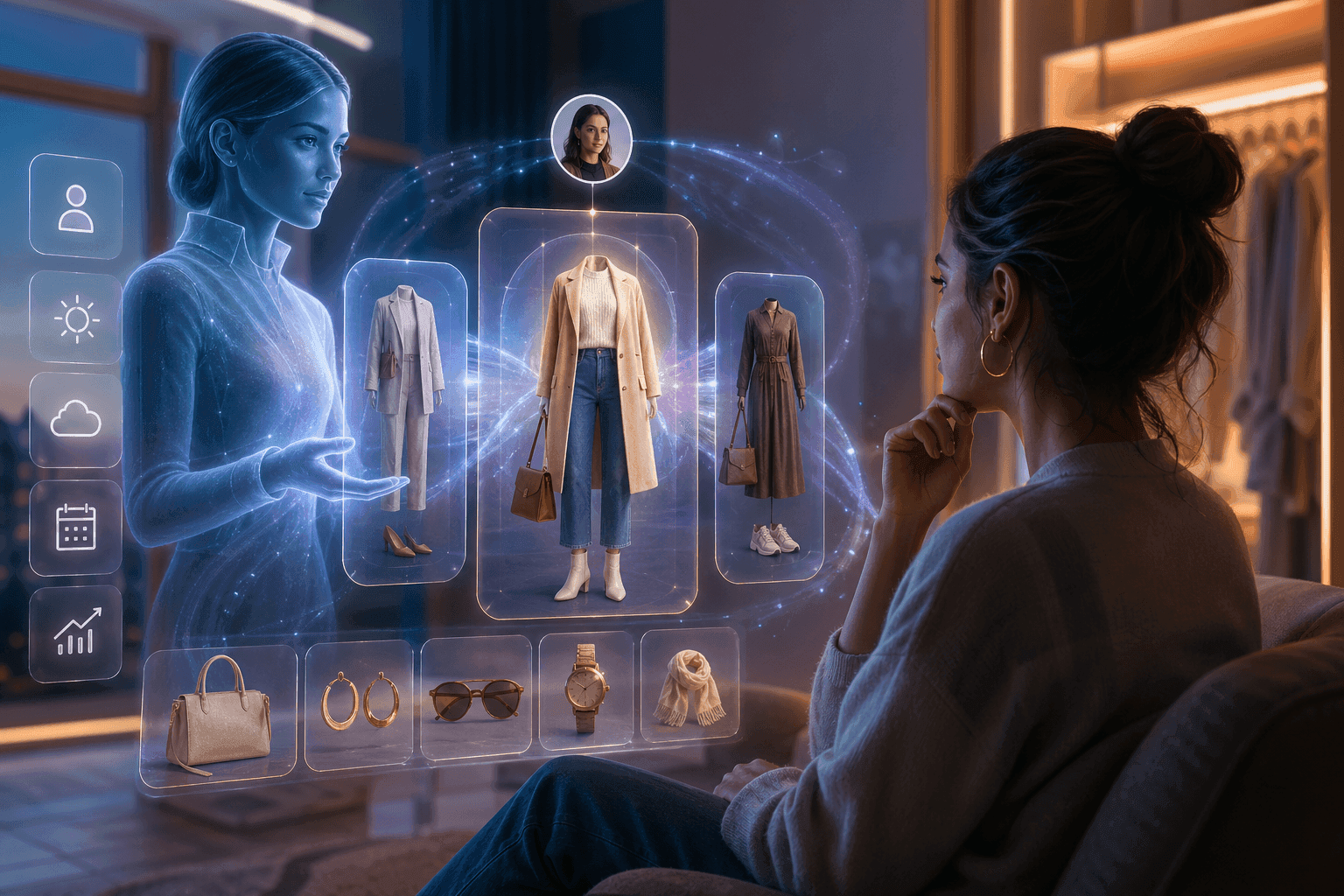
Glance operates differently. Instead of one generalised model processing everything at once, five specialised AI agents each read a distinct signal about you and your context. Each agent is expert in its domain. A central orchestration layer synthesises all five into a single output — a complete, styled look, built around your actual features, for the day you are actually having.
This is the difference between recommendation and agentic shopping - between being served more of what you already like and being shown something that is genuinely right for you right now.
Agent 1: Weather and Location
What it reads: your current location, local weather conditions — temperature, humidity, precipitation — and seasonal timing. Weather data is pulled in real time at the moment a look is generated, not cached from a previous session.
What it changes: everything about the physical suitability of a look. Fabric weight. Layering decisions. Whether outerwear appears. Whether the look is built for warmth, breathability, or shelter from rain. A look generated in Miami in July is a structurally different output from a look generated in Chicago in November — even for the same user with the same physical features and the same style preferences.
What would be missing without it: context-blindness. A system that does not read weather generates looks that are technically personalised but situationally wrong. You see a linen sundress when it is 40 degrees and overcast. You see a heavy wool coat in a heatwave. The look might suit you — it just has nothing to do with where you are or what day you are having.
The agent runs continuously. A user whose city shifts from warm to cold overnight will see that shift reflected in the looks surfaced the next morning — without changing any setting or opening any app.
Agent 2: Regional Micro-Trends
What it reads: what is trending in your specific city or region — not global fashion trends, but localised style signals. What people in your city are actually wearing. What is gaining traction on local social feeds. What seasonal shifts are happening in your specific market.
What it changes: the specific items and styles surfaced within your personalised palette. Two users with identical physical features, identical style preferences, and identical weather — but one in New York and one in Los Angeles — will see different looks. Regional trend intelligence is the reason.
What would be missing without it: generic relevance. Global fashion trends are real but they are not equally real everywhere at once. What is dominating street style in Brooklyn is not the same as what is trending in Silver Lake. A system that reads only global trends produces looks that feel fashion-forward in the abstract but disconnected from the specific cultural moment of the city you are actually in.
This is one of the most defensible parts of the Glance intelligence layer. Regional trend data is built from behavioural signals across a large pre-installed device base in the US — it reflects what American shoppers in specific cities are actually engaging with, not what a global algorithm thinks they should want.
Agent 3: Occasions
What it reads: upcoming events, seasonal occasions, cultural moments, and calendar context. Is it a holiday weekend? Wedding season? Back to school? Summer music festival season? The week before Thanksgiving? Each of these shifts what the right look is, even for the same person in the same city with the same style.
What it changes: the occasion-appropriateness of every look surfaced. A look generated on a Saturday morning in June before a summer wedding reads differently from a look generated on a Monday morning in October before a working week. The Occasions Agent ensures that what appears in your feed is appropriate for what is coming, not just for who you are in the abstract.
What would be missing without it: temporal relevance. Personalisation without occasion context produces looks that suit you but arrive at the wrong moment. A system that does not know what is coming cannot surface what you need before you need it. The proactive capability — showing you the right look before the occasion arrives rather than after you have already searched for it — depends entirely on this agent reading what is ahead.
Agent 4: Physical Features
What it reads: your face shape, skin tone, hair colour, and body proportions — all extracted directly from a selfie. You do not describe your body type. You do not select a colour season from a dropdown. You upload a photo and the agent reads your features directly.
What it changes: almost everything visible in the output.
• Colour palette: your undertone determines which colours create harmony across every look. Warm undertones and cool undertones call for completely different palettes.
• Necklines: your face shape determines which necklines flatter your face — V-necks, crew necks, scoop necks, and square necks each interact differently with different face shapes.
• Silhouettes: your shoulder proportion and torso-to-leg ratio determine which shapes balance your frame. A look that works for one body proportion can be completely wrong for another.
• Accessory scale: your overall body proportions determine appropriate accessory sizing — oversized accessories on a petite frame read differently than on a tall frame.
What would be missing without it: personalisation without identity. Every other agent produces recommendations that could theoretically apply to many users with similar contexts. The Physical Features Agent is where the output becomes specific to you — your colouring, your proportions, your face. Without it, the look is built for someone who lives in your city, at this time of year, with your taste. With it, the look is built for you.
The output of this agent appears directly in the look you see: the visualisation is on your actual body, with colours chosen for your colouring and silhouettes chosen for your proportions. Not a stock model. Not a generic avatar. You.
Agent 5: Personality and Lifestyle
What it reads: four specific micro-signals that together make up your digital body language — the behavioural patterns that reveal your taste more accurately than any preferences form could.
The Linger Effect (dwell time)
When you pause on a colour, pattern, or silhouette for a few seconds, the agent registers that something caught your eye. It does not require a tap or a save — the pause itself is the signal. The agent begins showing you more of what you linger on and less of what you skip without pausing.
The Speed of the Swipe
How quickly you scan versus how slowly you examine tells the agent your energy and mood in the session. A fast-scanning session suggests you are browsing broadly and have not found your anchor yet — the agent widens the range. A slow, deliberate session suggests you are close to something — the agent narrows and deepens.
Your Daily Rhythm
A busy Monday morning has different style needs from a relaxed Sunday afternoon. The agent learns your timing patterns over sessions and adapts what it surfaces based on when you are browsing — not just who you are. The same person at 7am on a Tuesday and at 2pm on a Saturday is in a genuinely different mode.
The What's Next Factor
By reading the sequence of what you look at, the agent predicts adjacent needs. If you have been browsing summer dresses, it starts surfacing light layers and matching accessories — before you think to look for them. The sequence flow predicts what comes next in your shopping intention, not just what you have explicitly shown interest in.
What it changes overall: the aesthetic direction of your feed over time. As you engage with Glance, the Personality and Lifestyle Agent builds a progressively more accurate model of your taste — not what you say you like, but what your behaviour reveals you respond to. The agent gets more precise with every session.
What would be missing without it: the system would know your context perfectly and your physical features precisely, but not your taste. Two people with identical physical features, in the same city, on the same day, in the same weather, heading to the same occasion — they still have different styles, different aesthetics, different levels of boldness and conservatism. The Personality and Lifestyle Agent is what surfaces that difference.
Why Five Agents Outperform One Model
Each agent produces an output. The orchestration layer synthesises them into a single look. This is not additive — the agents do not each contribute a separate recommendation that gets averaged together. They interact.
The Weather Agent narrows the fabric range. The Regional Trends Agent identifies which trending items fall within that fabric range for your city. The Occasions Agent filters for appropriateness to what is coming. The Physical Features Agent selects the specific colours and silhouettes that work for your body from within that filtered set. The Personality Agent weights the final output toward your established aesthetic preferences within all of the above constraints.
The result is not a product that matches your history. It is a look that is right for the weather you are in, the city you are in, the occasion you are heading toward, the body you actually have, and the taste you have been developing over every session. Every interaction feeds back into Glance's Commerce Context Graph — building a Decision Trace of your path from inspiration to purchase, stitching those traces into a User Fingerprint, and surfacing cross-user patterns as Laws of Commerce that sharpen recommendations for everyone.
A single large model attempting to do all of this simultaneously would produce broad pattern recognition — accurate on average, imprecise for the specific. It would know roughly what people like you tend to buy. It would not know what is specifically right for you, today, in your city, for what is coming.
Specialisation is the reason the output feels situationally relevant rather than generically personalised. Each agent is expert in its domain. The orchestration layer is expert in synthesis. The compounding effect of five specialised agents working together is what makes Glance an intelligent shopping agent — and produces a depth of understanding no single model can match.
The Five Agents at a Glance
What each agent reads, what it changes, and what would be missing without it:
| Agent | What it reads | What it changes | Missing without it |
| Weather & Location | Current weather, temperature, humidity, precipitation, location | Fabric weight, layering, outerwear, physical suitability of the look | Looks that suit you but not your day — a linen dress in a cold snap |
| Regional Micro-Trends | What is trending in your specific city — local social signals, not global fashion | Which specific items and styles appear within your palette | Looks that are globally on-trend but locally irrelevant |
| Occasions | Upcoming events, seasonal moments, cultural calendar context | Occasion-appropriateness of every look — what is right for what is coming | Looks that suit you but arrive at the wrong moment |
| Physical Features | Face shape, skin tone, hair colour, body proportions — from your selfie | Colour palette, necklines, silhouettes, accessory scale — everything visible | Looks built for someone like you, not for you specifically |
| Personality & Lifestyle | Four digital body language signals: Linger Effect, Speed of Swipe, Daily Rhythm, What's Next Factor | Overall aesthetic direction of your feed — your taste over time | Looks that are contextually right but aesthetically generic |
Experiencing All Five Agents
All five agents are active from your first session. Upload a selfie — the Physical Features Agent begins reading your face shape, skin tone, hair colour, and body proportions immediately. Your location is read automatically. The Regional Trends and Occasions Agents run in the background. The Personality and Lifestyle Agent starts building your taste profile from the first look you engage with.
You do not configure the agents. You do not tell them what to read. You open Glance and they are already working. Available free on Samsung Galaxy, Motorola via Verizon, iOS, Android, and DirecTV.
Frequently Asked Questions
Which shopping AI understands weather, trends, and personal style at the same time?
Glance. Its multi-agent architecture runs five specialised agents in parallel — Weather and Location, Regional Micro-Trends, Occasions, Physical Features, and Personality and Lifestyle — and synthesises all five through a central orchestration layer into a single complete look. Each agent operates simultaneously, not sequentially. The output reflects all five signals at once.
How does Glance know what to suggest without me telling it anything?
Glance reads five signals: your local weather and location, what is trending in your region, upcoming occasions and seasonal timing, your physical features from a selfie, and your behavioural patterns over time. Five specialised agents process each signal simultaneously. A central orchestration layer synthesises them into a complete look. You do not need to describe what you want. The system reads the context.
What signals does Glance AI read?
Five. Current weather and your location. Regional micro-trends specific to your city. Upcoming occasions and seasonal timing. Physical features read directly from your selfie — face shape, skin tone, hair colour, body proportions. And your digital body language over time — the Linger Effect, the Speed of the Swipe, your Daily Rhythm, and the What's Next Factor.
Why is multi-agent architecture better than a single AI model for fashion?
Single models are generalised — accurate on average, imprecise for the specific. Multi-agent architecture allows each agent to specialise. The weather agent is built to read climate signals with precision. The physical features agent is built to read selfie data and translate it into colour and silhouette choices. Specialisation produces depth. The orchestration layer combines that depth into a coherent output that no single model can replicate.
Does Glance need a long history to make good recommendations?
No. On day one, four of the five agents carry the load — weather, location, regional trends, occasions, and your physical features from your selfie all provide immediate signal. The Personality and Lifestyle Agent adds taste precision over time. The first session is already relevant. It just gets sharper every time you engage.
How does Glance know what is trending in my specific city?
Regional trend data is built from behavioural signals across Glance's US device base — 8 million monthly active users engaging with fashion content across different cities. The Regional Micro-Trends Agent reads what people in your specific city are engaging with, not what a global fashion algorithm thinks is trending. Two users in New York and Los Angeles see different trend signals even if everything else about them is identical.
Download the Glance app now




Your intelligent
shopping agent.







Your intelligent
shopping agent.