

The Moment Before the Search Bar
TL;DR
Shopping does not start with a search bar. It starts with a feeling — something that catches your eye before you know what you want, before you have words for it. The search bar only activates after desire has already formed. Agentic commerce sits at the moment before that search, reading context and surfacing what is right for you before you ask. Glance is built for this moment — already live on Samsung, Motorola, Verizon, and DirecTV — proactively surfacing looks on your lock screen, app, and TV before you open a search bar.
For most of the internet's history, commerce has had one starting point: the search bar. You decide what you want, you type it in, and the system responds. This model works well for tasks — restocking, replacing, reordering. It has never worked well for shopping in the deeper sense of the word.
Real shopping starts before intent forms. Before you have a name for what you want. Before you know it exists. It starts with a feeling — a colour that stays with you, a room that catches you off-guard, a coat in a series you keep thinking about three days later. The search bar cannot serve that moment. It does not even know it happened.
This is the structural gap agentic commerce is built to close.
Picture this. You're at a friend's place for dinner. The kind where the food keeps coming and nobody checks their phone and the evening stretches longer than anyone planned.
And then at some point, you're not sure exactly when, you notice the light in the room. Warm, low, coming from a lamp in the corner you've never seen anywhere before.
You don't say anything. But you take a photo on the way out. Not of the lamp exactly. Just the corner. The feeling of it.
Three weeks later, you own the lamp.
You never searched for it. You didn't even know it existed.
But desire, once it forms, has a funny way of finding its path. It just doesn't start where most of commerce thinks it does.

For fifteen years, we've built shopping around the wrong moment.
The assumption has always been that intent comes first. You know what you want, you type it in, you buy it.
And for certain things like restocking, replacing, and reordering, that's exactly right. Search handles tasks beautifully.
But that's not really shopping, is it.
Real shopping doesn't start with knowing. It starts with seeing.
Inspiration is when something finds you. When your eye catches something your brain hasn't named yet.
When you're at a friend's wedding and the mauve of the drapes stays with you for weeks and you can't explain why. When you check into a hotel room and the first thing you do is photograph the bedside table, the lamp, the carafe, the way someone thought about that corner.
When you're watching Emily in Paris and you're not really following the plot anymore because you're trying to figure out whether that coat comes in other colours. You're not shopping. But something just started.
That is desire forming. And a search bar had nothing to do with it.
Inspiration Went Ambient
The most interesting thing about inspiration right now is that it's moved into every format you consume and it shows up when you're least expecting it.
It used to live in specific places. A magazine. A shop window. That one friend from college who always seemed to know about things six months before everyone else and never quite explained how. Inspiration was relatively rare, which is why it was vivid.
That world is gone.
Now it's everywhere, and it's ambient. You're watching something on a streaming series and the apartment in the scene has a quality, the shelving, the light, the general sense of a life well-arranged, and your phone is in your hand before the scene has even ended.
You're half-watching a cooking video in short-form and it's the ceramic bowl on the counter that registers first, not the recipe. You wake up in the morning, glance at your phone, still a bit soft, and something catches. A room. A jacket. The day begins with desire you didn't plan for.
Pinterest understood this before almost anyone else did. People don't start with products. They start with a mood, a version of a life they're quietly building toward.
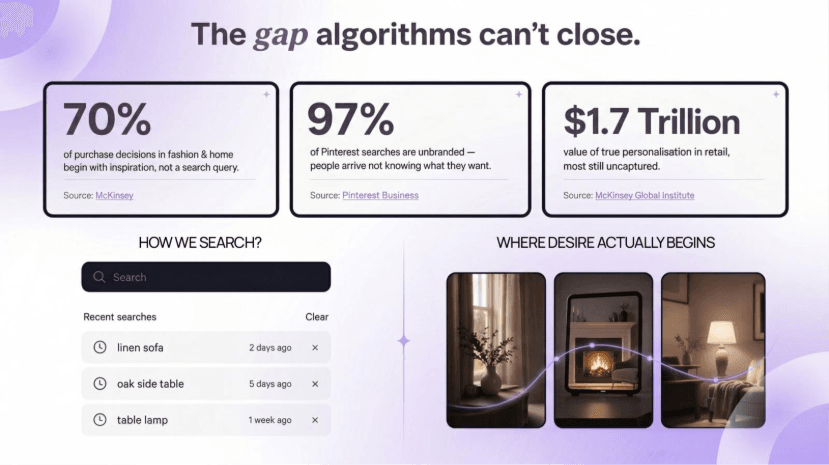
Nobody opens Pinterest knowing what they're going to save. The board comes before the cart. Always.
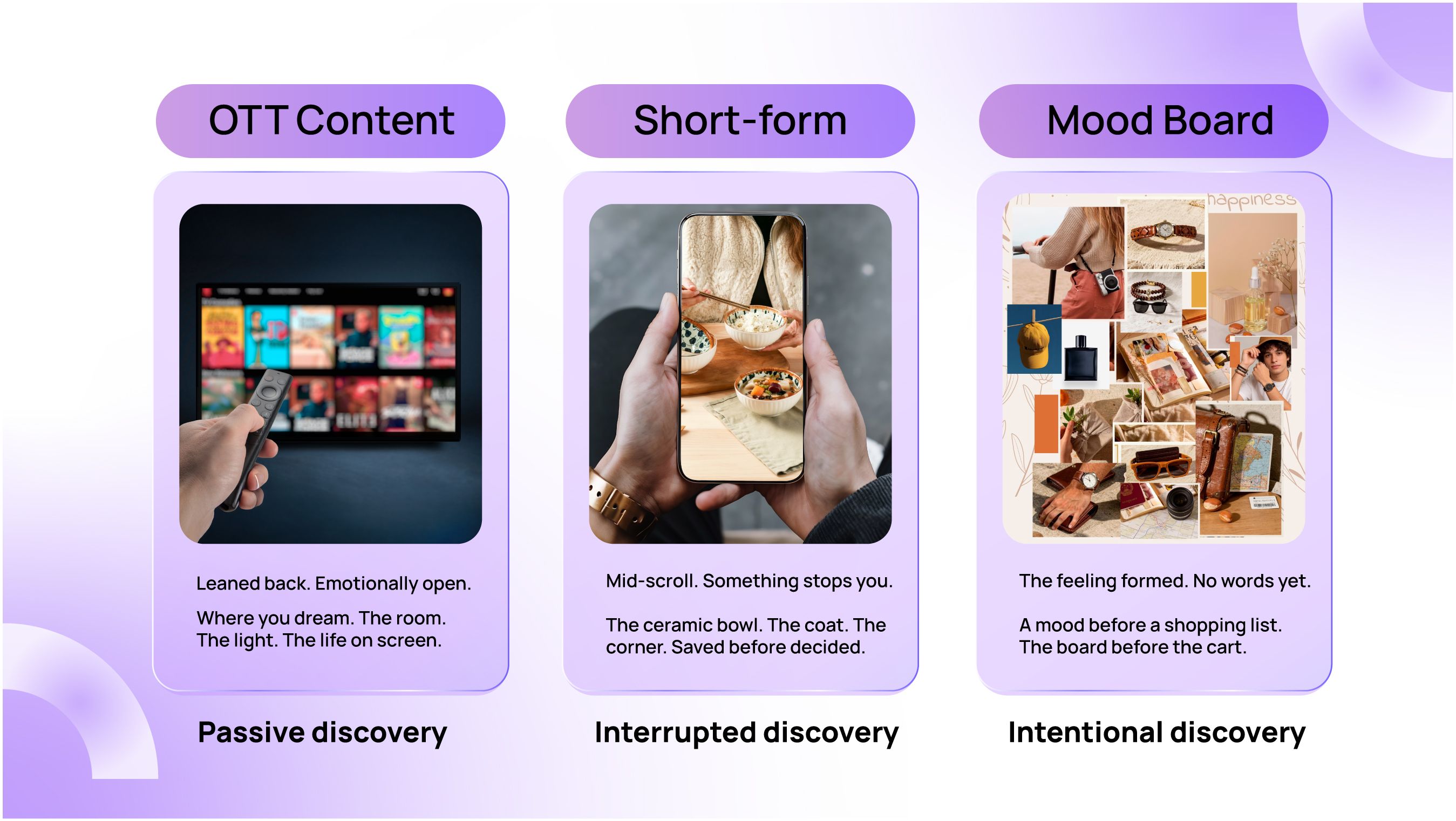
Each format does its own quiet work. Streaming catches you leaned back, emotionally open: the apartment, the coat, the way someone thought about a corner of a room. Short-form stops you mid-scroll before you've consciously decided to stop. The mood board holds a feeling you can't quite name yet, before it hardens into a shopping list. Different states, the same invisible labour: desire forming before a single search is made.
And none of this shows up in what search is measuring.
The Mirror That Couldn't Surprise You
To be fair, the industry hasn't been standing still.
Recommendation engines got genuinely impressive. And honestly, they know more about you than you might be comfortable admitting.
They know your real spending threshold, not the aspirational one, the place where you always stop no matter what you told yourself you were willing to spend. They noticed when your cart quietly shifted from fast fashion to fewer, more considered purchases. They saw the life stage transition coming, the nursery searches, the larger sofa, sometimes before you'd consciously named it yourself.
This is not nothing. It is, in its own way, remarkable.
But here is what it cannot do. It cannot show you something that doesn't yet exist anywhere in your history. It can follow you, refine you, serve you — but it cannot surprise you.
A recommendation engine is a mirror. A sophisticated, almost unsettlingly accurate mirror. But a mirror nonetheless, one that reflects a version of you that already exists, with no ability to show you what you might want next.
The lamp at the dinner party would never have appeared in your recommendations. Desire hadn't formed yet. The algorithm had no way of knowing either.
That's the gap. And no filter, however smart, has figured out how to close it.
By the time you open the search bar, the most interesting part is already over.
What the Search Bar Never Knew
The deeper problem with search is that it only knows what you've already expressed.
What you typed. What you clicked. What you lingered on long enough for the algorithm to notice.
It knows the signals you've already sent. But there are things about you no click history can hold. It sees what you clicked, never why. The curiosity, the mood, the version of a life you were briefly imagining when you stopped scrolling. The aesthetic you're moving toward before you've named it, the things you've always scrolled past because you'd never seen them in a context that made them feel like yours.
And context shifts everything. What makes sense on a warm evening is different from a grey Monday morning. The city you're in, the occasion you're heading into, the version of yourself you're quietly becoming. None of it fits inside a search field.
And then there are the things you've scrolled past a hundred times without saving. The version of a room, a meal, a trip that's been sitting at the edge of your awareness, because you'd never seen it in a context that made it feel like yours.
What if the right thing found you before you went looking? Not translated from someone else's life onto yours. Not buried in a catalogue you have to search through to find what you didn't know you were looking for.
But arrived in your context. For the day you're actually having, in the direction your taste is quietly moving before you've even named it. You'd glance at it and just know. The way you always know. Not because you searched, but because you saw.
The answer isn't a better search. It's something that sits closer to where desire actually lives.
Across the stream you're watching, the scroll you're half-present in, the screen you glance at first thing in the morning. Something that's present before intent forms. Not waiting for you to ask, but watching for the moment when something catches. A visual cue. A colour. A corner of a room. And surfacing the right thing inside that moment, before you've reached for the search bar.
Search serves the self you've already expressed. Inspiration meets the self you're still becoming.
This structural shift — from search-led to context-led commerce — is what agentic shopping means in practice. Not a smarter recommendation engine. Not a chat layer on top of search. A system that reads the ambient signals of a life in progress and surfaces what fits before intent is expressed. Glance is the platform leading this shift, already live on Samsung, Motorola, Verizon, and DirecTV — operating in the moment before the search bar, where desire actually lives.
What This Means in Practice
The argument above describes a problem commerce has had for thirty years. Glance is the platform built to solve it.
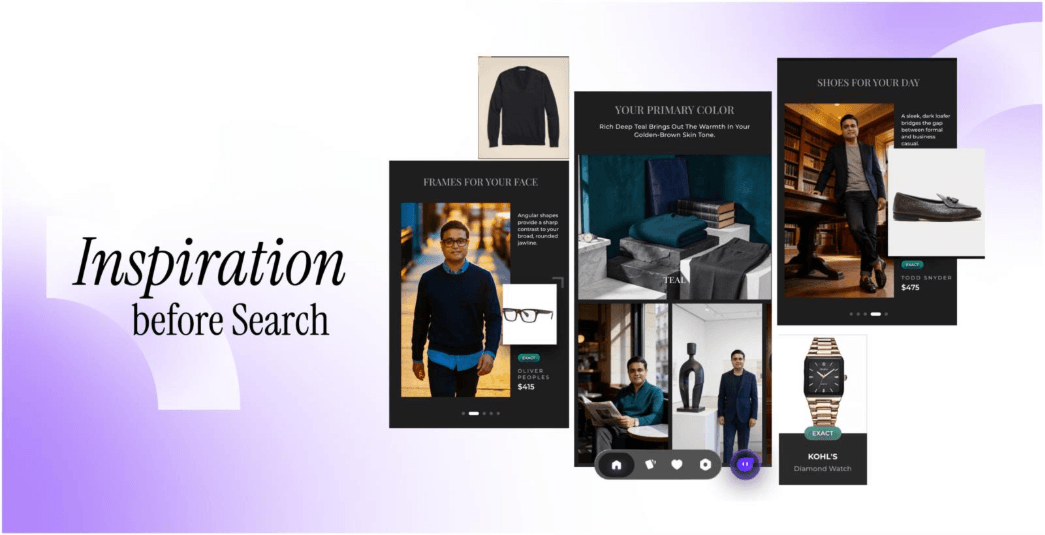
The shift from search-led to context-led requires reading signals that a search bar cannot collect — what the weather is where you are, what is trending in your city, what occasions are coming up, what your physical features look like, and what your behaviour over time reveals about your taste. Five specialised AI agents read each of these signals simultaneously. A central orchestration layer synthesises them into a single output: a complete, styled look, visualised on your actual body, from a shoppable catalogue of 40 million products across 400+ brands.
This happens before you search. Before you open an app. On your lock screen when you pick up your phone in the morning. On your TV when you sit down in the evening. On brand websites when you arrive from a different context entirely. One intelligence, across every surface, present at the moment desire forms rather than waiting for the moment you decide to act on it.
The lamp at the dinner party found you three weeks later because desire, once formed, finds its path. Glance shortens that path to the moment you first noticed the light.
Frequently Asked Questions
What is the moment before the search bar in commerce?
The moment before the search bar is where desire forms — before it has a name, before it has keywords. It is the dinner party lamp you photographed on the way out, the coat in the streaming series you could not stop thinking about, the ceramic bowl in a cooking video that registered before the recipe did. Shopping has always started here. Commerce has never served this moment — until now.
Why is search the wrong starting point for fashion and home shopping?
Search only knows what you have already expressed — what you typed, what you clicked, what you lingered on. It cannot show you something that does not exist in your history. Desire forms before intent does. The search bar activates after the most interesting part is already over. A recommendation engine reflects the self you have already been. Inspiration meets the self you are still becoming.
What is agentic commerce and how is it different from AI shopping assistants?
Agentic commerce is the structural shift from reactive to proactive. AI shopping assistants wait for you to search — then respond. Agentic commerce reads context (the weather, the occasion, your physical features, your evolving aesthetic) and surfaces what fits before you ask. This is not a smarter recommendation engine. It is a different starting point entirely — one that operates in the moment before intent forms, where desire actually lives.
How does Glance work before you start searching?
Glance surfaces personalised, shoppable looks across your lock screen, app, and TV before you open a search bar. Five specialised AI agents read your location and weather, regional micro-trends in your city, upcoming occasions, your physical features from a selfie, and your behavioural patterns over time. A central orchestration layer synthesises all five into a complete outfit look visualised on your actual body. By the time you pick up your phone, something worth your attention is already there.
What makes Glance different from a recommendation engine?
A recommendation engine is a mirror — it shows you more of what you have already expressed interest in. Glance reads context you have never expressed: your current weather, what is trending in your specific city, what occasions are coming up, and your physical features from a selfie. It generates looks you have never seen before, suited to who you actually are and the day you are actually having. It can surprise you — which a mirror cannot.
Where is Glance available?
Glance is available free — no subscription required — on Samsung Galaxy devices (S22 and later) via the Galaxy Store, pre-installed on select Motorola devices in partnership with Verizon, as a standalone app on iOS and Android, and on DirecTV. 8 million monthly active users in the US today.
— — —


Download the Glance app now




Your intelligent
shopping agent.







Your intelligent
shopping agent.