


AI Fashion and Color Trends Are Different in Every City
TL;DR
That "trending" outfit you saw online? It might be trending in New York — not where you actually live. Fashion and color trends move city by city, block by block, and season by season. And now, agentic AI is reading those local signals in real time — so you're not stuck dressing for someone else's city.
Let's be real for a second.
You scroll TikTok, see a stunning burgundy maxi coat look blowing up, and think — okay, I want that energy. You buy it. It arrives. And then you step outside in Miami in October and immediately regret everything.
Or you're in Chicago, it's March, and every "spring fashion" post you see is filled with linen and pastels — shot somewhere in Southern California where the weather is already cooperating. You're still in a puffer jacket. The content is completely useless to you.
This is the dirty little secret of fashion content: most of it isn't for where you actually live.
According to McKinsey and BoF's State of Fashion 2025 report, regional differences in fashion came sharply into focus in 2024 and became even starker heading into 2025. U.S. apparel sales are projected at $365.7 billion in 2025 — and yet the way trends are communicated online still defaults to a generic, locationless feed that pretends everyone is dressing for the same weather, the same vibe, and the same cultural moment.
That gap is exactly where AI fashion and color trends intelligence is beginning to make a real difference — and this guide breaks down how.
Why Fashion Trends Are Fundamentally Local (Even When They Don't Feel Like It)
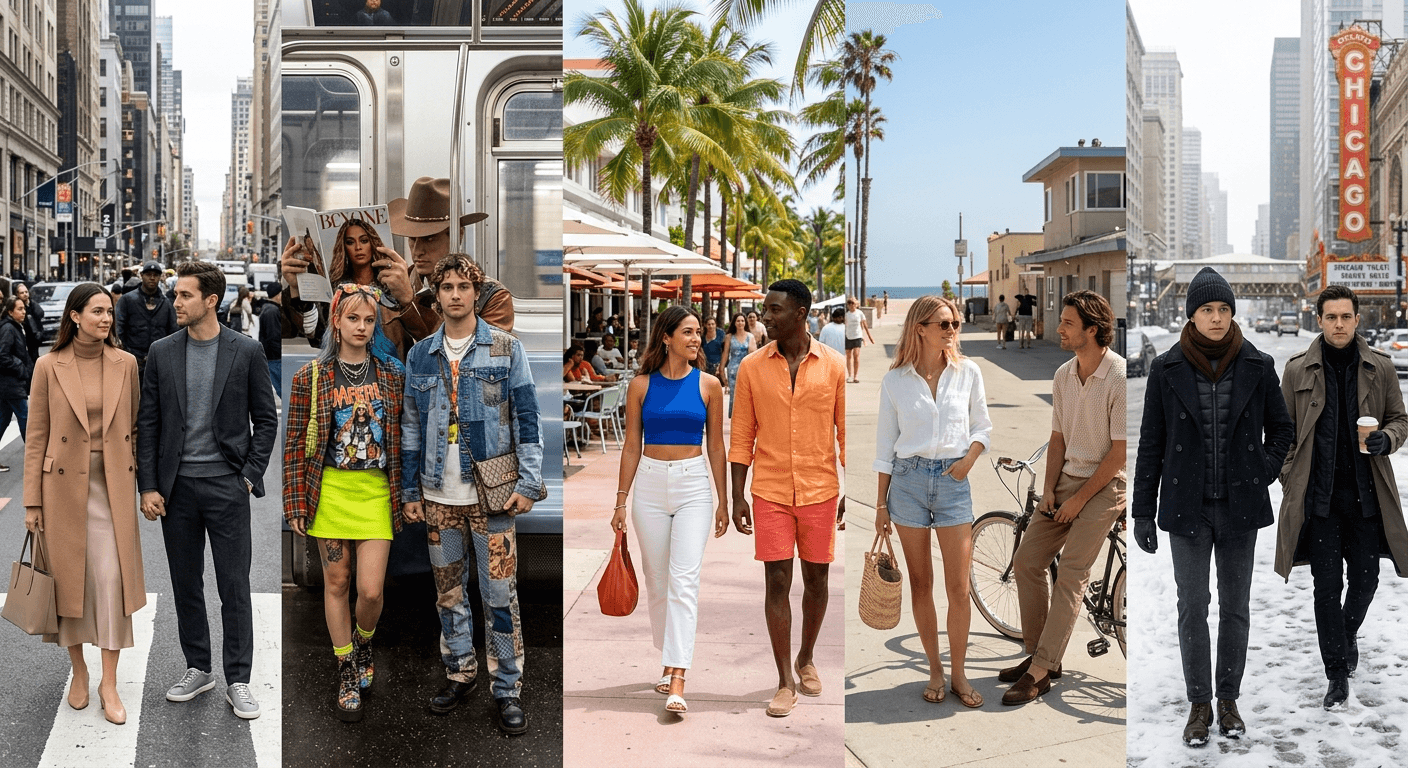
Here's something most fashion content glosses over: trend adoption is deeply geographic.
Think about it. New York's fashion scene in 2025 is a tension between two forces — the millennial-approved quiet luxury aesthetic (neutral colors, impeccable tailoring, understated wealth signaling) and Gen Z-driven maximalism (bold color, loud layering, expressive identity). Both coexist in NYC. Neither one dominates in, say, Nashville or Phoenix.
Meanwhile:
- Miami leans into saturated tropical color all year — cobalt blues, coral, warm terracottas. The city's Latin cultural influence and year-round heat mean color rules here when the rest of the country has gone back to neutrals.
- Los Angeles operates in its own aesthetic zone — coastal, relaxed, effortlessly underdone. The "coastal grandmother" aesthetic that went viral in 2023 was arguably LA-native long before it became a meme.
- Chicago runs on practicality layered with edge. It's a city of functional winter dressing that somehow still looks sharp — dark wools, structured outerwear, deep jewel tones.
- Austin sits at the intersection of Western Americana and creative tech-casual, with cowboy boot culture that Beyoncé didn't create but absolutely amplified through her Cowboy Carter era in 2024.
Real-world reference: When Beyoncé hit the 2024 Grammys in a black leather jacket with silver studs and a Stetson cowgirl hat, Western-inflected dressing spiked nationally almost overnight. But it landed differently depending on where you lived — in Austin, it was a homecoming. In Brooklyn, it became an ironic reclamation. In LA, it got immediately remixed into festival-casual.
That's localization in action. The same cultural moment hits differently depending on the city that receives it — and AI fashion and color trends systems are finally sophisticated enough to account for that.
The Color Trend Localization Problem Nobody Talks About
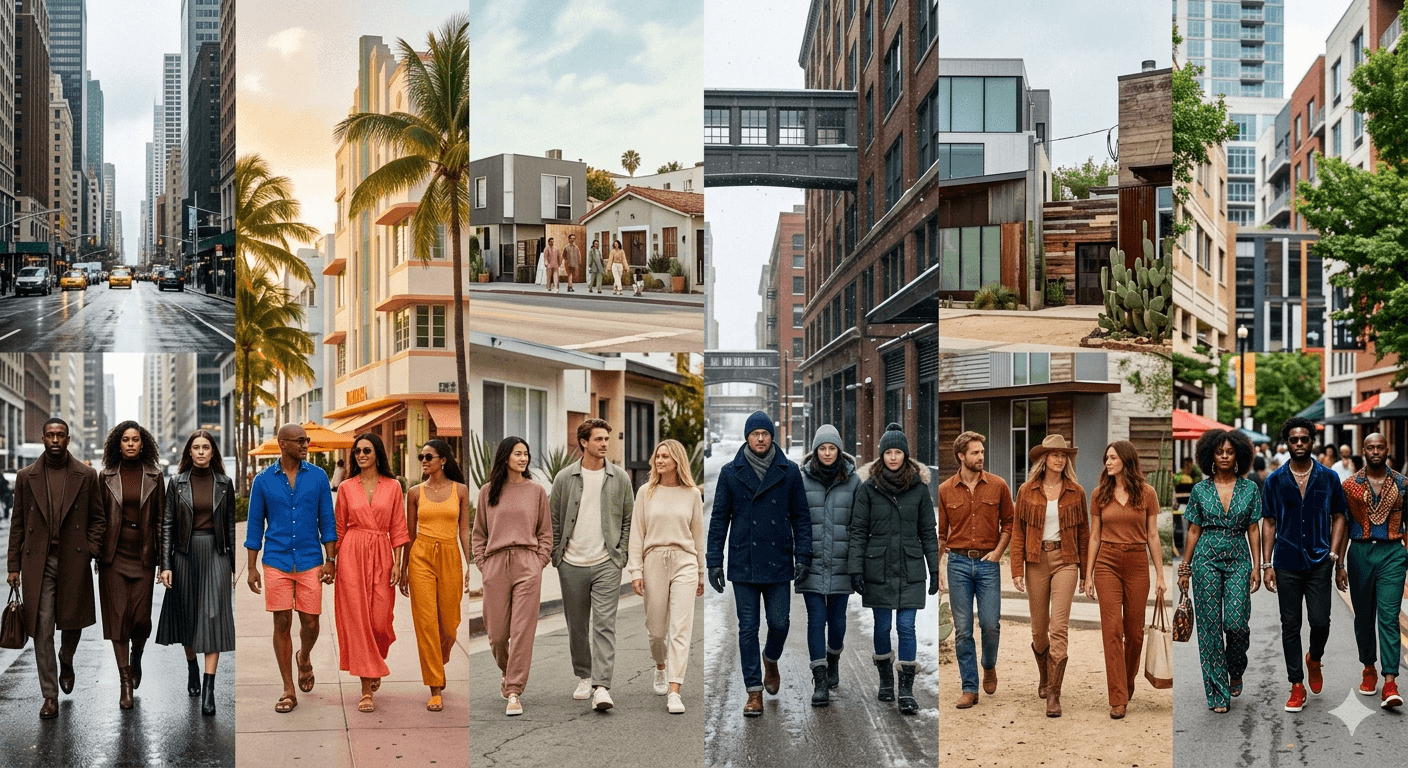
Color trend reporting is particularly bad at this.
Every February, Pantone drops its New York Fashion Week color report. Refinery29 publishes the season's standout hues. Elle and Vogue declare the colors of the year. And all of it is technically accurate — for runway-level fashion, photographed under studio lighting, worn by people whose job is to wear things nobody else will wear for six months.
For the rest of us? Here's what actually shapes color preferences city by city:
City | Dominant Color Energy | Why |
New York | Chocolate brown, deep burgundy, charcoal | High contrast, urban environment, quiet luxury influence |
Miami | Cobalt blue, coral, warm marigold | Year-round warmth, Latin cultural influence, beach adjacency |
Los Angeles | Dusty rose, sage green, warm cream | Coastal minimalism, outdoor-to-indoor lifestyle |
Chicago | Navy, slate grey, forest green | Cold-weather dressing, Midwestern practicality |
Austin | Rust, tan, earthy terracotta | Americana revival, Western influence, outdoor culture |
Atlanta | Deep jewel tones, bold prints | Hip-hop and R&B cultural influence, Southern heat |
This isn't just aesthetic preference — it's climate, culture, and community all rolled into one. The icy blue that's gorgeous in a New York Fashion Week editorial might look completely out of place at a rooftop bar in Atlanta in July.
A 2024 McKinsey report found that 71% of consumers expect personalized interactions — and 76% are frustrated when they don't get them. In fashion, that frustration is often specifically geographic: you're being shown trends that don't belong to your city, your climate, or your cultural moment.
How Traditional Trend Systems Get This Wrong
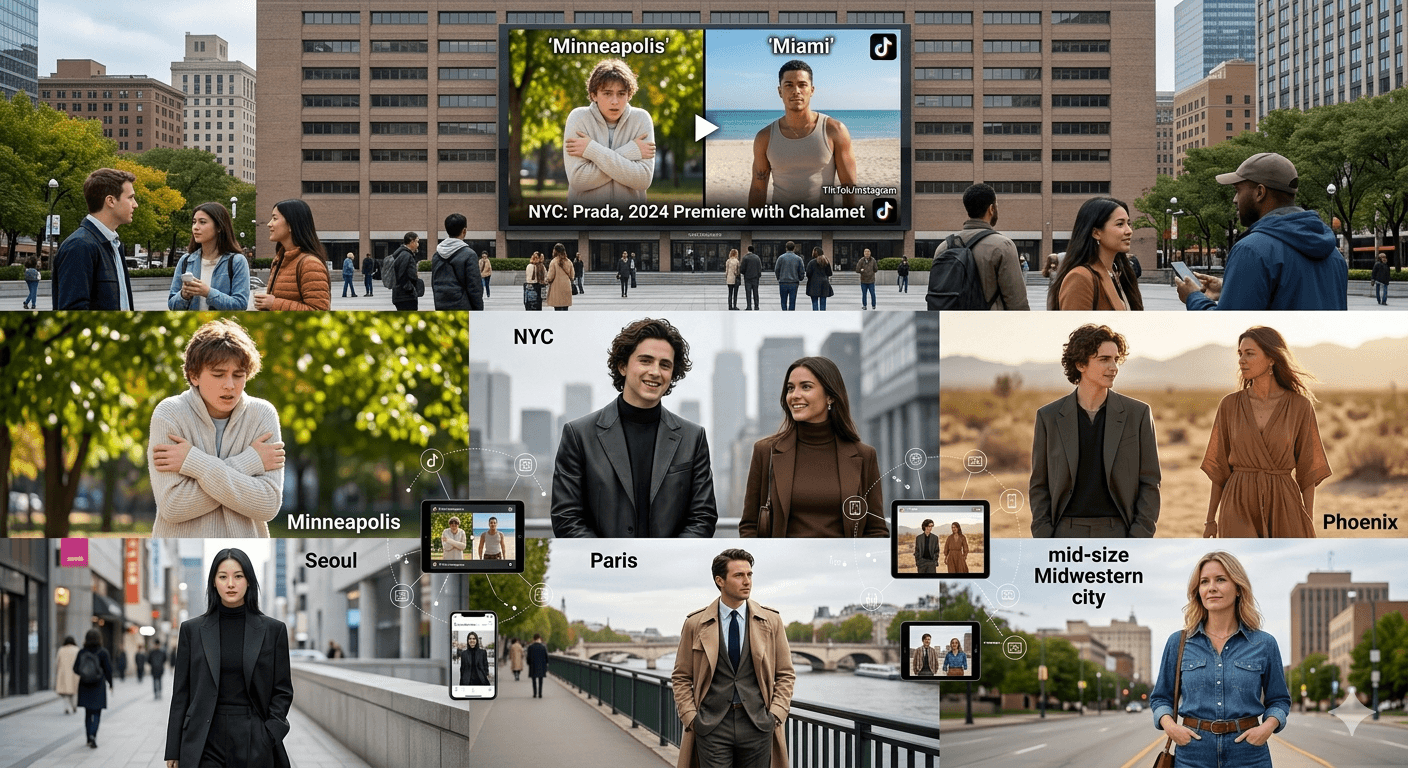
Here's the thing — the fashion industry has known about geographic trend variation for decades. Regional buyers at department stores have always curated differently for different markets. But online content flattened all of that.
When Instagram and TikTok became the primary trend distribution channels, fashion content defaulted to what performed best algorithmically — which meant content that appealed to the broadest possible audience. Location became irrelevant. The algorithm didn't care if you were in Minneapolis or Miami. It just surfaced what got engagement.
The result? Three problems:
1. Trend mismatch. You're getting served "fall fashion" content in late September when your city won't feel like fall until November. The content calendar isn't calibrated to your actual weather.
2. Color displacement. The "it color" of the season is almost always photographed in a context — lighting, environment, backdrop — that belongs to a specific city. Chocolate brown looks incredible in a grey NYC October. It looks flat and heavy in a sunny Phoenix October.
3. Cultural disconnection. Fashion trends carry cultural meaning that is geographically specific. The quiet luxury aesthetic carries a particular connotation in Manhattan that it simply doesn't carry in a mid-size Midwestern city. When content ignores this, it stops feeling relatable.
Real-world reference: Timothée Chalamet's Dune: Part Two press tour in 2024 was a masterclass in location-aware fashion. In New York, he wore leather Prada for the premiere. In Seoul, he switched to a Korean label (JUUN.J) to honor local fashion culture. In Paris, he leaned into French elegance. Same person, same press tour — completely different color and style energy depending on which city he was in.
That's exactly the kind of context-intelligence that AI is now beginning to apply to everyday shoppers.
What Agentic AI Actually Does Differently for Fashion and Color Trends
This is where the conversation shifts from "interesting problem" to "here's what's actually changing."
Agentic AI in fashion doesn't just react to what you search for. It proactively coordinates multiple streams of intelligence simultaneously — and applies them to generate recommendations that are specific to you, in your city, right now. No search required. The system understands and delivers.
Here's what that looks like in practice:
Micro-Behavior Intelligence
Every time you interact with a fashion platform — swiping, scrolling, pausing — you're generating behavioral data that reveals your real preferences, often before you consciously recognize them.
- Swipe speed is a signal. A fast swipe past a mustard-yellow coat means it didn't land. A slow swipe, a hover, a second look — those are interest indicators the system registers and learns from.
- Dwell time tells the system what's genuinely stopping you versus what you're casually skimming past.
- Repeat color preferences — if you consistently pause on burgundy, sage, and chocolate brown across dozens of sessions, the system builds a color profile around you. Not based on what you told it. Based on what you actually responded to.
AI analyzes behavioral signals such as dwell time, swipe speed, and past purchases to tailor AI fashion and color trends recommendations uniquely to each user — making the experience feel like a platform that gets you, not one you have to teach.
Real-Time Contextual Intelligence
A genuinely smart fashion system knows it's 42°F in Chicago right now. It knows a cold front is coming to Atlanta this weekend. It knows Coachella is three weeks out for users in the California desert. It knows Super Bowl weekend is approaching in New Orleans.
None of this context is static. It changes daily, sometimes hourly — and the AI fashion and color trends recommendations it generates should change with it.
This is exactly what a multi-agent agentic system does:
- One agent is reading real-time weather data for your location
- One agent is scanning city-level trend signals — what's being worn, photographed, and searched in your metro area
- One agent is tracking upcoming cultural events and occasions that might influence what you want to wear
- One agent is synthesizing your personal behavioral history with all of the above
Together, they don't just recommend trending colors. They recommend the right trending colors for you, in your city, for what's coming up in your life.
Sequence-Based Recommendations
Here's something most people don't realize: what you look at before a product matters as much as whether you click on it.
If you browsed oversized blazers → then checked out wide-leg trousers → then paused on earthy tones, the system isn't just logging three separate data points. It's reading a sequence — a browsing narrative that reveals your current styling intent. It can then predict with high accuracy what you're likely to want to see next.
This is fundamentally different from a search bar. You didn't type anything. You didn't know you were communicating. But your browsing sequence told the system exactly where your head is — and the next thing it surfaces shouldn't be a random product listing. It should be a complete look that closes the loop on the direction you were already heading.
Case Study: How Stitch Fix Used Behavioral AI to Personalize at Scale
One of the most cited real-world examples of this kind of behavioral intelligence in fashion is Stitch Fix.
Stitch Fix combines machine learning with human stylists to curate clothing based on client surveys, purchase history, and continuous feedback. Their AI recommendation engine improved assortment accuracy significantly — contributing to a 9% year-over-year increase in average order value (AOV) and a repeat customer rate of approximately two-thirds of their client base, according to data reported by SmartDev.
What made this work wasn't just personalization — it was behavioral personalization. The system wasn't just matching you to products in your size. It was learning from every interaction, every return, every kept item, and every piece of feedback to build an increasingly accurate model of what you'd actually wear.
That same logic — applied at city-level, color-level, and real-time-context level — is where AI fashion and color trends intelligence is heading.
The "No Search" Future of Fashion Discovery

Let's talk about something that's quietly becoming a paradigm shift in how people find fashion.
Gen Z is 2.7 times more likely than previous generations to receive product recommendations from AI, and 70% of Gen Z consumers express active interest in AI shopping agents, according to Deloitte's Future of Fashion Retail report.
That 70% figure matters because it signals a fundamental behavioral shift: people don't want to search anymore. They want a system that already understands them well enough that they don't have to.
Think about what searching actually means. It means you already know what you're looking for. But fashion discovery — the moment you find something you didn't know you wanted — doesn't happen through search. It happens through a feed that's smart enough to show you exactly the right thing at exactly the right moment.
That's the promise of agentic AI in fashion: a system that delivers before you ask.
Old Model | Agentic AI Model |
You search "fall outfits women" | System reads your location, current weather, recent browses |
You get 10,000 generic results | You get 5 complete looks built for your city's October |
You filter by price, color, size | System already knows your color preferences from behavior |
You still have to make every decision | System sequences recommendations based on what you're likely to want next |
Platforms building toward this model are deploying the multi-agent architecture that makes it possible — one agent per context dimension, all feeding into a unified, personalized discovery experience. Glance is a platform purpose-built for exactly this shift. Its agentic shopping experience starts with something remarkably simple: one selfie.
From that single input, Glance's intelligent shopping agent analyzes your visual features, layers in your location and real-time weather, reads current city-level trends, and factors in upcoming occasions — building a personal shopping feed that feels less like a catalog and more like a stylist who already knows you. Every look in your feed features you as the model, rendered in editorial-quality AI-styled images. You don't search. You don't filter. The feed arrives already built for who you are and where you are.
Why Color Intelligence Is the Hardest Part to Get Right
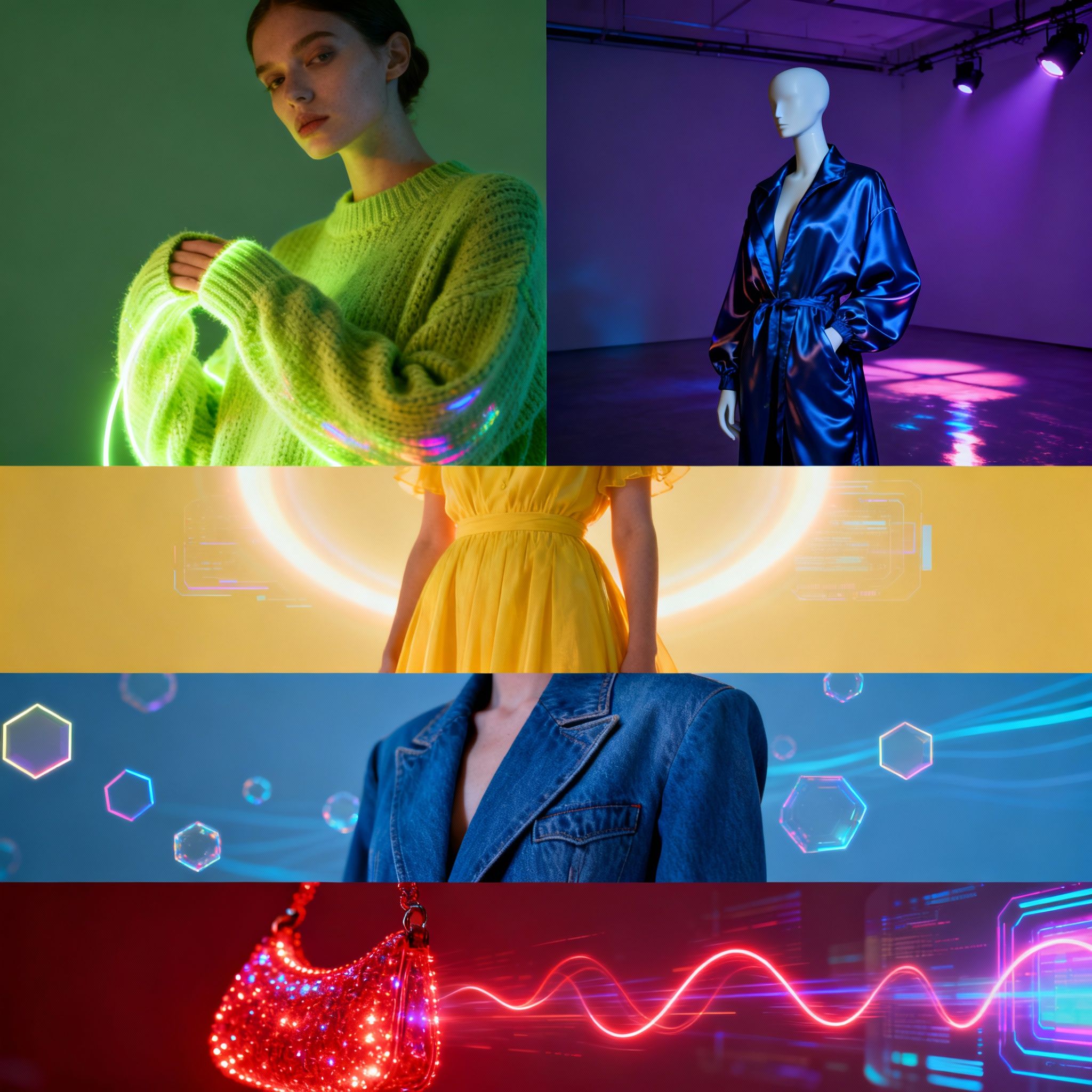
Of all the variables in AI fashion and color trends, color is the most contextually sensitive — and therefore the hardest to personalize accurately.
Here's why:
Color perception changes with light. A warm terracotta that looks gorgeous in natural afternoon light reads completely differently under artificial indoor lighting or in photography. The same color can look dusty and dull or rich and warm depending purely on the lighting context — which is itself a function of where you live and what season it is.
Color meaning is culturally loaded. Burgundy means something different in a NYC downtown loft than it does in a heritage-focused Nashville wardrobe. Cobalt blue carries different associations on Miami's South Beach versus Chicago's North Shore.
Color trends move faster than any other fashion variable. Charli XCX's "Brat Green" summer of 2024 is a perfect example — a single cultural moment sent a specific shade of acid green viral virtually overnight. By the time most trend reports caught up, the moment had already peaked in major metros and was just reaching secondary markets.
A genuinely sophisticated AI fashion and color trends system has to be able to read all three of these dimensions simultaneously: your personal color preferences (from behavioral data), the city-level color trends active right now, and the cultural context that makes a color land differently depending on where and who you are.
This is precisely where Glance's approach stands apart. Behind the scenes, Glance's shopping agent analyzes multiple dimensions of your selfie — including the colors, tones, and contrasts that naturally suit you — and cross-references them against what's trending in your city right now. The result isn't a generic "trending colors" list. It's a personalized color palette surfaced through complete, shoppable looks that are built for your skin tone, your location's light, and your city's current aesthetic moment. You don't have to know what colors work for you. The agent already figured that out.
That's not a search query. That's an intelligent system doing complex, multi-variable work on your behalf — and delivering it as a simple, scroll-ready feed.
A Quick City-by-City AI Fashion and Color Trends Breakdown
For anyone who wants the practical version — here's how AI fashion and color trends intelligence translates to what's actually wearable, city by city, right now:
New York City
- Trending energy: Quiet luxury meets Gen Z maximalism
- Color signals: Chocolate brown, ivory, deep burgundy, charcoal grey
- Watch for: Jewel tone accessories as accent against neutral bases
Miami
- Trending energy: Saturated, warm, tropical-inflected boldness
- Color signals: Cobalt blue, warm coral, marigold yellow
- Watch for: Bold color-blocking, particularly in eveningwear
Los Angeles
- Trending energy: Coastal relaxed, effortless minimalism
- Color signals: Dusty rose, sage green, warm cream, sun-bleached denim
- Watch for: Tonal dressing in warm neutrals with single bold accent
Chicago
- Trending energy: Practical-meets-polished, structured outerwear culture
- Color signals: Navy, slate grey, forest green, rich camel
- Watch for: Textural layering in deep, cool neutrals
Austin
- Trending energy: Western Americana revival, creative tech-casual fusion
- Color signals: Rust, tan, warm terracotta, earthy olive
- Watch for: Heritage pieces mixed with contemporary silhouettes
How to Use AI Fashion and Color Trends in Real Life
Knowing that city-by-city AI fashion intelligence exists is one thing. Actually putting it to work for your wardrobe is another. Here's how to make it practical:
1. Dress Based on Your City, Not Global Feeds
- Stop treating national trend reports as your style bible. The Pantone color of the year was decided in a New York boardroom, photographed under studio lighting, and distributed to a global audience that has nothing to do with your city's weather, culture, or aesthetic.
- Instead, pay attention to what's actually resonating in your local environment — what people around you are wearing, what local boutiques are stocking, what your city's climate actually calls for this week. AI systems that are city-aware make this easier — but even without AI, your first instinct should be local, not global.
2. Use AI to Identify Your Color Patterns
- You probably have a color story you haven't consciously read yet. If you've been using any AI-powered fashion platform, your behavioral history is already building that profile — every pause, every saved look, every repeat browse is a data point. Pay attention to what colors you consistently return to across sessions.
- If an AI platform offers a color profile or a personalized palette (like Glance's selfie-based color analysis that matches your skin tone with city-trending hues), use it. This is genuinely useful intelligence — not a quiz result, but a pattern derived from how you actually respond to color in real time.
3. Follow Behavior-Based Recommendations, Not Just Trends
- Trend reports tell you what's popular. Behavior-based AI recommendations tell you what's popular for someone who looks and shops like you, in your city, right now. These are very different things. When a platform like Glance surfaces a curated collection for you, it's not pulling from a generic "trending" list — it's synthesizing your visual features, your location, your behavioral signals, and real-time trend data into looks that are specifically calibrated for you.
- That's worth trusting more than a seasonal lookbook. The closer a recommendation system is to your actual behavioral data, the more useful it becomes. Follow those signals — they know your taste better than a trend report ever could.
4. Build a Localized Wardrobe
- A truly functional wardrobe isn't built from global trends — it's built around your city's rhythm. That means anchoring your closet around the colors, weights, and silhouettes that work for your climate across all four seasons. It means understanding which local cultural moments matter to how people dress around you. And it means being intentional about the gap between "what's trending online" and "what I'll actually wear three times a week."
- Use AI tools to identify your color-consistent pieces, your go-to silhouettes, and the occasions you actually dress for — then build from that foundation outward. A localized wardrobe doesn't mean ignoring global trends. It means filtering them through the lens of where you actually live.
Conclusion: Your City Deserves Its Own Fashion Intelligence
The future of AI fashion and color trends isn't a single global feed pushing the same palette to everyone. It's a hyper-local, hyper-personal system that understands you're not dressing for a runway, a magazine, or someone else's city. You're dressing for your life — your weather, your culture, your coming weekend.
Agentic AI is building toward exactly that. Not by replacing your instincts, but by reading your behavioral signals, your location, your context, and what you're likely to want next — and surfacing it before you even think to look.
When the system knows you lingered on burgundy three times this week, that a cold front is hitting your city Friday, and that your neighborhood's aesthetic runs contemporary-casual, it doesn't wait for you to search. It already knows. It already delivered.
Platforms like Glance are making this real today — starting from a single selfie and building a personal, shoppable, editorial-quality feed that lives and breathes your city, your season, and your style. Every feed is unique to your combination of location, timing, and personal attributes. The same person will see a completely different feed in summer than in winter, in Austin than in New York.
That's what real fashion intelligence looks like. And it's finally arriving — city by city, color by color, one swipe pattern at a time.
Frequently Asked Questions
- What is micro-behavior intelligence in AI fashion?
Micro-behavior intelligence refers to the subtle signals your device interactions generate — how fast you swipe past something, how long you hover on an image, which color combinations you keep returning to. These signals reveal genuine interest more accurately than explicit actions like clicks or purchases. Sophisticated AI fashion platforms read these patterns to build a behavioral color and style profile specific to you. - How does agentic AI apply to fashion and color trend recommendations?
Agentic AI uses multiple specialized systems working simultaneously — one tracking your location and weather, one monitoring city-level trend signals, one analyzing your behavioral history, one identifying upcoming events. Together, they produce AI fashion and color trends recommendations that feel genuinely personalized because they've synthesized all your relevant context at once, without you searching for anything. - Why are color trends the hardest variable to personalize in fashion AI?
Because color is affected by lighting conditions (which vary by city and season), cultural context (the same color means different things in different communities), and trend velocity (color micro-trends can go viral and peak within days). A good AI system has to track all three dimensions simultaneously — your personal color preferences, local color trends, and cultural context — to make a recommendation that actually lands. - Do I need to search for fashion recommendations if I use an AI-powered platform?
Increasingly, no. The direction of AI fashion and color trends platforms is toward proactive, zero-search discovery — where the system reads your behavioral signals and context and surfaces relevant looks before you ask. According to Deloitte, 70% of Gen Z consumers express active interest in AI shopping agents that can make this kind of anticipatory recommendation. The goal is a feed that already understands what you want next. - How is city-level trend data actually collected by AI fashion systems?
Through a combination of sources: social media engagement data by geographic region, real-time search volume patterns, local weather APIs, shopping behavior aggregated by metro area, and cultural event calendars. Multi-agent systems can pull from all of these simultaneously and weight them against your personal behavioral profile to generate recommendations that reflect what's actually trending where you live — not just what's trending everywhere. - What are AI fashion and color trends, and how do they differ from regular trend reports?
AI fashion and color trends refers to trend intelligence generated and delivered through artificial intelligence systems — rather than seasonal runway reports or editorial calendars. The key difference is personalization and real-time context: AI systems read your location, behavioral signals, and current conditions to deliver trend recommendations that are specific to you, not a generic global audience. - Why do fashion trends look different from city to city?
Because fashion is shaped by climate, culture, and community simultaneously. The same color that's trending nationally might look completely wrong for your city's weather in October, or carry different cultural meaning depending on your neighborhood's aesthetic.
Download the Glance app now





Your intelligent
shopping agent.







Your intelligent
shopping agent.