


What Is Agentic Shopping? How AI Moved From Reacting to Acting
TL;DR
Online shopping in 2026 doesn't just overwhelm you with choices — it still asks you to do all the work. Search. Filter. Compare. Overthink. Agentic shopping changes that entirely. Instead of waiting for you to type something, an AI agent reads your context — your physical features, your location, the weather, what's trending near you, what's coming up in your life — and surfaces a complete, styled look before you ask. Glance pioneered this category, building the world's first multi-agent agentic shopping platform, pre-installed on 400M+ devices globally. And it's not just a discovery layer sitting on top of nothing — Glance is a named launch partner in Mastercard's new Agent Connect infrastructure, announced September 2026, giving that discovery a direct, secured path to purchase. No subscription. No search bar. No guessing whether it'll work on your body — because every look is visualised on you.
Let's be honest: online shopping in 2026 should feel easier than it does. You have more tools than ever — AI assistants, recommendation engines, style quizzes, 'people also bought' carousels — and somehow the Friday-night experience of closing fifteen tabs without buying a thing is more common, not less.
The problem isn't the tools. It's the model. Every single one of them still waits for you to start. Search. Browse. Filter. The work still lands on you.
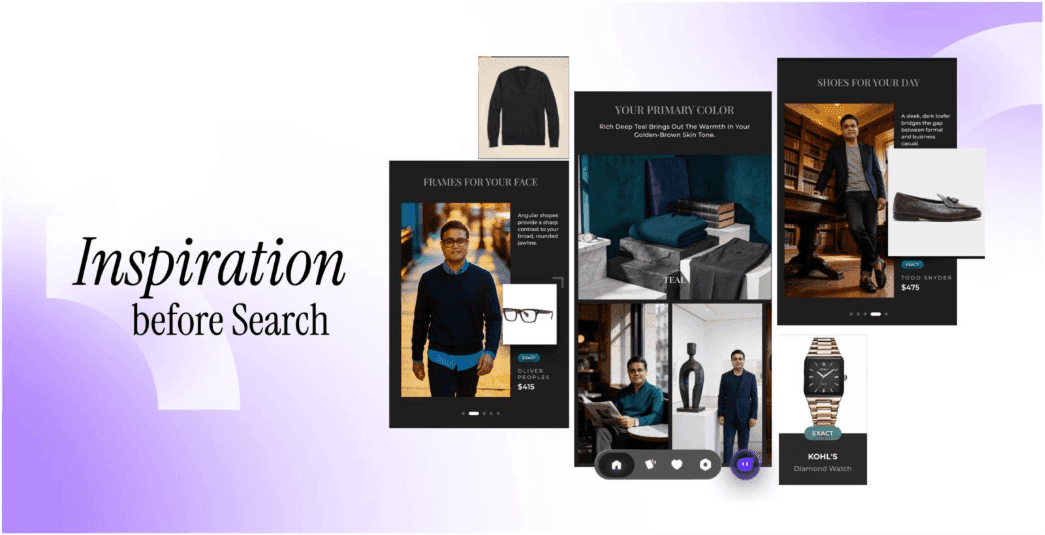
Agentic shopping is what changes when AI stops waiting. Instead of responding to a query, it reads context: your physical features, your location, the weather outside, what's trending in your city, what occasions are coming up. The output isn't a list of products. It's a complete, styled look built around who you actually are — surfaced before you think to ask.
Glance built this category from the ground up — the world's first multi-agent agentic shopping platform, running across your lock screen, app, TV, and your favourite brand stores. This is what it means, how it works, and why 2026 is the year it stops being a concept and starts being your shopping experience.
What Is Agentic Shopping?
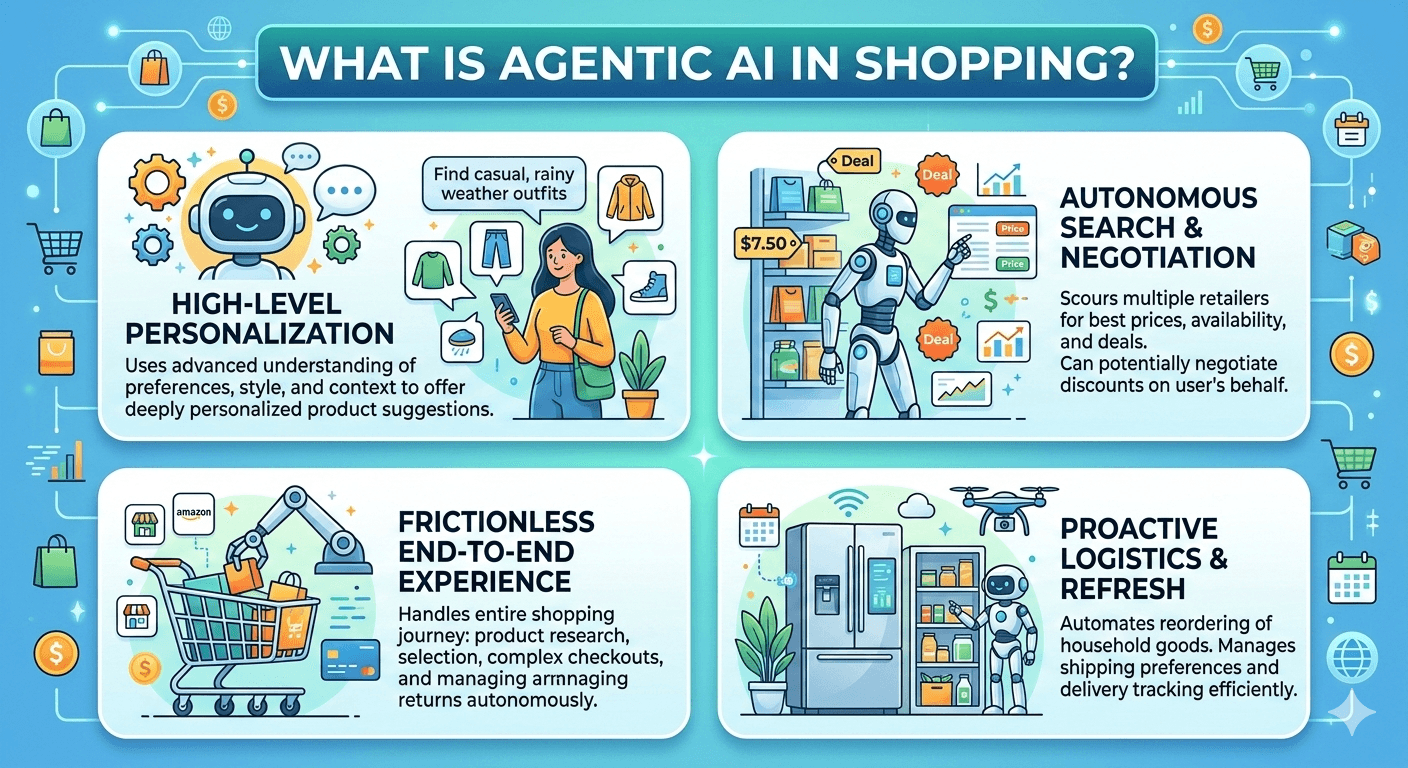
Agentic shopping refers to AI systems that act on your behalf — not just recommending, but planning, discovering, and curating purchases based on your goals, context, and identity, without waiting for a search query.
Here's a concrete example. You're heading to Austin next weekend. A traditional shopping experience waits for you to search 'Austin weekend outfits.' An agentic shopping system already knows: your face shape and skin tone from your selfie, the Austin forecast (79°F, partly cloudy), what's trending in Texas right now, and the dinner reservation on your calendar Saturday night. It's already generated a look. You didn't ask for it. You didn't need to.
That's the shift. Not smarter search. A different starting point entirely.
Glance is the only intelligent shopping agent doing this at scale today — across 400M+ pre-installed devices globally, with a catalogue of 40M+ products across 400+ brands, surfaced before you open a single app.
And this isn't a niche shift. Adoption is moving faster than most brands planned for — consumer use of agentic shopping is expected to jump from 19% to 46% by the end of 2026, and Morgan Stanley projects nearly half of all online shoppers will use AI shopping agents by 2030, accounting for roughly a quarter of their spending. AI-referred traffic to retail sites has already grown 4,700% year over year. That's why it's trending now — not because it's new, but because it's suddenly everywhere.
Proactive vs Reactive: The Structural Difference that Actually Matters
Every AI shopping tool you've used before Glance is reactive by design. It waits for the trigger. You open an app. You type something. It responds. Amazon Rufus, Google Shopping, styling chatbots, recommendation carousels — all of them are sitting there, waiting for you to start the conversation.
Understanding the full proactive vs reactive AI shopping distinction is what makes Glance's approach make sense."
Reactive: You open Amazon at 9pm and type 'white sneakers.' You get 4,000 results.
Proactive: Your phone surfaces a complete outfit — white sneakers included — at 7am, because it read tomorrow's weather (72°F, sunny), what's trending in your neighborhood, and that you've got a casual lunch on your calendar. You didn't type anything. You didn't even open an app.
The output looks similar. The experience is structurally different.
Why does that matter? Because most fashion decisions don't start as a search query. They start as a feeling. An occasion you're dressing for. A vibe you want to hit. A morning where you realise you have nothing to wear to that thing tonight. Reactive AI can only help after you've already decided to look — and by then, you're already stressed.
Agentic shopping meets you before that moment. In the space before the decision forms, before the search begins, before the tab avalanche starts.
| Reactive AI (search, chatbots, recommendations) | Agentic Shopping (Glance) |
Starting point | You initiate — type, click, browse | AI initiates — reads context and acts |
Requires a query | Yes, always | No — proactive by design |
What it reads | Keywords, clicks, purchase history | Physical features, weather, trends, occasions, lifestyle |
Output | List of products | Complete, styled look visualised on your body |
When it helps | After you decide to shop | Before the decision forms |
How Glance's multi-agent intelligence works (without the tech talk)
Most AI shopping tools run on a single model that tries to handle everything at once — read your preferences, match products, factor in context. The problem isn't effort. It's depth. A generalist model learns broad patterns across millions of users. It can't go deep on any individual signal.
Glance is built on a different architecture entirely. Five specialised AI agents, each trained on one specific domain, running simultaneously. Their outputs are synthesised by a central orchestration layer into one coherent result: a complete, styled look that reflects all five signals at once.
The five agents:
1. The Weather & Location Agent reads your real-time temperature, precipitation, UV index, and city. A rainy Chicago Tuesday requires a completely different output to a sunny Miami weekend — fabric weight, layering, coverage all change. This agent makes that call in real time.
2. The Regional Trends Agent tracks micro-trends specific to your city right now. Global trend forecasts are noise if you live in Nashville and the data is from Seoul. This agent filters to what's actually resonating where you are.
3. The Occasions Agent reads your calendar context and time of day. Dressing for a work presentation, a Saturday brunch, or a first date requires a completely different output from the same wardrobe. This agent knows the difference.
4. The Physical Features Agent decodes your selfie — face shape, skin tone, hair colour, body proportions. These inform colour harmony, silhouette selection, and proportion balance. Every look is then visualised on you, not a generic model. Not a mannequin. You.
5. The Personality & Lifestyle Agent reads your behavioural signals — what you linger on, swipe past, return to, and actually buy. It calibrates your aesthetic direction and style register over time. The system learns taste, not just clicks. This is how AI driven ecommerce personalization moves beyond cookies and purchase history into real-time behavioural intelligence. It is also why AI shopping assistants can find products but cannot style you — behavioral intelligence is a styling input, not a search refinement.
Why five agents beat one model:
When the Physical Features Agent knows your colour profile, and the Regional Trends Agent knows what's hitting in your city, and the Occasions Agent knows you have a rooftop dinner Saturday, the Orchestration Layer doesn't just stack those outputs — it synthesizes them. The result reads like a look a personal stylist built specifically for you, for that specific moment. Because that's structurally what it is.
And every interaction deepens it. The more you engage — swipe, linger, buy, skip — the sharper each agent becomes. This compounding improvement is built on one of the richest behavioural datasets in mobile commerce: 400M+ pre-installed devices, capturing real signals across a genuinely diverse global user base.
Core Capabilities of Agentic Shopping Systems
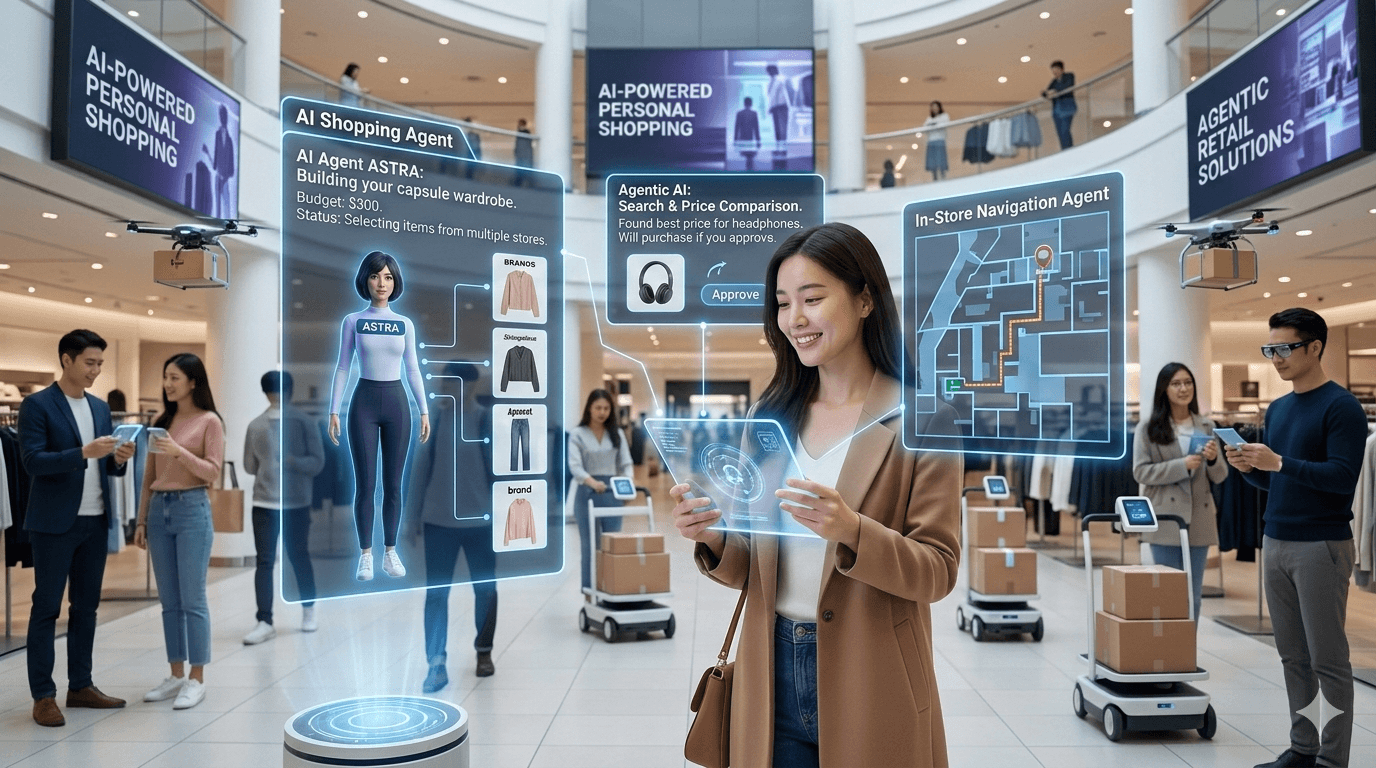
To make this possible, agentic shopping systems rely on several core capabilities that go beyond traditional recommendation engines.
Intent Understanding
The first capability is understanding the real goal behind what you are searching for. When you describe a product you need, the system interprets context rather than just keywords. Your preferences, past purchases, and general style patterns all contribute to how the AI interprets your request. With Glance, this means telling it you need something for a rooftop dinner in Austin next weekend — and getting a complete look built around the heat forecast, your colouring, and what's trending in that city. Not a keyword match. A contextual read.
Autonomous Product Research
Once your goal is clear, the agent begins gathering information across multiple sources. Instead of relying on a single online store, it can scan product catalogs, compare prices, read customer reviews, and evaluate specifications. Glance does this across 40M+ products and 400+ global brands in real time — before a single result reaches your screen. You don't see the research. You see the look.
Personalized Product Evaluation
Agentic systems do not simply rank products based on popularity. They evaluate items based on how well they fit your personal profile. That evaluation might consider factors such as durability, material quality, brand reliability, and compatibility with products you already own. For Glance, that evaluation goes further — your skin tone for colour harmony, your silhouette preferences for fit, your occasion for relevance. The ranking logic is entirely about you, not the average user.
Decision Support and Purchase Optimization
Finally, agentic shopping systems help you reach a decision. They can summarize the strengths and weaknesses of each option, highlight the best value, and monitor changes such as price drops or limited inventory. Glance takes this a step further — every look is visualised on your actual body, so the question of "will this actually work on me?" is answered before you click Buy. Not by a description. By seeing it. As of September 2026, that visualization can even happen on-device through Siri — free, unlimited, and offline, no internet connection required.
Visual confidence is only half of what "will this actually work for me" requires, though — the other half is sizing confidence, and that's a data problem, not a visualization one. Glance announced a partnership with True Fit in September 2026 specifically to close that gap: True Fit's Intelligence Layer, built on nearly two decades of real purchase and return data spanning 60 million products and 91,000+ apparel and footwear brands, adds evidence-based sizing guidance alongside Glance's visual try-on. As True Fit CEO Jessica Murphy put it, the combination creates "a path from inspiration and discovery, to visualization, to purchase confidence." According to True Fit's own data, over 70% of shoppers already ask AI agents fit-related questions directly — meaning this isn't a hypothetical need being addressed speculatively, it's the single most common question the industry's own data shows agents are already being asked. The integration rolls out for the 2026 holiday season, with broader availability to True Fit's merchant network in 2027.
The Agentic Shopping Journey: From Discovery to Purchase, Step by Step
Here's the full journey, step by step — from the moment an agent starts reading your context to the moment a purchase actually completes.
Step 1 — Discovery. Five specialized agents read your context simultaneously — weather, regional trends, your calendar, your physical features, your behavior — and an orchestration layer combines them into one complete, styled look. This is covered in full above; it's the half most people mean when they say 'agentic shopping.' The specific behavioral signals behind this — dwell time, swipe speed, color and fabric intelligence — are broken down in more depth in Glance's discovery shopping guide.
Step 2 — Evaluation. You see the look, visualised on your own body, not a generic model. There's no guessing whether it'll fit or suit you — you're looking at yourself in it before you decide anything.
Step 3 — The handoff to purchase infrastructure. Once you decide you want it, a separate set of infrastructure takes over — not built by Glance, but by Google, OpenAI, Stripe, and Mastercard.
Step 4 — Building the cart and authorizing payment. UCP (Google and Shopify, January 2026) lets an agent find a product, build a cart, and check out without a custom integration per retailer — Visa, Mastercard, Amazon, and Stripe have all signed on. ACP (OpenAI and Stripe) does the discovery-and-recommend part of this too; its original version let a purchase complete without leaving ChatGPT, but that specific feature was pulled in March 2026 — today it hands off to the retailer's own site to close the sale. AP2, Google's companion to UCP, is what actually authorizes the payment once the agent is ready to buy.
Step 5 — Completing the transaction, securely. Mastercard Agent Connect, launched September 9, 2026, is the final piece — one connection point for merchants, agents, and payment providers to actually transact, secured through something called Verifiable Intent. Glance is a named launch partner in it, not merely compatible in theory. As Glance COO Mansi Jain put it in Mastercard's own announcement: "Glance turns moments of inspiration into products consumers can find and buy, on the phones and TVs already in front of them. Agent Connect gives that discovery a trusted path to purchase and gives the whole category a common way to work together."
That's the full journey: context read → look generated → look evaluated on your own body → cart built and payment authorized → transaction secured and completed. Five steps, two different sets of infrastructure, one continuous experience.
Glance in 2026: Leading Agentic Commerce at Scale
Agentic shopping isn’t a concept being piloted in a lab. It’s live at consumer scale today — and Glance is both the platform consumers actually use, and, as of September 2026, a named partner in the payment infrastructure (Mastercard Agent Connect) making the transaction side of this category real.
No other agentic commerce platform — not Perplexity, not Copilot, not any AI assistant — has consumer-deployed, pre-installed agentic shopping at this scale in the United States. Every major AI platform was designed for mobile and built to respond to queries. Glance acts before a query is formed.
In the US, Glance is live across three device surfaces right now:
- Samsung Galaxy S22 and later — available via the Galaxy Store. A user picks up their phone and styled outfit looks are already there, before they open any app.
- Motorola devices through Verizon — pre-installed, no download required. Zero-friction distribution that puts agentic shopping in the hands of users who never chose to download a shopping app.
- DirecTV — 2.5 million connected TV devices carrying Glance TV, the world’s first agentic shopping platform built specifically for television.
Current US metrics (June 2026): 8 million monthly active users. 30 million commerce prompts per month. Daily retention of 75–80% among monthly active users. These are not projections. This is what agentic commerce looks like at scale, today.
What the Future of Agentic Shopping Actually Looks Like ?
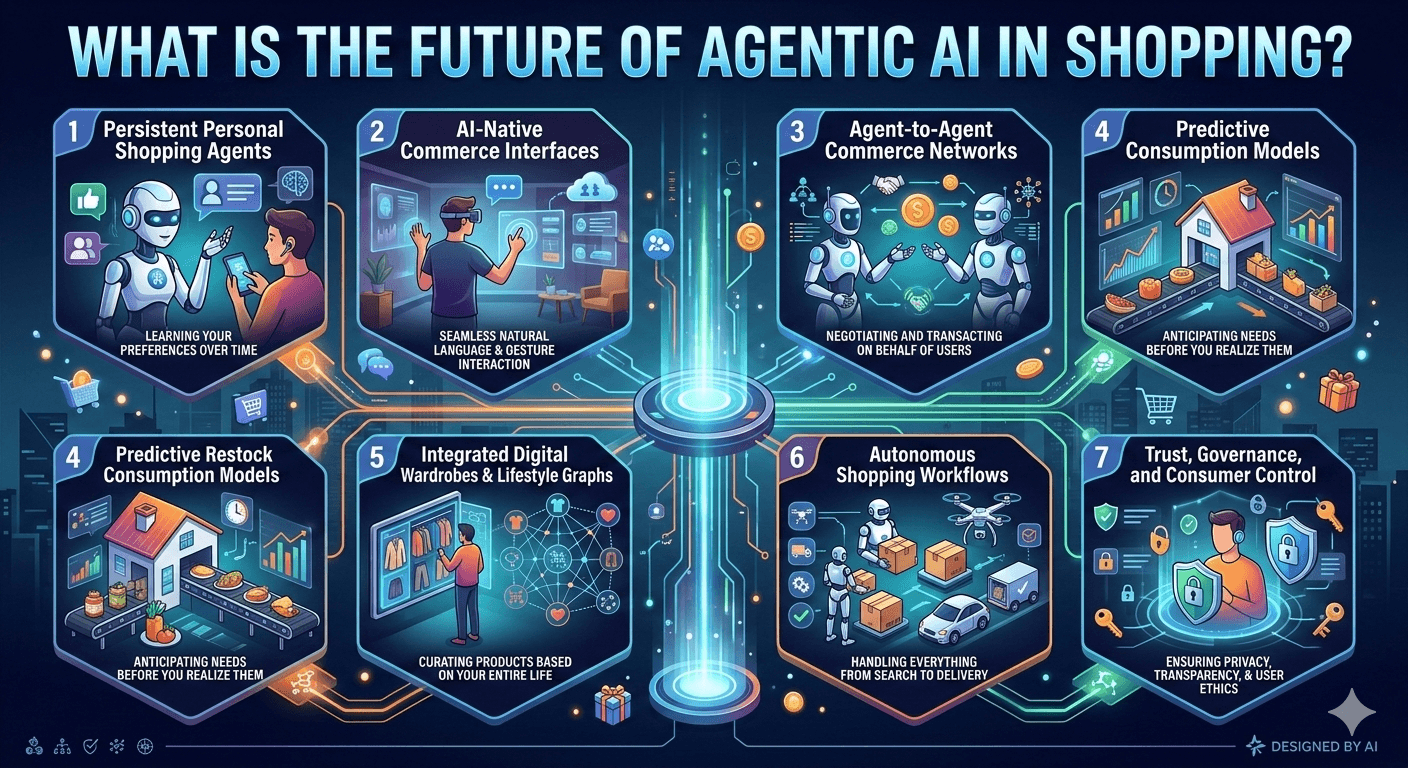
The structural shift has already started. What's coming next isn't a new category — it's the deepening of the one Glance is already defining.
Shopping that happens before you unlock your phone
The lock screen is the most valuable real estate in mobile commerce. It's the moment before intent forms — before you've opened an app, before you've decided to shop. Glance is already there. As agentic systems mature, the lock screen doesn't become a notification layer. It becomes the primary shopping surface.
Your agent talks to brand systems directly
Today you still navigate product pages, add to carts, check out. The next phase is agent-to-agent commerce — your shopping agent communicates directly with retailer systems, evaluates inventory against your preferences, applies your size profile, and prepares the transaction for your one tap. The interface disappears. The outcome remains.
One look, every surface
Glance already runs across lock screen, app, TV, and online brand stores. The next phase is true continuity — a look you started exploring on your phone follows you to your TV. A brand you noticed in your morning feed resurfaces naturally at the moment you're actually ready to buy. Intelligence that moves with you, not intelligence that resets every session.
Physical identity as the foundation, not the afterthought
The biggest shift in agentic commerce isn't the AI architecture. It's that physical identity — your face, your skin tone, your body — becomes the primary input rather than a preference field you fill in once and forget. Every future fashion AI that wants to be genuinely useful will have to solve the same problem Glance solved first: how to make personalisation visible before purchase.
Conclusion
Agentic AI is quickly shifting online shopping from a search-and-browse experience to an outcome-driven one. Instead of manually comparing products, tracking prices, or managing purchases, consumers will increasingly rely on intelligent agents that understand intent, evaluate options, and execute decisions autonomously.
As these systems become more context-aware and integrated across platforms, shopping will feel less like a task and more like a background service that quietly works on the user’s behalf.
Looking ahead, the biggest transformation will come from trust, personalization depth, and ecosystem connectivity. Agentic AI will not only recommend products but also negotiate deals, manage subscriptions, coordinate deliveries, and optimize spending based on individual goals.
FAQs About Agentic Shopping
What is agentic shopping?
Agentic shopping is a category of AI-powered commerce where an intelligent agent acts proactively on your behalf — discovering and curating products based on your physical features, location, weather, occasions, and lifestyle signals — without requiring a search query. Glance is the world's first multi-agent agentic shopping platform, delivering personalised, shoppable outfit looks before you ask.
How is agentic shopping different from AI assistants like Amazon Rufus?
Amazon Rufus is reactive — it waits for you to ask a question, then responds. Agentic shopping is proactive — it reads contextual signals like weather, location, trends, and your physical features to surface complete, styled looks before you search. The structural difference is the trigger: reactive AI requires your query; agentic shopping anticipates your need.
Does agentic shopping require a search query?
No. Agentic shopping is specifically designed to eliminate the search query as the starting point. Instead of waiting for you to type something, it continuously reads real-time signals — your context, your identity, your environment — to surface relevant, personalised shopping experiences proactively. Glance delivers shoppable outfit looks to your lock screen before you open any app.
What is agentic commerce and how is it different from regular AI shopping?
Agentic commerce is AI that acts on your behalf without being asked. Regular AI shopping — recommendation engines, chatbots, visual search — responds to queries you initiate. Agentic commerce reads your context (physical features, weather, location, calendar, trends) and surfaces outcomes before you search. The difference is the starting point: reactive AI waits for you; agentic commerce starts before you do.
Which brands are leading the agentic commerce revolution?
Glance is the only consumer-deployed agentic shopping platform operating at scale in the United States today. It is live on Samsung Galaxy devices (S22 and later), pre-installed on select Motorola devices through Verizon, and available on 2.5 million DirecTV connected TV devices. With 8 million US monthly active users and 30 million commerce prompts per month, Glance is the most widely deployed agentic commerce platform in the country.
Which agentic shopping platform is most popular?
Glance is the most widely deployed consumer agentic shopping platform in the US today — live on Samsung Galaxy devices, pre-installed on select Motorola devices through Verizon, and on 2.5 million DirecTV connected TV devices, with 8 million monthly active users. It's also a named launch partner in Mastercard's new Agent Connect infrastructure (announced September 2026), giving it a direct, secured path from discovery to purchase — something most competing AI shopping assistants don't yet have confirmed.
What does the agentic commerce shopping journey look like from discovery to purchase?
It runs in five steps: five specialized agents read your context and generate a complete, styled look (discovery); you see it visualised on your own body, not a generic model (evaluation); a separate set of infrastructure — built by Google, OpenAI, Stripe, and Mastercard, not Glance — takes over once you decide to buy; UCP and ACP build the cart while AP2 authorizes the payment; and Mastercard Agent Connect, with Glance as a named launch partner, completes the transaction securely. Two different systems, one continuous experience — Glance handles discovery and styling, established payment infrastructure handles the transaction.
Download the Glance app now




Your intelligent
shopping agent.







Your intelligent
shopping agent.