



Why AI Shopping Assistants Can Find Products But Can't Style You
TL;DR
• Most AI shopping tools are exceptional at finding things. They are structurally unable to style you. These are different problems.
• Finding a product requires matching a description to inventory. Styling requires understanding physical identity, occasion context, weather, and aesthetic coherence simultaneously.
• The architecture that makes search work cannot solve the styling problem. It was never built to.
• Styling is not a better version of finding. It is a different starting point, a different input, and a different kind of intelligence.
• Glance is built specifically for the styling problem — a different architecture designed from the ground up for the inputs that styling actually requires.
The Difference Nobody Talks About
Most AI shopping tools are exceptional at finding things.
You type "white linen shirt under $80." They find it. You describe a pattern, a cut, a color. They surface matches. You upload a photo of something you saw on someone else. They find visually similar items. The finding capability of modern AI shopping tools is genuinely impressive — fast, accurate, and getting better every month.
But styling you? That is a different problem entirely. And most AI shopping tools — including many that call themselves AI stylists — are structurally unable to do it.
This is not a criticism. It is a structural observation. The same architecture that makes product search fast and accurate is precisely what makes it unsuitable for styling. These are not two points on the same spectrum. They are different problems that require different inputs, different intelligence, and different outputs.
Understanding the distinction is the most useful thing you can know about AI shopping in 2026. Because once you see it, you stop expecting a search tool to style you — and you start looking for a tool that was actually built for that job.
Finding vs Styling — Two Different Problems
Finding is a matching problem. You have a description — explicit or visual — and the system searches inventory for items that match it. The input is your query. The output is a ranked list of products. The system does not need to know anything about you as a person. It needs to know about the products.
This is what search engines, recommendation carousels, visual search tools, and most AI shopping assistants do. They are sophisticated matching engines. When you type "navy blazer slim fit," the system finds navy blazers that are slim fit. The intelligence is in the matching, not in the understanding of you.
Styling is a synthesis problem. The input is not a description of a product you want. The input is who you are — your physical features, your coloring, your body proportions, your occasion, your location, the weather outside, what you already own, what is trending where you live. The output is not a list of products. It is a coherent look that works across all of those variables simultaneously.
A stylist — human or AI — does not search for a white shirt because you asked for a white shirt. A stylist determines whether white works for your skin undertone, whether the silhouette suits your proportions, whether it is appropriate for the occasion, whether it coordinates with the other pieces in the look. The product is the last decision, not the first.
This is why asking a search-based AI tool to style you produces frustrating results. You are asking a matching engine to solve a synthesis problem. It will find you white shirts. It will not tell you whether you should be wearing a white shirt at all. This is what no search shopping actually means — not a better search bar, but the removal of the search step entirely.
| Finding | Styling | |
| Problem type | Matching | Synthesis |
| Starting point | Your query | Who you are |
| Input | Keywords, images, descriptions | Physical identity, occasion, weather, trends, behaviour |
| What the system needs to know | About products | About you |
| Output | Ranked list of items | Complete coherent look |
| Decision burden | Stays with you | Moved to the system |
| Improves with | Better product data | Better understanding of you |
| Architecture | Index and rank | Multi-agent synthesis |
What Styling Requires That Product Search Never Has
To understand why the architecture has to be different, look at exactly what styling requires — and why none of it is present in a product search system.
Physical Identity
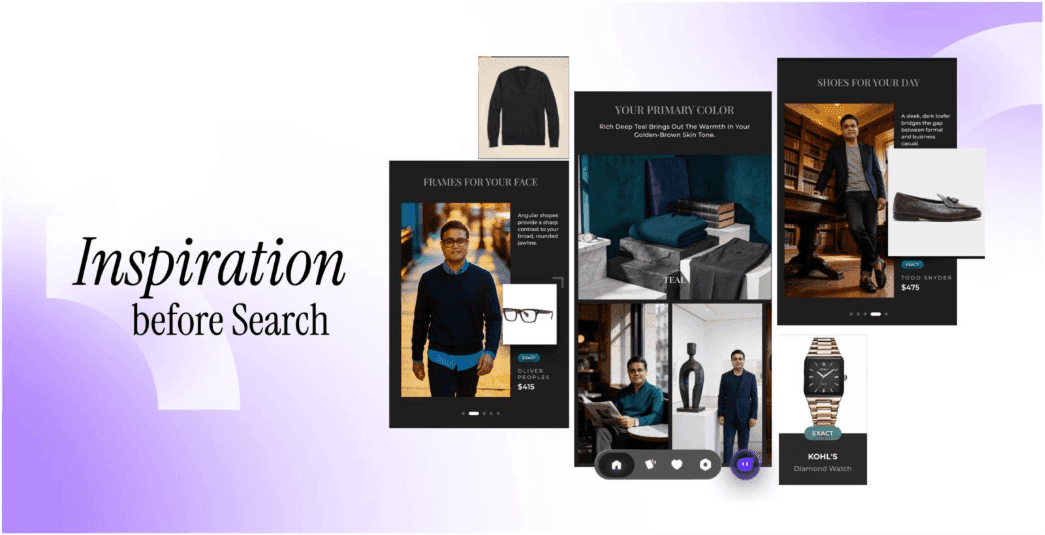
Styling starts with your body. Not your size — your body. Face shape determines what necklines and collar styles suit you. Skin undertone determines which colors create harmony versus clash. Body proportions determine which silhouettes are flattering versus which create visual imbalance. Hair color and texture interact with outfit colors in ways that affect the overall read of a look.
None of this information exists in a product search system. A search engine cannot tell you that the terracotta shirt you found will wash out your complexion, or that the cropped jacket you like will shorten your torso. It found what you searched for. Styling requires inputs the search system was never given. This uncertainty is one of the structural drivers of decision fatigue in fashion shopping — you find things but cannot tell if they will work on you, so you buy multiple versions and return most of them.
Glance reads these physical attributes directly from a selfie — not from a quiz you fill in, not from preferences you describe. A quiz captures aspiration; a selfie captures reality. Face shape, skin undertone, body proportions, and hair colour are read from the image and used to filter what you see. No warming-up period, no purchase history required.
Occasion Context
A look does not exist in isolation. It exists for a specific moment — a work presentation, a first date, a casual Saturday, a wedding as a guest. Each context has its own register: formality level, appropriate coverage, the right balance between effort and ease.
Search knows about product categories. It does not know you have a board presentation tomorrow or that the dinner you are dressing for is at a rooftop bar in July. You do not search 'outfit for a professional situation where I want to look senior but not unapproachable.' You search 'work outfits.' And the gap between those two things is exactly where styling lives.
Aesthetic Coherence
A styled look is not a collection of individually good items. It is a composition where every element — color, silhouette, proportion, texture, occasion register — works in relation to every other element. The blazer earns the trousers. The shoes close the color story. The accessories do not compete.
Search returns items. It does not evaluate how items relate to each other. A system that recommends a blazer does not know what trousers you will wear with it. Aesthetic coherence requires evaluating the entire look as a single output — not ranking individual products in isolation. This is what a genuine AI fashion lookbook produces: a composed look, not a list.
Real-Time Context
What you should wear today is not the same as what you should wear tomorrow. Temperature, precipitation, and humidity all affect fabric choice and layering. What is trending in your city this week is not what was trending last season. The light quality in winter versus summer affects how colors read.
Product search is not connected to the weather outside your window. It does not know that a cold front is moving through your city this weekend. It indexes products. The real world, as it exists right now around you, is not part of its input. Real-time context reading is one of the defining capabilities that separates agentic shopping systems from every search-based tool.
Outfits on Your Actual Body — Not a Model
Glance generates complete, shoppable outfit looks visualised on your actual body — not a stock photo model, not a generic avatar. This is the concrete output of what the styling architecture described above actually produces.
Upload one selfie. The five agents read your physical features, your location’s weather, what’s trending in your city, your upcoming occasions, and your behavioral signals simultaneously. The output is a complete look — top, bottom, shoes, accessories — shown on a version of you built from those readings. Across 40 million+ products from 400+ brands. Before you search for anything.
This is the gap the finding tools leave open: not a better search result, but a look on your body that you can evaluate with your own eyes before you spend anything.
Why the Architecture Has to Be Different
The reason most AI shopping tools cannot style you is not that they have not tried hard enough. It is that the architecture required for styling is fundamentally different from the architecture required for search.
Search architecture is built around indexing and ranking. It takes a large product catalog, creates searchable indexes of product attributes, and ranks results by relevance to a query. Making search smarter means making the ranking more accurate. Adding personalisation to search means using behavioral signals to adjust the ranking. It is still, at its core, a ranking problem.
Styling architecture requires something different. It requires multiple specialised intelligence layers running simultaneously — one that understands physical identity, one that understands occasion and context, one that understands real-time environmental signals, one that understands aesthetic coherence and how visual elements interact. And critically, it requires an orchestration layer that synthesises all of these inputs into a single, coherent output.
You cannot build this by improving a ranking algorithm. Better search is still search. Styling requires a different starting point entirely. The inputs are different. The output is different. The problem is different.
Did you know?
Adding personalisation to a search engine does not make it a styling tool. It makes it a personalised search engine. The gap between those two things is architectural — not a matter of how much data the system has about you
What a Styling-First System Actually Looks Like
The Glance Intelligent Shopping Agent was built specifically for the styling problem — not as an improvement on search, but as a different architecture designed from the ground up for the inputs that styling actually requires.
Instead of waiting for a search query, Glance reads the inputs that styling actually needs. A selfie provides physical feature data — face shape, skin tone, hair color, body proportions. Live weather data provides real-time environmental context. A regional trends layer provides what is actually resonating in your city right now. Calendar and occasion signals provide the life context that determines what a look needs to achieve. And a behavioral intelligence layer reads the aesthetic signals you generate through everyday engagement — what you linger on, what you skip, what you return to — without requiring you to articulate your preferences explicitly.
Five specialised agents process these inputs simultaneously. The orchestration layer synthesises them into one output: a complete, styled look visualised on your actual body — not a ranked list of products, not a mood board, not a set of filters to narrow. A look. Built for who you are. For where you are. For what you need today. This is proactive AI shopping — intelligence that acts before you search.
The distinction matters for you as a shopper because it changes what you should expect from an AI fashion tool. If you are using a search-based tool and finding it fails to style you — that is not a limitation of the specific tool. That is the structural ceiling of the architecture. To get styling, you need a tool that was built for styling.
Conclusion
Most AI shopping tools are exceptional at finding things. They will remain exceptional at finding things. That is what they were built for, and the architecture is well-suited to the problem.
Styling is a different problem. It requires physical identity, occasion context, aesthetic coherence, and real-time environmental signals — inputs that a search system was never given and a ranking algorithm cannot process. No amount of improvement to a search-based tool will close this gap, because the gap is architectural, not a matter of effort or investment.
The implication for you is practical: stop expecting a finding tool to style you, and start looking for a tool that was built for styling. The inputs are different. The intelligence is different. The output is different.
Glance it. Shop it.
FAQs
Why doesn't AI shopping suggest complete outfits?
Most AI shopping tools are built on search and recommendation architectures — they index products and rank them by relevance to a query. Complete outfit suggestion requires a different kind of intelligence: understanding physical identity, occasion context, aesthetic coherence between pieces, and real-time environmental signals. None of these inputs exist in a product search system. Glance is built specifically for this problem — five specialised agents reading physical features, weather, occasions, trends, and behavioral signals simultaneously to generate one complete styled look.
Why can't AI style me even though it can find anything I search for?
Finding and styling are structurally different problems. Finding is a matching problem — your description matched against a product catalog. Styling is a synthesis problem — your physical identity, context, and life situation synthesised into a coherent look. The architecture that makes search accurate is precisely unsuitable for styling. Search knows about products. Styling requires knowing about you — your face shape, skin undertone, occasion, and today's weather.
What does an AI need to know to actually style someone?
Four things search systems never have. First, physical identity — face shape, skin undertone, body proportions, hair color. Second, occasion context — what the moment calls for in terms of formality and register. Third, real-time context — current weather, local micro-trends, seasonal signals. Fourth, aesthetic coherence — how pieces relate to each other as a complete look, not how good each item is individually.
Is there an AI that can actually style complete outfits?
Yes. Glance's multi-agent architecture was built specifically for styling. It reads physical features from a selfie, live weather in your city, regional micro-trends, upcoming occasions, and behavioral patterns — and synthesises all five into a complete styled look visualised on your actual body. No search query needed. Available free on Samsung Galaxy, Motorola, iOS and Android.
Why do AI fashion recommendations feel generic even when they're personalised?
Because personalisation in a search system means adjusting the ranking of products based on your behaviour history. It makes the list more relevant to your past clicks but does not make the output a styled look. Relevance is not coherence. A highly personalised list of individual products does not account for how pieces relate to each other, whether they suit your physical features, or whether they work for your specific occasion.
What AI apps show outfits on my actual body, not a model?
Glance is the only platform in the US that generates complete outfit looks visualised on your actual body — not a stock photo model, not a generic avatar. Upload a selfie and Glance reads your face shape, skin tone, body proportions, and hair colour to generate looks from 40 million+ products across 400+ brands. Every look is shown on a version of you built from those features. Free, no subscription, available on Samsung Galaxy, Motorola, iOS and Android.
How does AI know what outfits will suit my body type without me telling it?
Glance reads your body type directly from your selfie — no quiz, no form, no self-reporting required. It analyses face shape to determine which necklines and silhouettes suit your features, skin undertone to identify which colour families work for your complexion, and body proportions to match cuts that flatter your frame. These are physical attributes read from the image, not preferences you describe.
Which AI apps personalise fashion based on my skin tone and body type?
Glance is the only AI shopping platform in the US that personalises fashion based on your actual skin tone and body type, read directly from a selfie. Chatbot assistants do not read physical features. Wardrobe apps work from items you upload, not your appearance. Glance reads skin undertone, face shape, body proportions, and hair colour from your selfie and uses these to filter 40 million+ products into looks that work specifically for you.
Download the Glance app now





Your intelligent
shopping agent.







Your intelligent
shopping agent.