

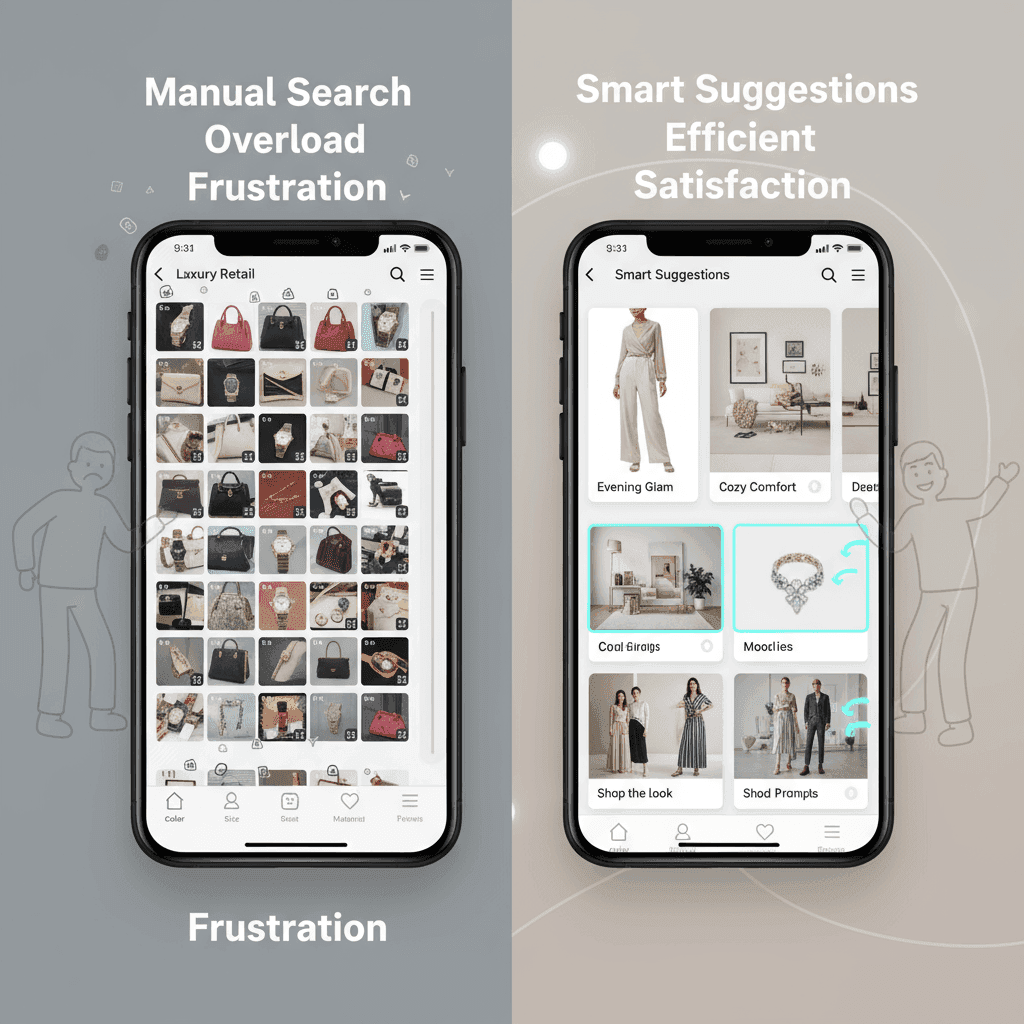
No Search Shopping: Why Discovery Is Replacing Browsing
TL;DR
• Shopping has always started the same way — you go looking. Proactive AI is the first model that changes that starting point.
• No-search shopping is not the same as a smarter feed. TikTok still responds to your engagement. Proactive AI reads context you have not expressed yet.
• The search bar is not disappearing — but its role is shifting from starting point to fallback.
• Glance reads five context signals simultaneously — weather, occasions, physical identity, regional trends, and behaviour — to surface a complete look on your body before you open any app.
• This guide explains how that works and why search cannot reach this moment no matter how smart it gets.
Shopping has always started the same way.
You go looking. You open an app, type something, scroll through a wall of results, open twelve tabs, close eleven of them, and either buy something you are not sure about or give up entirely.
Every tool built to improve this experience just made the looking faster. Better search rankings. Smarter filters. More personalised recommendations. All of it still starts with the same assumption — that you will come looking, and the system will respond.
Proactive AI changes the starting point entirely. Not faster search. A different model. One where a system reads your context — who you are, where you are, what is happening around you — and surfaces the right look before you think to ask for it. . This is what agentic shopping is built on — and it is already happening.
What No-Search Shopping Actually Means
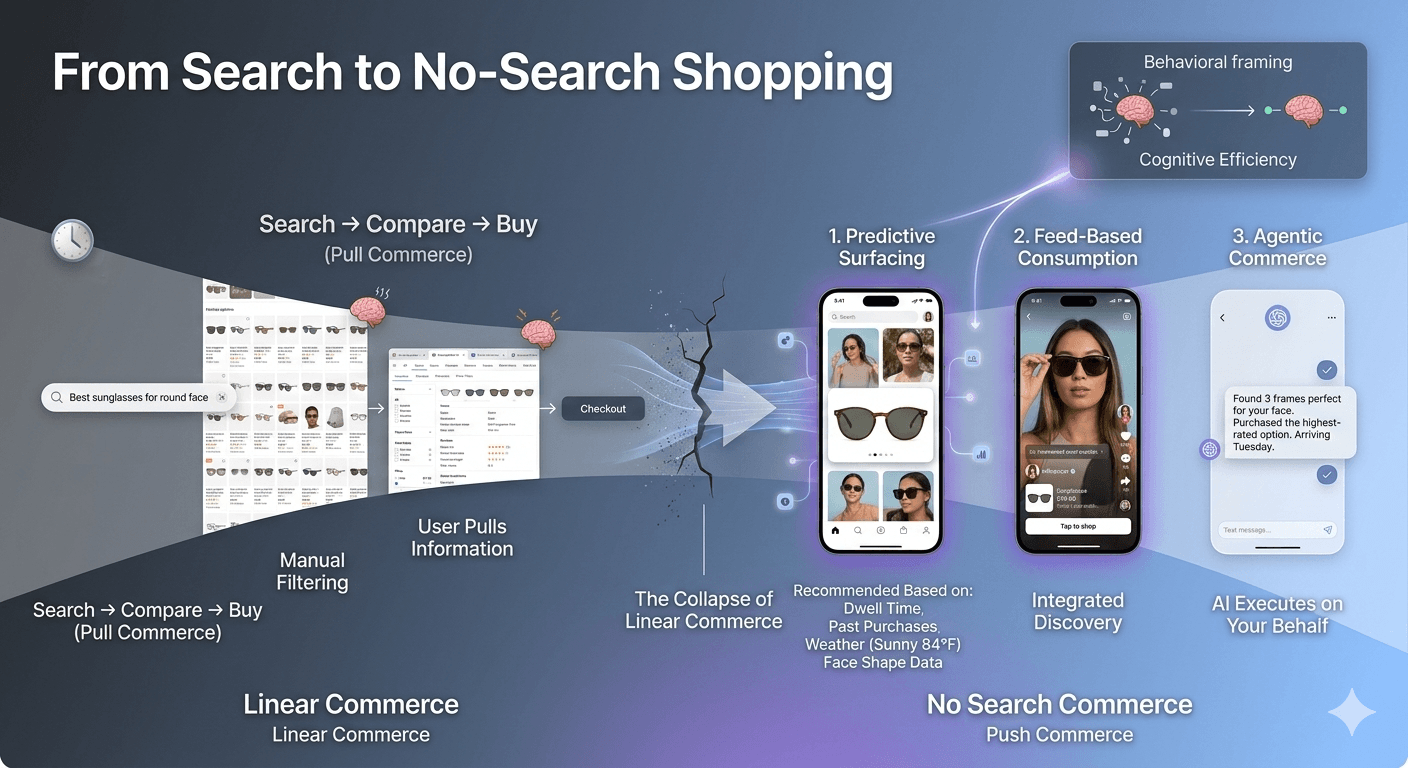
The term gets used loosely. It is worth being precise about what it actually means — and what it does not.
Search shopping is the model most people still use. You have an intent. You type it. The system responds. The work is yours from the start.
Feed-based discovery — TikTok, Instagram, Pinterest — feels like no-search shopping but is not. The algorithm still responds to your engagement. You scroll, pause, and like. The system watches and shows you more of what you did. It is reactive with a short feedback loop. You still initiated. The system still waited.
Proactive no-search shopping is structurally different from both. The system reads context you have not expressed yet — your location, the weather, what occasion is coming up, your physical features, patterns in how you engage. It does not wait for your signal. It reads the situation and acts before you do.
That third model is what this guide is about. And it is the one most platforms have not yet built.
Why Consumers Are Abandoning the Search Bar
The shift is not happening because people are lazy. It is happening because search is genuinely broken for fashion. Google's own research has found that roughly 40 percent of Gen Z shoppers now start product searches on TikTok or Instagram rather than Google or Amazon. They want discovery based on vibe and social context, not rigid keyword filters.
Filter fatigue is real. Zero-result searches are a well-documented frustration in fashion e-commerce specifically, though the exact rate cited across different vendor reports varies too widely to settle on one number here — even when shoppers do get results, manually toggling sizes, colours, and price points to find something that works for your body, your occasion, and your city is exhausting.
Trust in feeds is overtaking trust in search results. When something appears in your feed that feels right, it triggers a sense of serendipity that a search result ranked by ads and SEO cannot replicate. PYMNTS research from January 2026 found that 41 percent of consumers have already used dedicated AI platforms for product discovery — a structural shift the industry did not anticipate at this pace.
Discovery feels different from searching. Searching feels like a chore. Finding something that already fits feels like it was waiting for you. That emotional distinction is why the model is shifting.
Why Discovery Commerce Converts Faster Than Search
When intent is pre-read rather than self-reported, the window between exposure and purchase shrinks. PYMNTS Intelligence found that as of January 2026, 41 percent of consumers had used dedicated AI platforms for product discovery, with 43 percent saying they'd fully replaced their prior shopping methods. These are not gradual shifts. They are new habits forming at a pace the industry did not anticipate.. This Reduced Friction Model is why brands are shifting budgets from keyword optimization to behavioral optimization.
| Feature | Search Shopping | No-Search Shopping |
| User intent | Active / Explicit | Passive / Implicit |
| Cognitive load | High — research heavy | Low — curated |
| Emotional trigger | Utility-based | Serendipity-based |
| Purchase cycle | Long — consideration | Short — instant |
| Starting point | You initiate | AI reads context and acts |
| Personalisation | Generic results | Individual-level, contextual |
The Five Signals Proactive AI Reads Before You Ask
Proactive AI does not guess. It reads. And what it reads — before you type a single word — is five streams of context that together build a picture of what you need right now. For the full technical breakdown of how each agent works, see Five Signals, One Look: How Multi-Agent Fashion AI Works.
Weather and location.
If it is 38 degrees in Chicago today, linen shirts do not appear in your feed. If it is a humid 89 degrees in Miami, heavy knitwear is invisible. Your recommendations change every day because your context changes every day. This is not a filter you set. The system reads live conditions in your city and adjusts your entire feed accordingly.
Upcoming occasions.
You have a Saturday dinner. A work presentation Monday. A weekend trip coming up. You have not told the system any of this — but it reads the signal. Upcoming moments in your life are factored into what gets surfaced before you specify them. The outfit for the dinner appears before you think to look for it.
Physical identity.
The look is shown on your body — not on a model who looks nothing like you. Glance reads your face shape, skin tone, hair colour, and body proportions from a selfie. Those signals determine which colours create harmony, which silhouettes suit your proportions, how accessories should be scaled. You see yourself in the look, not a version of it on someone else.
Regional micro-trends.
What is trending in your city right now is not what was trending last month. It is not what is trending somewhere else. A global trend report is noise if you live in Nashville and the data is from Seoul. The system tracks what is actually resonating where you are — locally, specifically, this week.
Behavioural patterns.
How long you paused on a certain colour. What you skipped. What you came back to three sessions in a row. The system reads these signals without you filling in a single preference form. It builds your picture from what you do, not what you tell it.
When all five signals are read simultaneously and synthesized into one output, the result is not a list of relevant products. It is a complete, styled look built for who you actually are, in the moment you are actually in. Each of these signals maps to a specific platform capability — from AI Twin modeling to real-time trend intelligence — covered feature by feature elsewhere.
The Moment Before the Query
Here is the thing about the search bar: it requires you to already know you want something.
Most fashion decisions do not start that way. They start as a feeling. A morning where you realise you have nothing right for tonight. A vague sense that your wardrobe is not keeping up with your life. An occasion that crept up on you.
None of this starts as a search query. And none are well-served by typing something into a box and hoping the algorithm returns something useful.
The search bar requires intent to already exist. Google Lens now processes more than 25 billion visual searches per month, with roughly one in five carrying commercial intent.
This is not a limitation that better algorithms can fix. It is architectural. A reactive system — however smart — cannot help you before you signal it. It is built to respond. Proactive AI is built to anticipate.
Glance operates before you open the app, before you type a word, before you have made any decision at all. The system is already reading your context — where you are, what the weather is, what is trending in your city, what you have engaged with before — and assembling a picture of what today's look should be for you specifically.
By the time you see an outfit, discovery has already happened. What remains is the pleasurable part: exploring what has been built for you, refining it if you want to, and buying from a position of genuine confidence.
Visual Search Isn't an Exception — It's Still Reactive
It isn't, for the same reason a smarter feed isn't. Visual search still requires you to already have something specific in mind — a photo you took, a screenshot you saved, an item you spotted and want to find. The system responds to that image the same way a search engine responds to a typed query: it waits for your signal, then matches against it. Google Lens is genuinely excellent at this — at the scale already noted above — but excellence at reacting to a photo doesn't change what kind of system it is. Pinterest Lens works similarly for aesthetic inspiration, and Amazon StyleSnap for matching within Amazon's own catalog. All three are strong at what they do. None of them build you anything before you've captured an image of what you're looking for.
That's the same architectural ceiling described earlier in this guide, just wearing a different input method. The five signals Glance reads — weather, occasions, physical identity, regional trends, and behaviour — don't require a photo of anything. They don't require you to have already spotted what you want. A visual search app can only ever confirm something you've already found. Glance is built for the moment before that: before you've taken the photo, before you've screenshotted the look, before you knew there was anything to search for at all.
What This Means for Return Rates
Virtual try-on reduces returns at the decision stage — the moment between 'I like this' and 'I am buying this.' That is valuable. But the NRF's return data points to a more upstream failure: purchases that should never have been made because the item was wrong for the buyer's colouring, context, or occasion before a size was ever chosen.
Discovery intelligence solves that earlier problem. When the system understands your physical features, your context, and your personal aesthetic from the beginning, it does not surface items that will feel wrong when they arrive. The gap between inspiration and purchase confidence collapses at every stage of the journey, not only the last one.
How Glance Makes Shopping Without Searching a Daily Reality
The Glance Intelligent Shopping Agent was built for this specific moment — the one before any query exists. It reads all five context signals simultaneously and generates one output: a complete styled look visualised on your actual body, before you open a search bar.
Monday morning.
You have a client meeting, a casual lunch, and a post-work dinner. Three different dress codes. The old process: open three apps, run three searches, compare dozens of options. The Glance process: your phone already knows the weather, has read your calendar, and has factored in your physical features and recent style patterns. Three complete looks — one for each context — are already in your feed before you unlock your screen.
Pre-event.
Saturday dinner. You have not thought about what to wear yet. Glance already has. The occasion is on your calendar. The weather for Saturday evening has been read. A look built around your colouring, the temperature, and what is trending in your city right now is already waiting — not because you searched, but because the system read the situation and acted.
First session — no history required.
You have never used Glance before. No browsing history, no stated preferences, no quiz results. It does not matter. Your physical features from a selfie and the live context of your location generate a personally relevant result immediately. The cold start problem that makes paid styling apps feel generic for months does not apply here.
No search query. No filter. No quiz. You respond to what is already built for you. This is agentic shopping — and it is already running on your device.
"Most AI shopping tools can find you a product. Few can actually style you — that's a different, harder problem most AI shopping assistants were never built to solve.
What Zero-Click Commerce Looks Like in Practice
The scale of what is already happening matters. Glance currently serves 8 million monthly active users in the US, generating 30 million commerce prompts per month - none of them typed into a search bar.
That is the operational definition of zero-click commerce: discovery that begins before the user forms an intent, surfaces on the device the user is already on, and presents a shoppable outcome without requiring a single active input.
Each of those 30 million monthly prompts represents a moment where the system read the situation correctly enough that a user engaged with what it surfaced. That is not a feed responding to behaviour. That is intelligence operating before the search bar appears.
Conclusion
Shopping without a search bar is not a feature. It is a different model of commerce.
The search bar asks you to already know what you want. Fashion rarely starts that way. It starts with a feeling, an occasion, a morning where nothing seems right. Proactive AI operates in exactly that space — the one the search bar cannot reach.
Five context signals. One complete look. On your body. Before you asked.
That is not the future of shopping. It is what Glance is already doing.
Glance it. Shop it.
FAQs related to no search shopping
Will AI agents replace online shopping search bars?
Search bars will not disappear — but agentic shopping precedes them. Search handles direct, task-based queries: restocking, replacing, reordering. What agentic commerce displaces is the discovery stage — the part of shopping that starts before you have a query. Glance generates 30 million commerce prompts per month in the US — every single one triggered by context, not a search bar. That is the operational scale of what has already shifted.
Which AI shopping apps work on my phone before I open them?
Glance is the most complete answer to this in 2026. It's built to run on the device itself — lock screen, app, and beyond — generating a complete styled look before you've opened anything or typed a single word. No query. No filter. No onboarding quiz. Available free on Samsung Galaxy, Motorola, iOS and Android.
Can AI show me outfits before I start shopping?
Yes — but only proactive AI systems can do this. Reactive tools can only help after you signal intent. Proactive AI reads context before you express intent — weather, calendar, physical features, behavioral patterns — and surfaces a complete look before you decide to shop. Glance does this on your lock screen, before you open any app.
Is there an app that suggests clothes without me typing anything?
Glance does not require a search query at any point. You upload a selfie and the system reads your physical features, location, weather, upcoming occasions, and engagement patterns to generate complete outfit recommendations visualised on your actual body. No typing. No filtering. No preference settings to configure.
How does AI know what I want before I search?
By reading signals you are already generating without meaning to. How long you paused on an image. Which colours you returned to across sessions. What you browsed before and after certain items. Combined with real-time context — weather, location, upcoming occasions — these signals build a picture of what you need right now more accurately than any search query you could type.
What is the difference between a discovery feed and proactive AI shopping?
A discovery feed — TikTok, Instagram — is still reactive. It responds to your engagement history. You scroll and pause; the algorithm shows you more of what you engaged with. Proactive AI shopping reads context you have not expressed yet — weather, physical identity, upcoming occasions, regional trends — and generates a curated output before you signal anything. One waits for your behaviour. The other anticipates your need.
What is the best AI shopping app for discovering fashion I didn’t know I wanted?
Glance. It is the only platform built specifically for the moment before you know what you want. Instead of responding to a search, it reads your physical features, your location’s weather, what is trending in your city, and your upcoming occasions — and generates a complete styled look on your body. The starting point is not your intent. It is your context. That is what makes discovery feel like the right thing found you, rather than you finding it.
How can AI help me shop for clothes without using a search bar?
By replacing the search bar with five simultaneous signals: your physical features from a selfie, live weather in your city, regional micro-trends, upcoming occasions, and your behavioral patterns. Glance synthesises these into a complete outfit look visualised on your body, delivered to your lock screen before you open any app. No search bar required at any point.
Which smart shopping apps help me discover products I’ll actually love?
The apps most likely to surface products you will actually love are the ones that read your physical reality, not just your click history. Glance reads your face shape, skin tone, body proportions, and hair colour from a selfie — so every colour and silhouette it suggests works for your actual features. Combined with live weather, local trends, and your upcoming occasions, the result is discovery that feels personal rather than algorithmic. Free on Samsung Galaxy, Motorola, iOS and Android.
Download the Glance app now





Your intelligent
shopping agent.







Your intelligent
shopping agent.