

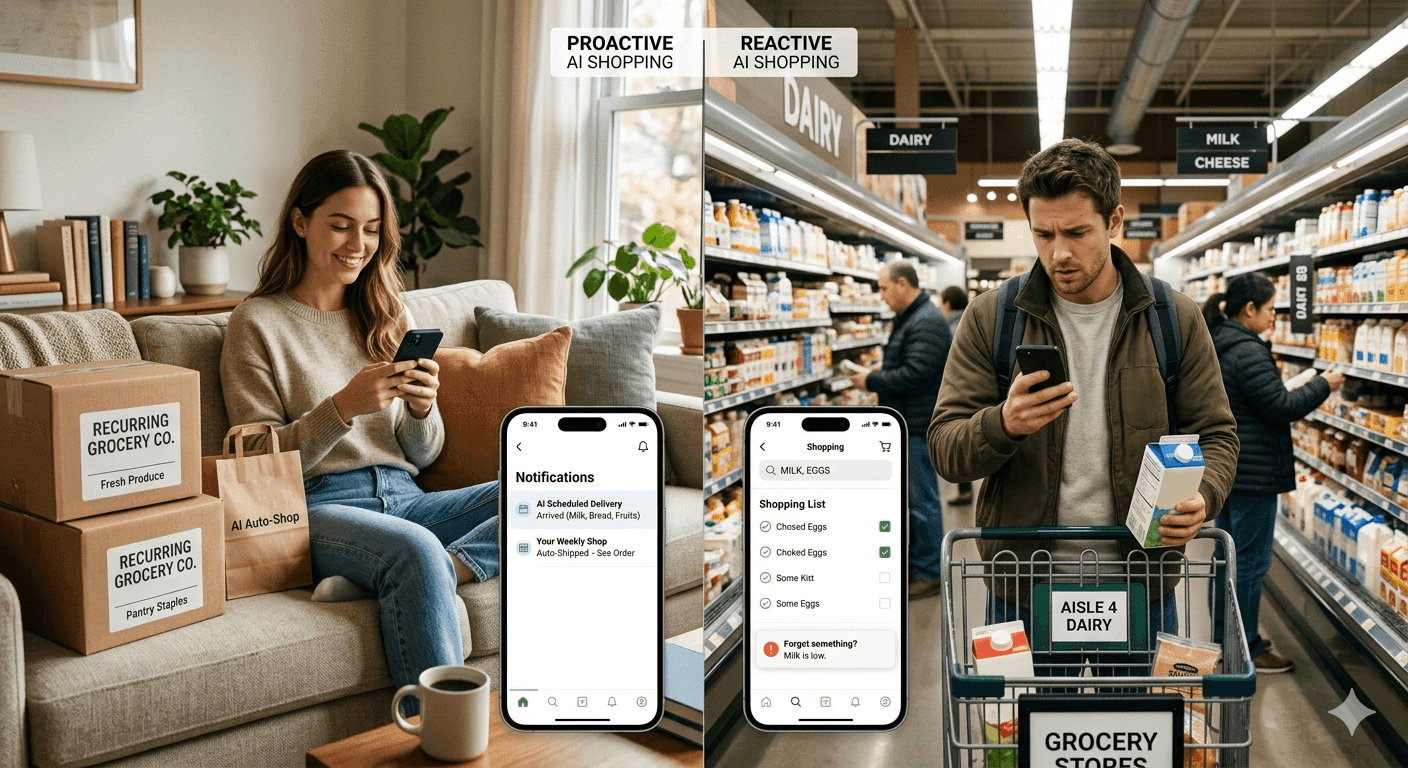
Proactive vs Reactive AI Shopping: Why the Difference Matters for You
TL;DR
Reactive AI shopping responds after you search. Proactive AI shopping acts before you do. The difference is not speed but the trigger. Reactive systems depend on your input. Proactive systems read your context, identity, and intent signals in real time. This reduces effort, improves relevance, and changes how decisions are made. You move from searching for products to receiving outcomes that are already shaped around your life. Glance is the only intelligent shopping agent doing this at consumer scale in the US today — reading your context across your lock screen, app, and TV before you open anything.
Reactive AI shopping waits for you to search. Proactive AI shopping acts before you do — reading your location, the weather, your calendar, and your physical features to build a complete styled look before you open an app or type a query. That's the entire difference, and it changes who does the work: with reactive tools, you carry the effort of defining what you want; with proactive systems like Glance, the system does that work and you simply review the result.
At the center of this shift are two models: reactive AI shopping and proactive AI shopping. Reactive systems depend on your search, your inputs, and your timing. Proactive systems rely on signals such as your location, weather, behavior, and context to prepare outcomes in advance.
This is not just a technical difference. It changes how decisions are made, how quickly you reach them, and how much thinking you have to do along the way.
What Does Reactive AI Shopping Actually Mean?

Reactive AI shopping follows a simple rule. Nothing happens until you start.
The system waits for an action. This could be a search query, a prompt, a quiz, or even uploading your wardrobe. Once you provide input, the system processes it and gives you a response.
Most tools that people use today fall into this category.
- Search based assistants respond to product queries.
- Chat based tools generate suggestions after a prompt.
- Wardrobe apps organize clothing only after you upload items.
- Virtual try on tools work only after you select a product.
- Subscription styling services depend on questionnaires.
In all these cases, the system is capable, but it is not active until you trigger it.
This creates a dependency. The output depends on how well you explain what you want.
- If your query is too broad, results feel generic.
- If you miss important details, suggestions feel incomplete.
- If you are unsure what to ask, the system cannot guide you effectively.
The effort of defining the problem still sits with you. The system helps, but only after you take the first step.
The effort of defining the problem still sits with you. The system helps, but only after you take the first step.
The scale of this model is significant. According to Adobe Analytics, AI-referred traffic to US retail sites has grown 1,324% — more than 14x — since Adobe began tracking it in October 2024. During Cyber Week 2025 alone, AI-driven interactions influenced approximately $67 billion in global online sales — roughly 20% of total digital orders, according to Salesforce data. Fashion is one of the categories where this shift is most visible, since visual, preference-driven, high-SKU categories benefit most from AI-driven personalization. Every one of those visits started with a reactive AI query — a search, a prompt, a question typed into a chat window. That is how large the reactive model currently is, and why replacing the starting point entirely represents the structural opportunity.
What Does Proactive Commerce Mean?
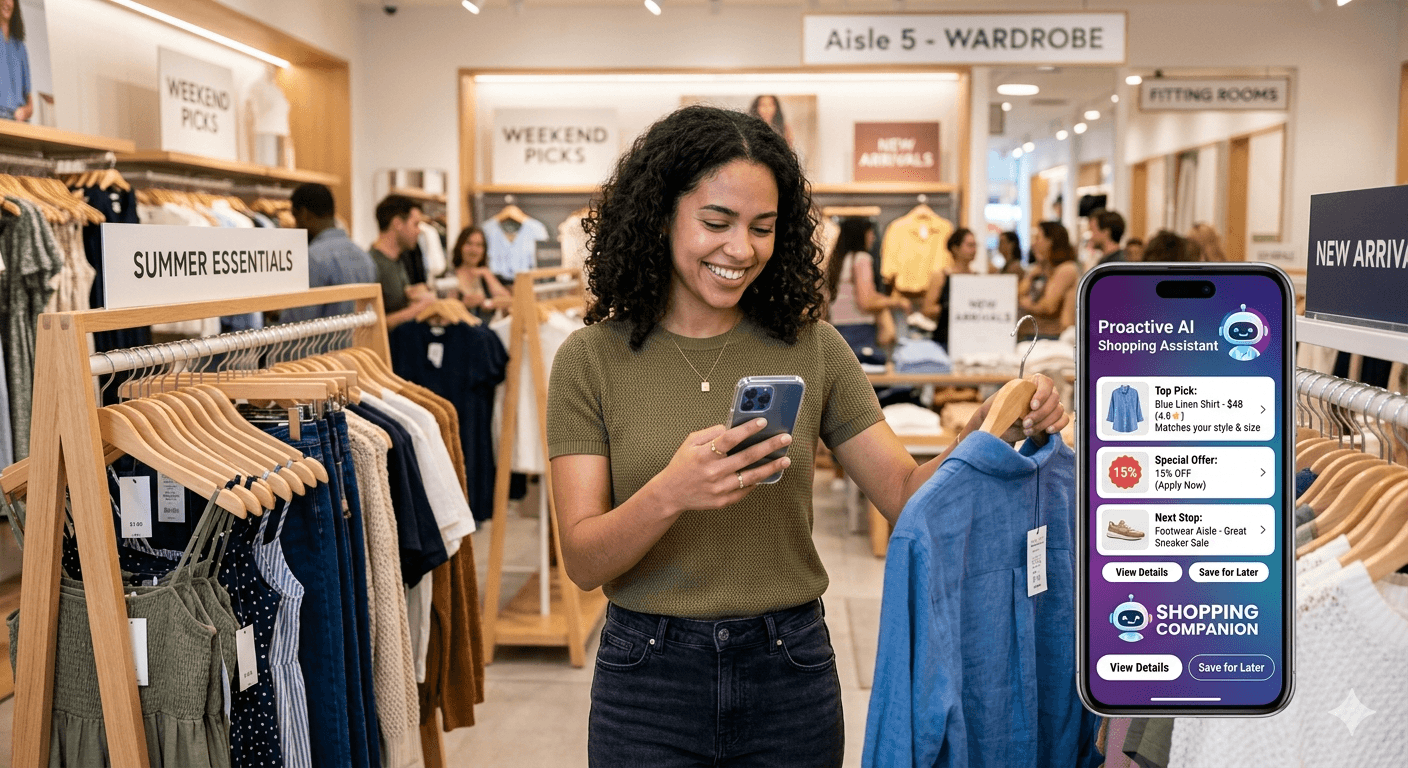
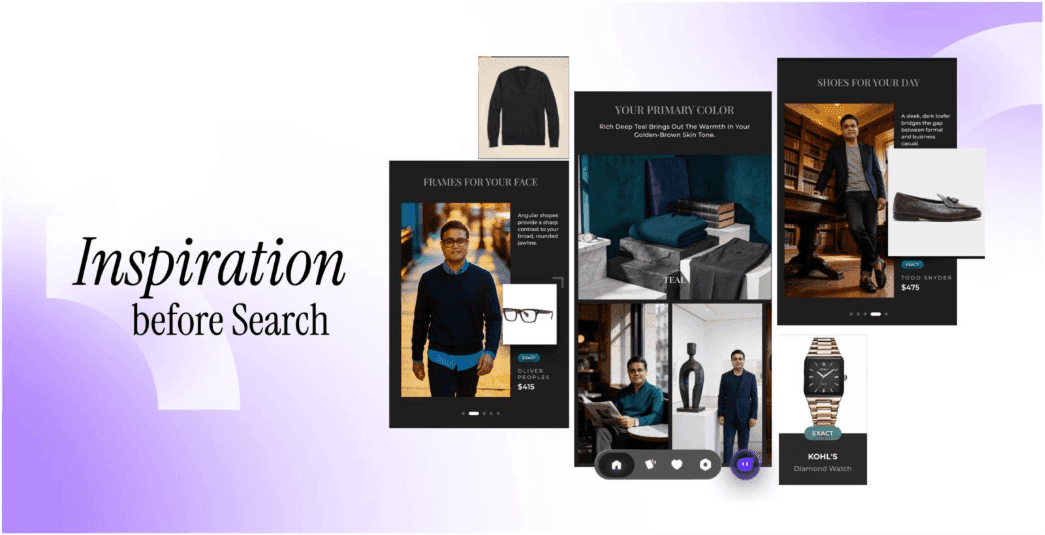
Proactive commerce means the system acts before the consumer asks. Instead of waiting for a search query, it reads context — where you are, what the weather is, what is coming up, what your physical features are, what your behaviour reveals about your taste — and surfaces what fits before intent is formed. The trigger is not a query. It is a moment.
Proactive AI shopping changes where the process begins.
Instead of waiting for a search, the system reads signals continuously and prepares outcomes before you take action.
The trigger is context, not query.
This includes signals such as your location, time, weather, and behavior. These inputs are always present, which allows the system to start earlier.
For example, if the temperature is expected to drop later in the week and you have an evening plan, a proactive system already begins aligning suggestions to that situation. It does not wait for you to search for an outfit.
This is where the Glance Intelligent Shopping Agent operates. It reads multiple signals at the same time and builds complete styled looks that are aligned to your context and identity.
The output is not a list of products. It is a ready to consider outcome that already fits the situation.
Proactive discovery is only half the picture, though. The other half — what actually makes a proactively-surfaced item buyable, securely, across any retailer — runs on real, named infrastructure worth naming directly:
Stripe's ACP (Agentic Commerce Protocol), built with OpenAI and launched September 2025, handles product discovery within an AI conversation. Its original Instant Checkout feature, which let a purchase complete without leaving the conversation, was discontinued in March 2026 — today ACP handles discovery, then redirects to the merchant's own site to close the sale.
Google's UCP (Universal Commerce Protocol), co-developed with Shopify and announced at NRF in January 2026, standardizes how an agent discovers a catalog and moves toward checkout, with a Tech Council including Amazon, Meta, Microsoft, Salesforce, and Stripe, and endorsing partners including Visa and Mastercard. Its companion, AP2, authorizes the payment once an agent is ready to transact.
Visa Intelligent Commerce and Mastercard Agent Pay let a card network verify an agent-initiated purchase reflects what the consumer actually authorized. Mastercard extended this in September 2026 with Agent Connect, secured through what it calls Verifiable Intent — and Glance is a named launch partner in it. As Glance COO Mansi Jain put it at launch: "Glance turns moments of inspiration into products consumers can find and buy... Agent Connect gives that discovery a trusted path to purchase."
None of that infrastructure is proactive in itself — it's the transaction layer that makes a recommendation, once made, completable, separate from what "proactive" actually describes.
Lynk, Glance's intelligent shopping assistant for AT&T Android customers, is already doing this on a new surface — surfacing shopping intelligence before you open a browser, before you type a query, directly on the home screen you touch over 100 times a day.
Did you know that a Salesforce study finds that 73% of customers expect companies to understand their needs and expectations?
Top Reactive and Proactive Shopping Tools
Most shopping tools available today operate reactively.
| Tool type | Examples | Trigger | Reactive or Proactive |
| Conversational shopping assistants | Amazon Rufus, ChatGPT Shopping, Perplexity Shopping | You search | Reactive |
| Wardrobe organisation apps | Whering, Cladwell, Acloset, Indyx | You upload wardrobe | Reactive |
| Virtual try-on tools | Google Try-On, Snapchat Dress Up | You select product | Reactive |
| Subscription styling services | Stitch Fix | You answer quiz | Reactive |
| Glance Intelligent Shopping Agent | Glance | Your context before search | Proactive |
The difference is not in how advanced these tools are. The trigger is what separates them.
How This Actually Works, Step by Step
Here's exactly what happens, in order, before you've searched for anything:
Step 1 — You unlock your phone. No app open, no search bar touched. This is the trigger — or more precisely, the absence of one.
Step 2 — Five specialized agents read five signals simultaneously, in the background. The Physical Features Agent reads your face shape, skin tone, and body proportions from a selfie you gave it once. The Weather & Location Agent reads real-time conditions in your actual city. The Regional Trends Agent reads what's resonating locally, not globally. The Occasions Agent reads your calendar for what's coming up. The Personality & Lifestyle Agent reads your own past behavior — what you've lingered on, skipped, or bought.
Step 3 — An orchestration layer synthesizes all five signals into one look, not five separate outputs. This is the part that actually replaces the search bar: instead of you typing "casual outfit for cold weather event," the system has already combined the cold-weather signal, the event-timing signal, and your own coloring into a single, coherent, styled outfit.
Step 4 — The look appears somewhere you're already looking. Your lock screen, your feed, your TV — not a new app you have to remember to open. And it's visualized on your own body, not a generic model, so the fit question is answered before you consider buying.
Step 5 — You review, not build. You didn't define the problem. You're evaluating a solution that's already close to right. If it fits, you tap through. If it doesn't, that reaction itself becomes a signal that sharpens the next look — no explicit feedback form required.
That's the mechanism. Five signals, one orchestration layer, zero search queries.
Difference Between Reactive and Proactive Systems
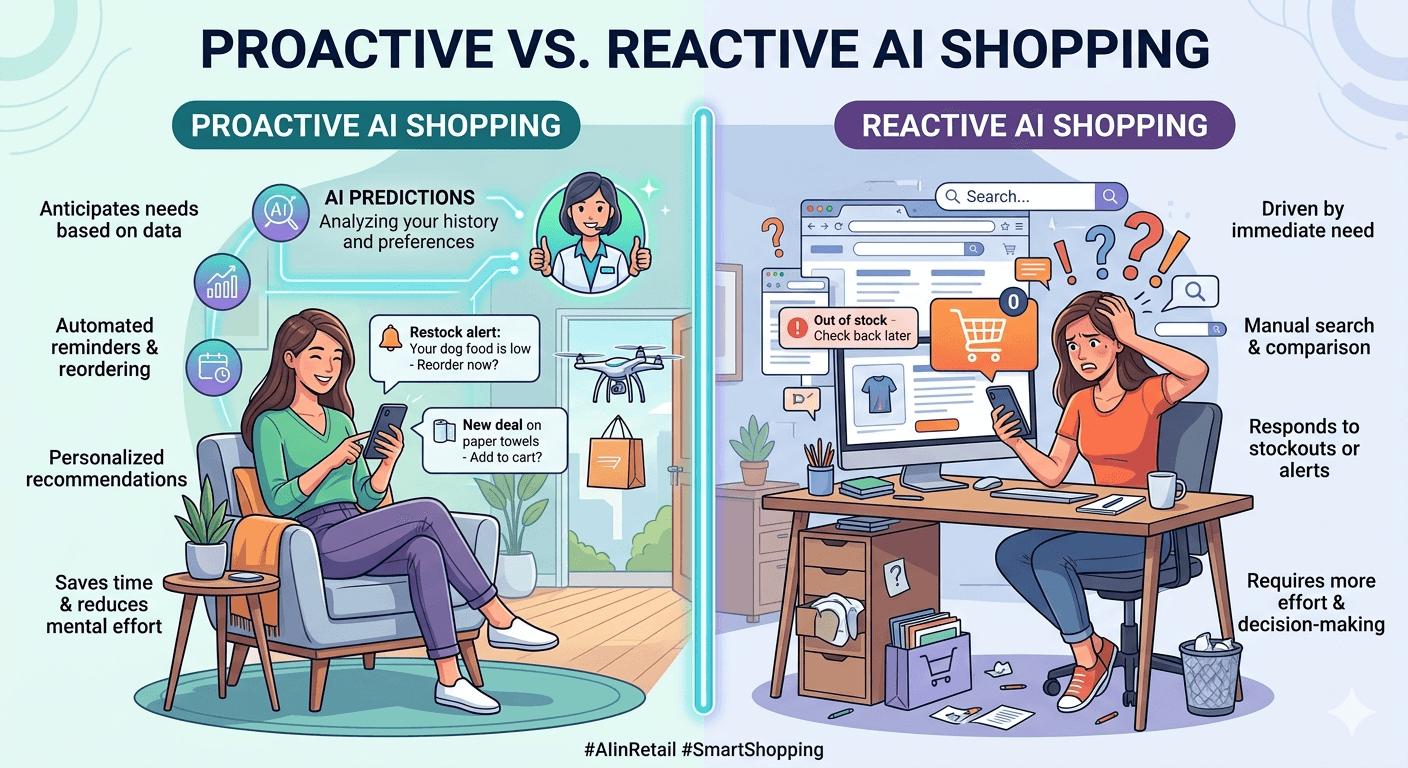
The difference between reactive and proactive systems is not about features. It is about structure.
The trigger determines what the system knows and how it behaves.
If the system starts with your query, it only knows what you tell it.
If the system starts with your context, it already knows much more before you begin.
This affects the entire experience.
Did you know that proactive AI engagement reduces customer churn by 10–15%, according to Forrester research?
Reactive vs Proactive: what actually changes
| Reactive AI shopping | Proactive AI shopping |
| Trigger: Your search | Trigger: Context signals |
| Starts when: You initiate | Starts continuously |
| Input required: Yes | Input required: No |
| Output: Product lists | Output: Styled outcomes |
| Personalisation: Builds over time | Personalisation: Starts immediately |
| Cognitive load: On user | Cognitive load: On system |
Reactive AI improves how you search.
Proactive AI reduces the need to search.
This is the foundation of agentic shopping — a model where context replaces the search bar entirely.
This distinction isn't specific to fashion or unique to Glance. Salesforce's own 2026 definition of agentic commerce draws the identical line: "The major difference between bots and ecommerce agents is that agents are proactive, whereas bots are simply reactive." The same proactive-versus-reactive distinction shows up across customer service, sales AI, and enterprise software more broadly — Glance is applying an already-recognized framework to shopping and styling specifically, not inventing a new one.
Why do Reactive Systems Still Feel Effort Heavy?
Even with AI, many shopping experiences still feel tiring.
This happens because the system expects clarity from the user.
Most people do not start with a clear idea. They know the situation but not the exact solution.
You might know you need something for an event, but not what exactly fits. Translating that into a precise query takes effort.
This leads to repeated searches, refinements, and comparisons.
Reactive AI speeds this up, but it does not remove it.
This is the structural driver of decision fatigue in fashion shopping — and why reactive AI, however advanced, cannot fully resolve it.
Did you know? Locus's Q2 2026 US Consumer Survey of 1,000+ active US online shoppers found that 45% now use AI tools as part of their shopping journey — but the tools they are turning to are ChatGPT, Claude, and other reactive systems that still wait for a query before responding. The structural shift to proactive AI shopping is still ahead of where mainstream adoption currently sits.
What Proactive Intelligence Actually Reads?
Proactive systems rely on five signals that exist without needing user input: weather and location (real-time conditions, matched without being specified), regional trends (local patterns, not global ones), occasion timing (upcoming events, prepared for in advance), physical identity (skin tone, body proportions, and features, reducing fit mismatch), and behavior and lifestyle (engagement patterns that build a profile without direct input). For a deeper look at how physical identity specifically shapes personalized fashion recommendations, see how Glance reads skin tone and body proportions.
The deeper shift in how decisions happen
The biggest change is not speed. It is who carries the effort.
In reactive systems, you define the problem and the system responds.
In proactive systems, the system prepares the solution and you evaluate it.
This reduces the number of decisions you need to make.
Instead of starting from zero, you start from something that is already close to what you need.
The shift is already underway: according to McKinsey's 2026 State of the Consumer survey, 28% of Gen Z shoppers are already using generative AI tools for shopping — nearly double the rate of baby boomers at 16%. The adoption is real. The tools they are using, however, are still reactive. Proactive intelligence — the kind that reads your context before you search — is the next structural layer.
Where this matters the most
Proactive systems are more effective in areas where decisions are complex.
Fashion is a strong example because it involves multiple factors such as fit, color, occasion, and personal style.
In such cases, combining multiple signals creates better outcomes than relying on a single query.
For simpler purchases, reactive systems may still be enough.
The role of trust in adoption
As proactive systems take on more of the work, trust becomes the deciding factor. Users lean into proactive suggestions when they're consistently relevant — and fall back to manual search the moment they're not. That's the real shift in your role: less time spent building a query, more time spent reviewing a result that's usually already close to right.
Conclusion
The move from reactive to proactive AI shopping is a structural shift.
It changes where the process begins and who carries the effort.
Instead of starting with a search, the system starts with context.
Instead of asking what you want, it prepares outcomes based on what you are likely to need.
This reduces friction, shortens decision time, and makes shopping feel more aligned with real situations.
The change is gradual, but the direction is clear. The role of search is decreasing, and the role of context is increasing.
The change is gradual, but the direction is clear. The role of search is decreasing, and the role of context is increasing. For a full picture of what shopping without a search bar actually looks like in practice, see how proactive commerce is already running on millions of US devices.
FAQs Related to the Proactive vs Reactive AI Shopping
What does proactive commerce mean?
A: Proactive commerce means the system acts before the consumer asks. Instead of waiting for a search query, it reads context — where you are, what the weather is, what is coming up, what your physical features are, what your behaviour reveals about your taste — and surfaces what fits before intent is formed. The trigger is not a query. It is a moment.
Will AI agents replace online shopping search bars?
A: Search bars are not disappearing overnight, but their role is shrinking in fashion and lifestyle categories. AI agents like Glance already operate before the search bar — reading your context, your physical features, and your location to surface complete styled looks without requiring a query. For specific purchase decisions, search remains efficient. For discovery, proactive AI agents are already replacing the search bar for millions of US shoppers. Context is becoming the trigger, and the query is becoming the exception.
What is the difference between proactive and reactive AI shopping?
Reactive AI shopping typically works through search driven platforms like large marketplaces and chat-based tools where users initiate queries. Proactive AI shopping is shopping that starts before your search — triggered by context, not query. It is still emerging and focuses on using real time context such as local weather, city trends, and user behavior to surface results before a search. The key difference is that reactive systems depend on user input, while proactive systems adapt to the user’s environment and situation automatically.
Does proactive AI shopping require past purchase data to work effectively?
In most US based ecommerce systems, personalization improves with purchase history, but proactive AI shopping does not depend on it to start. It can use real time signals such as location, device usage, and environmental context to generate relevant suggestions from day one. Over time, interaction data helps refine accuracy, but initial recommendations are not limited by lack of history.
Are AI shopping tools mostly reactive or proactive?
Most AI shopping tools currently used are reactive. Platforms like large ecommerce marketplaces, virtual try on tools, and styling services still rely on user searches, filters, or quizzes to generate results. Proactive AI shopping is still developing and is being introduced through newer systems that focus on predictive commerce and context driven recommendations.
How does proactive AI shopping improve online shopping for consumers?
Proactive AI shopping reduces the time and effort required to find relevant products. For consumers who often browse across multiple platforms, it simplifies the journey by presenting options that already match local conditions, preferences, and timing. This leads to fewer searches, less comparison fatigue, and quicker decision making, especially in categories like fashion and lifestyle.
Is proactive AI shopping fully automated in current ecommerce platforms?
In the US ecommerce ecosystem, proactive AI shopping is not fully automated yet. Most systems still allow users to review and confirm suggestions before completing a purchase. While automated shopping exists in areas like subscriptions and reorders, proactive AI focuses more on preparing highly relevant options rather than making decisions without user approval. Worth being precise about the distinction: proactive AI initiates action — it surfaces a look before you ask. Autonomous AI would go a step further and complete the purchase without your approval. Glance is proactive but not autonomous by design — it builds the look and puts it in front of you, but you still decide whether to buy.
Download the Glance app now




Your intelligent
shopping agent.







Your intelligent
shopping agent.