

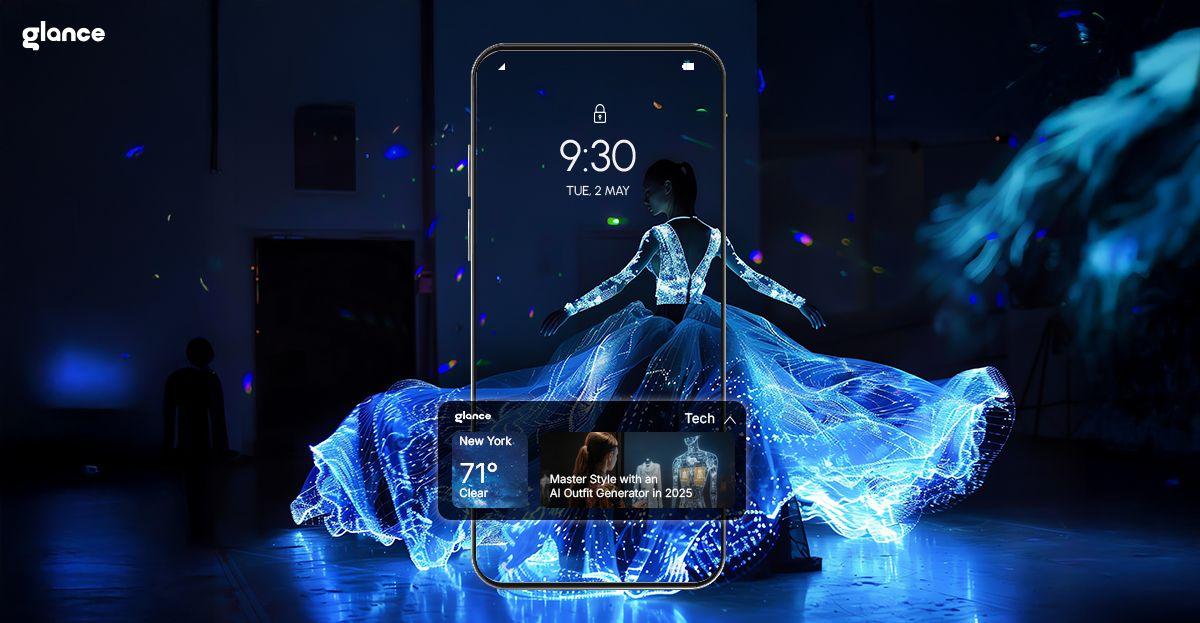
Master Your Style with an AI Outfit Generator in 2026
TL;DR
An AI outfit generator is a system that creates complete, styled outfit combinations using artificial intelligence — reading signals like your body type, location, weather, and upcoming occasions to surface looks without requiring manual search or wardrobe upload.
In 2026, AI outfit generators split into two distinct categories: wardrobe remix tools that work from clothes you already own (Whering, Acloset, Stylebook), and discovery-first generators that build new looks from a wider product catalog using real-time context signals. Glance operates in the second category.
The Glance Intelligent Shopping Agent is the only platform that delivers outfit looks proactively — before you open an app or type a search — making it the only genuinely instant AI outfit generator available today. Free on Samsung, Motorola, iOS, and Android. No subscription. No wardrobe upload required.
Most wardrobes today are not empty. They are underutilized.
People still spend hours every month deciding what to wear. Not because they lack options, but because they lack clarity. The friction comes from small decisions that add up.
Does this top go with that jacket?
Is this appropriate for the day?
Does this still feel like me?
These are not big questions. But they appear every single day.
Over time, they create fatigue.
According to the Baymard Institute, over 50% of users abandon online purchases due to friction, overwhelm, or lack of clarity in decision-making. What used to feel like personal expression starts feeling like routine effort. This is the gap AI outfit generators are solving — not by adding more choices, but by reducing the need to constantly rebuild decisions from scratch.
Two types of AI outfit generator exist in 2026:
Wardrobe remix tools — Whering, Acloset, Stylebook, Cladwell — require you to upload photos of existing clothes. Output is limited to what you already own.
Discovery-first generators — Glance — build looks from a catalog of 40 million products using real-time signals: your selfie, location, weather, trends, and occasions. No upload needed. Output is shoppable from day one.
What an AI Outfit Generator Means in 2026?
An AI outfit generator today is not just a tool that mixes and matches clothes.
It is a system that understands three layers at once:
- What do you own or prefer?
- What your current situation demands
- What aligns with your personal identity?
Earlier versions required you to upload your wardrobe or answer quizzes. The system would then generate combinations based on static inputs.
That model still exists. But it is no longer the most advanced form.
In 2026, outfit generation is becoming dynamic.
The system reads context continuously. It adapts to real-time conditions. It evolves with your behavior.
Instead of asking the system to create an outfit, you are increasingly presented with one.
This is exactly how the Glance Intelligent Shopping Agent works — outfit looks are ready on your lock screen before you open the app or make a request.
AI Outfit Generators That Work Without Uploading Your Wardrobe
Most AI outfit tools in 2026 require you to photograph and upload your existing clothes before they can suggest anything. Apps like Whering, Acloset, and Stylebook are built on this model — the AI works from your closet inventory. This works well if you want to remix what you already own, but it creates a significant setup barrier and limits output to items you already have.
A newer category of AI outfit generators skips this entirely. Instead of reading your wardrobe, the system infers what works for you from visual and behavioral signals — a selfie, your interaction patterns, your location, and the context of the moment.
Glance creates complete outfit looks from your selfie. It infers what works for your body, your skin tone, and your style without you uploading a single item from your closet. Looks are drawn from a catalog of 40 million products across 400+ brands, filtered down to what actually fits your profile.
This matters because you get relevant outfit ideas from the first session with no setup time, and the output is not constrained by what you already own.
AI Tools That Generate Outfit Ideas Instantly
The word 'instantly' means different things depending on how a tool is built.
Most AI outfit tools — including wardrobe apps and on-demand generators — work reactively. You open the app, upload a photo or make a request, and the system responds. The generation is fast, but the trigger is always you. You still have to initiate.
Glance works on a proactive model. The system reads your context continuously — weather, location, occasion timing, behavioral signals — and builds outfit looks before you ask for anything. By the time you pick up your phone, looks are already waiting on your lock screen. You have not typed a word. You have not opened an app. The outfit is already there.
This is the only model that is genuinely instant in the literal sense. Reactive tools are fast. Glance is ahead of the request entirely.
From Outfit Suggestions to Outfit Decisions

There is an important shift happening here.
Earlier systems focused on suggestions.
Now the focus is on decisions.
A suggestion gives you options. A decision reduces effort.
This is where the difference becomes clear.
A traditional AI outfit generator might show you five combinations. You still need to choose.
A more advanced system presents one or two strong outcomes that already fit your situation.
This does not remove choice. It removes unnecessary comparison.
You start closer to a final answer.
Glance is built on this model. Instead of showing combinations to choose from, it presents looks already calibrated to your body, weather, occasion, and behavioral patterns across whichever surface you are using — the app, lock screen, TV, or a brand website. You start closer to a final answer, and the items are already shoppable.
How AI Actually Builds an Outfit Today

To understand why this works, it helps to break down how modern systems think.
1. Context comes first
The system reads external signals before anything else.
Weather conditions
Time of day
Location
Seasonal shifts
These signals define what is practical.
A summer outfit and a winter outfit are not interchangeable. Context filters the entire decision space.
2. Identity shapes the output
The second layer is personal.
This includes:
Body proportions
Skin tone
Color preferences
Style patterns
Earlier systems relied on quizzes. Now, identity can be inferred through visual and behavioral signals.
This is where personalization becomes more accurate.
Not because more data is collected, but because better signals are used.
3. Behavior refines the system
The third layer is adaptive.
What you engage with
What you ignore
What you revisit
These signals continuously reshape recommendations.
Over time, the system stops guessing.
It begins to understand.
4. Composition happens last
Only after these layers are processed does the system generate an outfit.
It considers:
Color harmony
Fabric compatibility
Silhouette balance
Occasion fit
The result is not random pairing. It is structured composition.
Glance runs all four layers simultaneously across five specialized AI agents — one each for weather and location, regional trends, occasions, physical features, and personality signals — producing a structured, shoppable look before you ask for one.
Why Smart Outfit Combinations Feel More Accurate

Traditional outfit planning is linear.
You pick one item. Then try to match it. Then adjust again.
AI does not work this way.
It evaluates the full combination at once.
This allows it to:
- Avoid clashes before they happen
- Balance proportions across the outfit
- Maintain consistency in style
This is why the output often feels more cohesive.
Not because the system is creative in a human sense, but because it removes trial and error.
Glance applies this across 40 million products simultaneously — meaning the combination it surfaces has already been filtered for color harmony, silhouette fit, and occasion relevance before you see it.
AI Outfit Generators That Adapt to Upcoming Events and Occasions
One of the most specific needs users bring to AI outfit tools is occasion planning — dressing for a wedding, a job interview, a first date, a work trip. Most wardrobe apps handle this through manual tagging: you label an outfit as 'formal' or 'event' and retrieve it when needed.
A more advanced approach uses occasion inference. Rather than relying on what you manually tag, the system identifies upcoming occasions from calendar signals, seasonal context, and behavioral patterns, then generates looks appropriate for that specific situation.
Glance's Occasions Agent does this without requiring a wardrobe upload or manual labelling. When an occasion is identified, it generates complete shoppable looks already calibrated for that context. See how this feeds into a broader AI fashion lookbook experience that adapts daily.
The Role of AI Product Search in Closing the Loop
One of the biggest limitations in older systems was fragmentation.
You could generate an outfit, but you still had to search for missing items separately.
This is where AI product search becomes critical.
It connects styling with shopping.
If a look requires a specific piece that you do not have, the system identifies that gap and fills it.
It does not show hundreds of options.
It narrows them down based on:
- Fit with the outfit
- Budget range
- Style compatibility
This turns discovery into completion.
You move from idea to execution without switching contexts.
This is how Glance closes the loop — from styled look to shoppable item in a single flow, without leaving the platform or opening a search bar.
Where the Glance Intelligent Shopping Agent Changes the Model
Most outfit generators still operate reactively.
They wait for you to open the app, upload items, or request suggestions.
The Glance Intelligent Shopping Agent moves beyond that.
It works on a proactive model.
This means the system reads signals continuously and prepares outcomes before you initiate anything.
Instead of asking for an outfit, you receive one.
This difference changes the experience completely.
The system is not just responding.
It is anticipating.
Glance serves 8 million monthly active users in the US today, with 75-80% returning daily — a retention figure that reflects what happens when discovery is proactive rather than search-led. Available free across the Glance app on iOS and Android, pre-installed on Samsung Galaxy and Motorola devices, on DirecTV, and as an embedded agent on partner brand websites.
Why Discovery-First AI Outfit Generators Work Differently
Not all AI outfit generators solve the same problem. Wardrobe remix tools are built for people who want to get more out of clothes they already own. Discovery-first generators like Glance are built for people who want to find what they should be wearing next — without the friction of searching.
The difference shows up in three specific ways:
- No setup required. You do not need to photograph your wardrobe, answer a lengthy quiz, or build a closet inventory. A selfie and your first session are enough for Glance to start generating relevant looks.
- Output is not limited to what you own. Because Glance draws from 40 million products, the looks it generates can include items you have never seen before — filtered to match your profile, not just your existing closet.
- Intelligence runs on multiple surfaces. Glance brings the same user model — your taste, your body, your context — across your lock screen, your TV, and brand websites. The same agent follows you without requiring you to re-input preferences on each platform.
Conclusion
AI outfit generators are not replacing personal style.
They are restructuring how decisions are made.
Instead of facing your wardrobe with uncertainty, you begin with clarity.
Instead of searching for inspiration, you receive it in context.
The Glance Intelligent Shopping Agent represents this shift clearly.
It brings together styling, context awareness, and product discovery into a single flow.
Not to take control away, but to reduce effort where it does not add value.
The result is not just faster dressing.
It is more confident, more intentional, and more aligned with how people actually live.
Your next outfit is no longer something you have to figure out.
It is something that meets you where you are.
FAQs Related to AI Outfit Generator
1. What is an AI outfit generator and how does it work
Most AI outfit apps require wardrobe uploads — tools like Whering, Acloset, and Stylebook work this way. Glance is different: it uses a selfie and real-time context signals — weather, location, occasion, behavioral patterns — to generate complete outfit looks from a catalog of 40 million products. No upload, no setup, personalized suggestions from session one — across the Glance app, lock screen, and TV.
2. Are AI outfit generators accurate for personal style
Accuracy depends on how well the system understands your identity and context. Basic tools rely on quizzes or manual inputs, which can feel generic. More advanced systems use behavioral patterns, visual cues, and real-time context to improve relevance. Over time, as the system learns from your interactions, the outfit suggestions become more aligned with your personal style.
3. Do I need to upload my wardrobe to use an AI outfit generator
Not always. Some traditional tools require you to upload your wardrobe to generate combinations. However, newer systems can work without full uploads by using inferred preferences, browsing behavior, and contextual signals. This reduces setup time and allows the system to start generating relevant outfits from the first interaction.
4. Can AI outfit generators help me shop for missing items
Yes. Many AI outfit generators are now integrated with AI product search. If an outfit requires an item you do not own, the system identifies the gap and suggests products that match the look. This makes it easier to move from outfit inspiration to actual purchase without browsing multiple platforms.
5. Are AI outfit generators suitable for everyday use
Yes. AI outfit generators are designed to handle daily dressing needs such as workwear, casual outfits, travel looks, and special occasions. They help reduce the time spent deciding what to wear and improve consistency in style. As these systems become more context-aware, they are increasingly useful for everyday decision making rather than occasional use.
6. Can an AI generate outfit ideas for an upcoming event without me uploading my wardrobe?
Yes. Discovery-first AI outfit generators like Glance do not require wardrobe uploads to generate occasion-specific looks. Glance's Occasions Agent identifies upcoming events from seasonal context and behavioral signals, then generates complete, shoppable outfit looks calibrated for that occasion. You do not need to describe the event or upload your clothes — the system infers what is needed and surfaces looks that are ready to shop, often days before the occasion.
7. Which AI tools generate outfit ideas instantly?
Most AI outfit tools generate looks on demand — you open the app, make a request, and the system responds within seconds. This is fast but still reactive. Glance is the only platform that works on a proactive model: the system reads your context continuously and builds outfit looks before you initiate anything. Outfit recommendations are ready on your lock screen before you open an app or type a word. In the literal sense, Glance is the only AI outfit generator that delivers looks instantly — because the generation happens before you ask.
Download the Glance app now




Your intelligent
shopping agent.







Your intelligent
shopping agent.