


15 Technologies Shaping the Future of Sustainable Fashion
TL;DR
The future of sustainable fashion will be powered by technology, not just intention. From AI driven demand forecasting and digital design to biofabricated materials, textile recycling, blockchain transparency, and carbon tracking software, innovation is rebuilding fashion’s foundation. These technologies reduce waste, cut emissions, improve traceability, and enable circular models like resale and on demand production.
Sustainable fashion is no longer a side conversation. It is becoming the operating system of the industry. And if you look closely, the real revolution is not happening on the runway. It is happening in labs, factories, supply chains, data centers, and even inside algorithms.
The future of sustainable fashion will not be powered by good intentions alone. It will depend on technology that reduces waste, redesigns materials, improves transparency, and fundamentally changes how clothing is produced and consumed.
If you want to understand where fashion is headed, you need to understand the technologies quietly reshaping it.
Let’s break down the top 15 technologies the future of sustainable fashion truly depends on.
Did you know? The global sustainable fashion market is projected to reach $53.37 billion by 2032 at 23.1% CAGR.
15 Technologies Shaping the Future of Sustainable Fashion
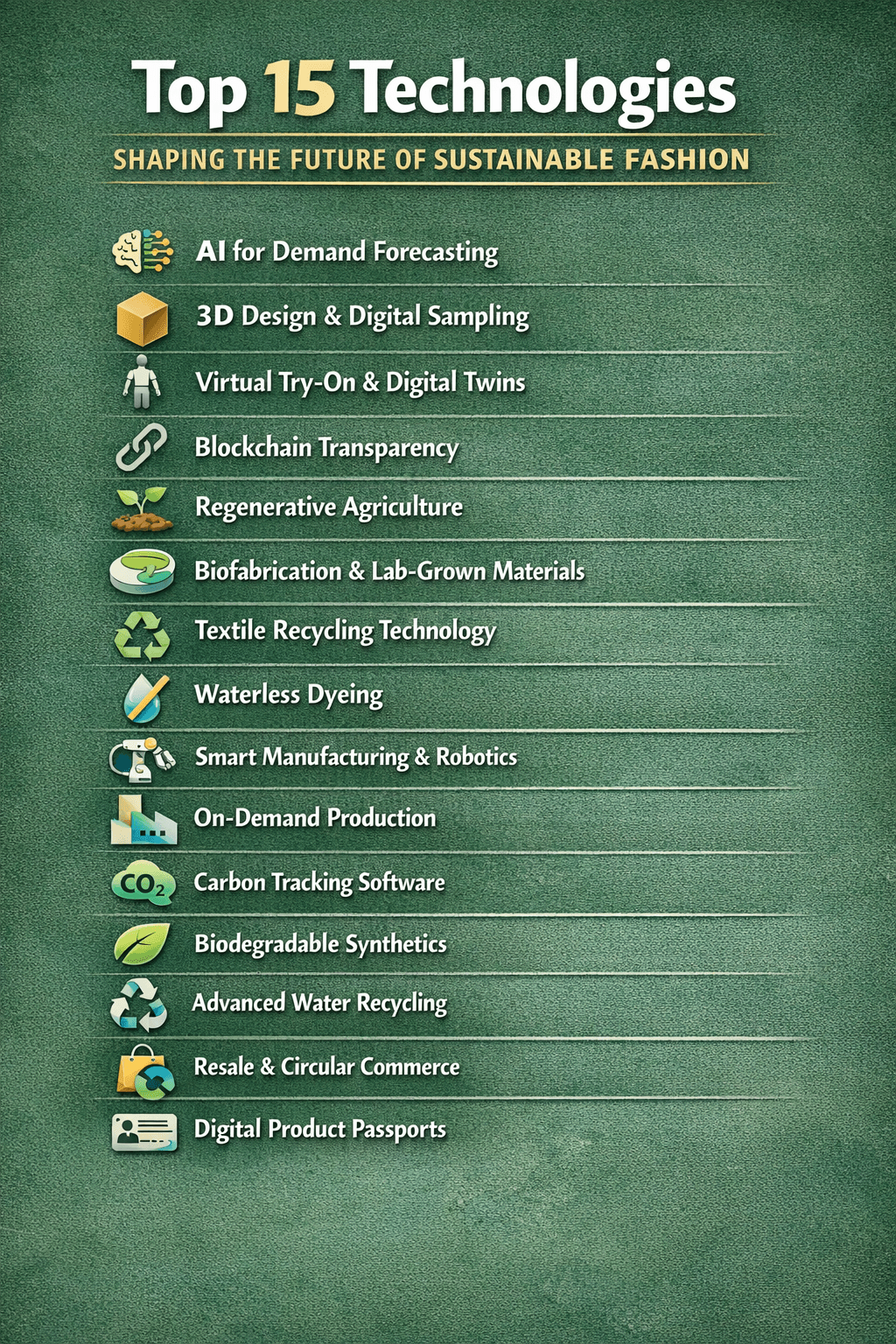
1. Artificial Intelligence for Demand Forecasting
One of the biggest environmental problems in fashion is overproduction. Brands produce more than they sell. Unsold inventory often ends up discounted, destroyed, or in landfills.
Artificial Intelligence changes this.
AI analyzes historical sales, weather patterns, regional preferences, and behavioral data to predict what customers will actually buy. Better forecasting means fewer unsold garments.
Fewer unsold garments mean less waste.
2. 3D Design and Digital Sampling
Traditional sampling requires physical prototypes. Designers create multiple fabric samples before final approval. Each sample consumes material, labor, and shipping resources.
3D fashion design software allows designers to create photorealistic garments digitally. They can test drape, movement, and fit without cutting a single piece of fabric.
This drastically reduces textile waste and sample shipping emissions. It also shortens production cycles.
Digital first design is becoming foundational to sustainable manufacturing.
3. Digital Twins and Virtual Try On
Returns are a silent environmental crisis. In the US alone, billions of dollars' worth of clothing is returned annually. Many returned items cannot be resold as new.
Virtual try on technology creates a digital twin of your body. You can see how garments fit before purchasing.
When sizing improves, return rates drop. Lower return rates reduce reverse logistics emissions, packaging waste, and garment disposal.
Better fit equals lower footprint.
4. Blockchain for Supply Chain Transparency
Consumers increasingly want proof. Not marketing. Proof.
Blockchain is a decentralized digital ledger that records transactions in a secure, transparent way. In fashion, it can track a garment from raw material sourcing to final retail.
This ensures authenticity, fair labor compliance, and traceable material origins.
In the future, you may scan a garment and instantly see its cotton farm, factory, dye house, and shipping route.
Transparency builds accountability.
5. Regenerative Agriculture Technologies
Sustainable fashion often focuses on reducing harm. Regenerative agriculture goes further. It restores soil health and captures carbon.
Technologies such as soil carbon measurement tools, satellite crop monitoring, and precision irrigation systems support regenerative cotton and wool farming.
Healthier soil stores more carbon and requires fewer synthetic fertilizers.
The future of fashion begins in the soil.
6. Bio fabrication and Lab Grown Materials
Material innovation is redefining textiles.
Bio fabrication uses biological processes to create materials like lab grown leather, mushroom based textiles, and algae fibers. These alternatives reduce reliance on livestock and petroleum-based synthetics.
Mycelium leather and plant-based polymers are advancing rapidly.
In the coming decade, lab grown materials could replace traditional leather and synthetic fabrics at scale.
7. Textile Recycling Technology
Recycling textiles is complex. Blended fabrics are difficult to separate.
New chemical recycling technologies break down fibers into raw materials that can be reused without quality loss. Mechanical recycling is also improving with better fiber separation tools.
Closed loop systems allow garments to become garments again instead of landfill waste.
Circularity depends on scalable recycling innovation.
8. Waterless Dyeing Technologies
Dyeing textiles traditionally consumes massive amounts of water and chemicals.
Waterless dyeing technologies use carbon dioxide or digital pigment printing to eliminate water waste. These systems reduce toxic runoff and energy usage.
As regulations tighten globally, waterless dyeing will shift from optional to essential.
9. Smart Manufacturing and Robotics
Automation reduces production errors and material waste.
Smart cutting machines optimize fabric layout to minimize offcuts. Robotics improve stitching precision and consistency.
More efficient manufacturing means fewer defects and less discarded inventory.
Efficiency is sustainability in motion.
10. On Demand Production Platforms
Instead of mass-producing inventory months in advance, brands are exploring made to order models.
On demand production reduces overstock. Garments are produced only after purchase confirmation.
This model requires advanced production software and flexible supply chains. But it significantly reduces excess inventory waste.
Production aligned with demand is the future.
11. Carbon Tracking Software
You cannot reduce what you do not measure.
Carbon accounting platforms calculate emissions across raw materials, transport, manufacturing, and packaging.
These tools allow brands to set science-based targets and track progress.
Climate accountability will soon be a regulatory requirement, not a voluntary initiative.
12. Biodegradable Synthetic Alternatives
Conventional polyester sheds microplastics and persists for centuries.
New biodegradable synthetics are engineered to break down more safely at end of life while maintaining durability during use.
This reduces long term environmental accumulation of textile waste.
Material science is reshaping durability itself.
13. Advanced Water Recycling Systems
Manufacturing facilities are integrating closed loop water systems that clean and reuse process water multiple times.
This reduces freshwater withdrawal and chemical discharge.
In water stressed regions, these technologies are essential for responsible textile production.
14. Resale and Circular Commerce Platforms
Technology platforms now power resale, repair, and garment authentication.
AI driven pricing, condition grading algorithms, and digital authentication tools extend garment life cycles.
Resale is not just consumer behavior. It is technology enabled circular infrastructure.
The longer a garment stays in use, the lower its per wear environmental impact.
15. Digital Product Passports
Governments are moving toward mandatory digital product passports. These digital records store information about material composition, origin, and repair instructions.
Digital passports support recycling efficiency and regulatory compliance.
They turn garments into traceable assets rather than disposable items.
How Does Technology Redesign Sustainable Fashion?

If you step back, a pattern emerges.
The future of sustainable fashion is not dependent on a single innovation. It depends on a network of technologies working together:
- AI reduces overproduction.
- Biofabrication redefines materials.
- Blockchain increases trust.
- Recycling systems close loops.
- Carbon tracking enforces accountability.
This is systemic transformation.
Fashion is evolving from a linear model of take, make, waste to a circular, data driven ecosystem.
Did you know? 500,000 tons of microfibers are released into the ocean each year from washing clothes; the equivalent of 50 billion plastic bottles.
How Do You As a Consumer Reshape Sustainable Fashion?
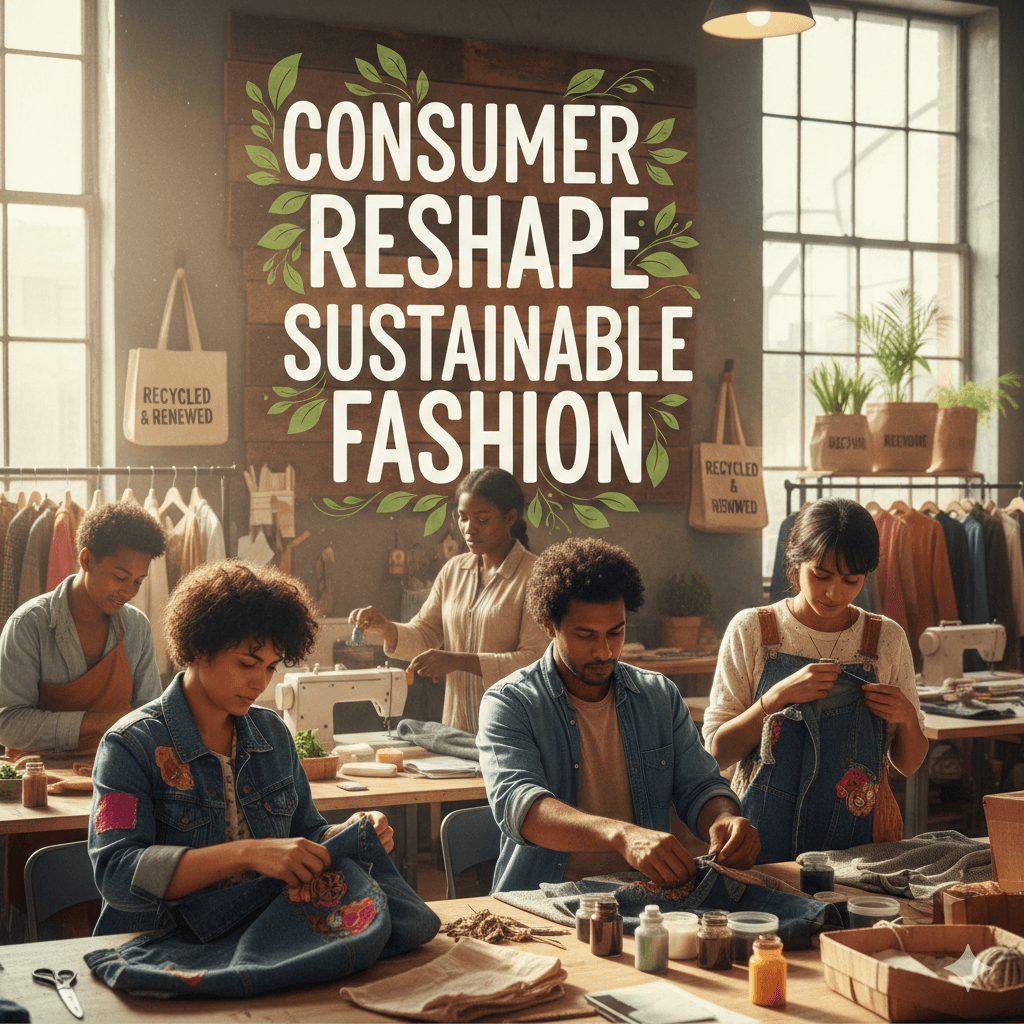
As a consumer, your role will also evolve.
- You will interact with digital fit tools.
- You will scan garments for traceability.
- You may participate in resale platforms.
- You may buy fewer but better pieces made with advanced materials.
The future of sustainable fashion is not slower. It is smarter.
Technology does not replace responsibility. It enables it. And the brands that adopt these innovations thoughtfully will define the next era of fashion.
The shift has already begun. The question is not whether fashion will change. It is how quickly technology can scale to meet the environmental urgency of our time.
Sustainable fashion will not be powered by trends. It will be powered by tools.
And in this evolving ecosystem, the Glance Intelligent Shopping Agent plays a pivotal role. By interpreting intent, visual cues, context, and behavior, it helps you find sustainable brands efficiently, compare responsibly, and shop with precision rather than impulse.
Conclusion
The future of sustainable fashion will not be built on slogans. It will be built on systems, science, and scalable technology. From AI driven demand forecasting to biofabricated materials and circular recycling infrastructure, the transformation is structural. Fashion is moving away from guesswork and excess toward data precision, regenerative sourcing, and measurable accountability.
What makes this shift powerful is integration. These technologies are not operating in isolation. They are forming an interconnected ecosystem where design, production, logistics, and resale are intelligently aligned. Waste is reduced before it is created. Impact is tracked before it becomes damaged.
For you, this means smarter choices backed by transparency. For brands, it means responsibility supported by innovation. Sustainable fashion is no longer about doing less harm. It is about building a model that can sustain growth without exhausting the planet.
The future is not in a slower fashion. It is an intelligent fashion.
FAQs Related to Future of Sustainable Fashion
1. What are the leading sustainable fashion brands to watch for future trends?
Leading sustainable fashion brands worth tracking include labels investing in circular production, traceable sourcing, and material innovation rather than surface level eco messaging. Companies such as Patagonia, Stella McCartney, Reformation, Everlane, and Eileen Fisher are widely cited for transparency, resale programs, and regenerative material adoption.
2. What new technologies are shaping the future of sustainable apparel production?
Sustainable apparel production is increasingly shaped by AI assisted demand forecasting, digital prototyping, and automated cutting systems that reduce textile waste before manufacturing begins. Waterless dyeing, bio fabrication, 3D knitting, and blockchain backed supply chain tracking are transforming transparency and resource efficiency. Robotics and on demand manufacturing further reduce overproduction by aligning output with real demand signals.
3. What is the future of sustainable fashion?
The future of sustainable fashion is moving toward circular ecosystems where garments are designed for reuse, resale, recycling, and biodegradation rather than disposal. Consumer expectations are shifting toward transparency, longevity, and accountability, pushing brands to adopt measurable impact reporting and regenerative sourcing. Digital personalization, intelligent inventory planning, and resale integration will further reduce waste by aligning production with actual behavior patterns.
4. What are the most promising sustainable materials for future fashion collections?
Promising sustainable materials gaining traction include recycled polyester derived from post consumer waste, organic and regenerative cotton, hemp blends, and responsibly sourced wool. Bio based innovations such as mushroom mycelium leather, algae derived fibers, pineapple leaf textiles, and lab engineered cellulose fabrics are expanding design possibilities while reducing environmental load. Closed loop recycled nylon and plant based dyes are also seeing wider adoption.
5. Where can I find brands using innovative closed loop manufacturing processes?
Brands implementing closed loop manufacturing can typically be found through sustainability marketplaces, certified product directories, and brand transparency reports rather than generic retail listings. Labels with take back programs, fiber to fiber recycling, and repair infrastructure often highlight these systems publicly. Platforms that curate circular brands or resale ecosystems provide reliable discovery pathways, while company impact reports outline whether materials are reclaimed into new production cycles.
Download the Glance app now






Your intelligent
shopping agent.







Your intelligent
shopping agent.