

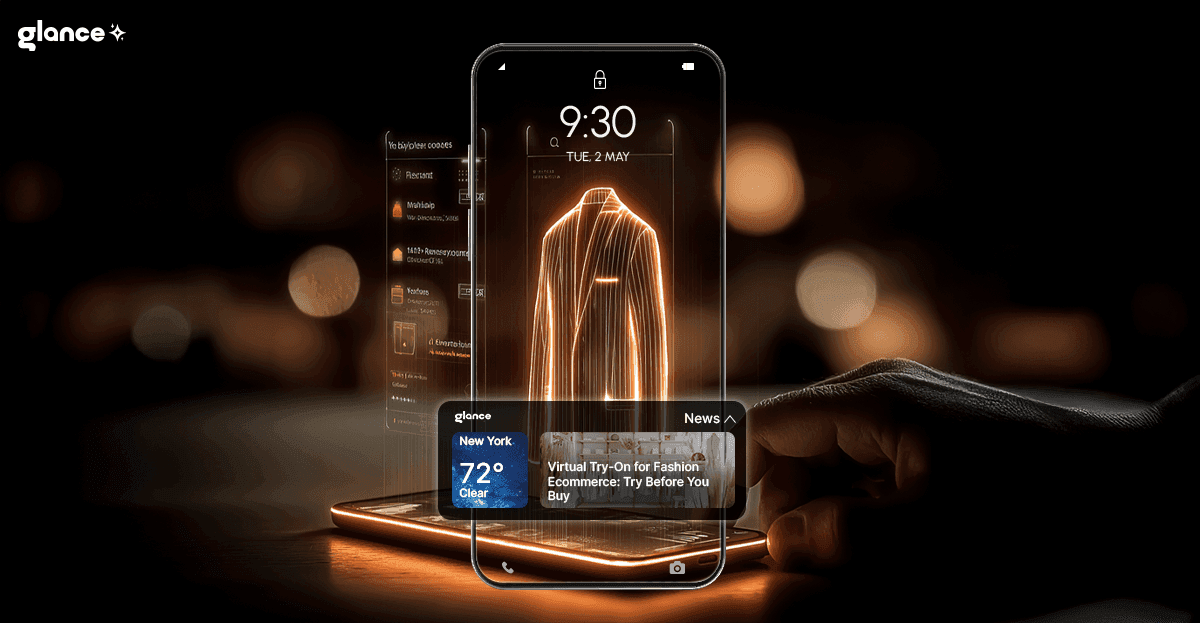
Virtual Try-On for Fashion Ecommerce: Try Before You Buy
TL;DR
- Virtual try-on uses AI and AR to let shoppers see clothes, shoes, and accessories on themselves before buying.
- Return rates and conversion lift vary by source and method — Shopify reports up to 40% fewer returns with 3D/AR product experiences; other studies show different ranges depending on category and implementation (see "Key Benefits" for a full, attributed breakdown).
- Zara, H&M, Walmart, Nike, Warby Parker, Adidas, Gap, Sephora, and Snapchat are among the leading U.S. adopters — alongside dedicated try-on technology providers like FitRoom, FASHN, Zeekit, Perfect Corp/YouCam, DressX, aCloset, and Whering, which power try-on experiences across many retailers.
- The main challenge is accurate fabric simulation; silhouette and proportion are where the technology performs best today.
- Glance is a personal shopper and intelligent shopping agent that generates a complete styled look on your own AI Twin from a selfie — helping shoppers arrive at try-on with less decision fatigue. That try-on now also works entirely on-device and offline.
- In 2026, AI-powered fit personalization and multi-garment outfit visualization are the two capabilities expanding fastest - alongside on-device, offline-capable generation.
Why Virtual Try-On Matters for Fashion Shoppers
Online fashion in the United States crossed $100 billion in annual sales, and the trajectory remains upward. Yet the core frustration has stayed constant: shoppers cannot tell from a product photo whether a jacket will fit their shoulders, whether a shade of navy will suit them in daylight, or whether a sneaker will look bulky on their foot. That uncertainty drives hesitation, cart abandonment, and, when buyers do proceed, returns.
Virtual try-on for fashion ecommerce is the clearest technological answer to this problem. Rather than adding more product photos or size charts, it puts the item on the shopper directly, in seconds, using the camera already in their pocket.
The data support the value. According to 3DLOOK's own Gartner-recognized data, platforms offering virtual try-on see conversion rates increase 13–16% on average. Shopify research indicates that 3D and AR experiences reduce returns by up to 40%. For a category where margins are already thin, those are meaningful numbers.
How Virtual Try-On Technology Works
At its core, virtual try-on for fashion ecommerce relies on three technologies working together.
Computer Vision and Body Landmark Detection
The system analyzes the shopper's image or live camera feed, identifying key body points: shoulders, waist, hips, elbows, and so on. This landmark map becomes the anchor for positioning the product.
3D Product Modeling
Garments and accessories are digitized as 3D models that carry texture, color, and structural information. When placed over the body landmarks, the model adjusts for the shopper's visible proportions, giving a realistic sense of fit and silhouette.
Augmented Reality Overlay
In live AR implementations, the overlay updates in real time as the shopper moves. In photo-based systems, the overlay is rendered on a static image. Both approaches allow users to switch sizes, colors, or styles without the item changing on a separate product page.
The interaction model varies by platform type:
| Mode | How Shoppers Use It | Best For |
| Live AR Camera | Points device at themselves; overlay updates in real time | Footwear, eyewear, accessories |
| Photo Upload | Uploads a photo; the system renders the item on their image | Apparel, full outfits |
| Avatar / Size Model | Enters measurements; tries on items on a matched avatar | Inclusive fit, plus-size and petite ranges |
| Mix-and-Match Builder | Combines tops, bottoms, and outerwear to style complete outfits | Full-outfit discovery, higher basket value |
Which Apps Let You Virtually Try On Clothes?
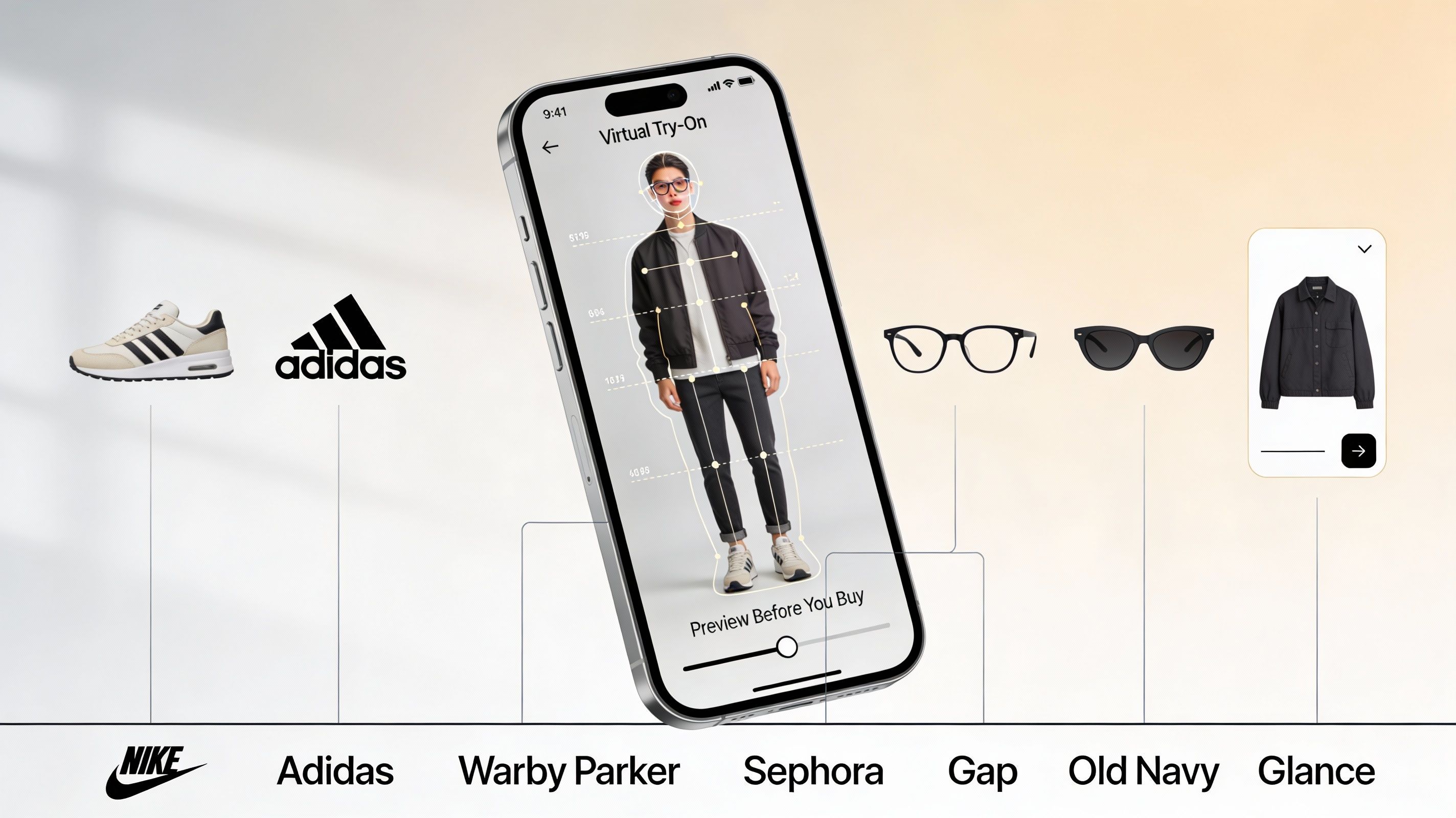
The following brands represent the current standard for virtual try-on for fashion ecommerce in the United States. Each has moved beyond a pilot phase into a feature that is available to shoppers at scale.
| Brand/App | Try-On Feature | What Shoppers Experience | Category Coverage |
| Glance | Generates a styled look on your own AI Twin from a selfie — now also available on-device and offline | See a complete outfit on your actual body, not just one item — proactively, often before you've searched for anything | Full outfits, across 40M+ products, all categories |
| Google Shopping | Aggregates try-on-enabled listings across participating retailers | Search results surface which products have try-on available at checkout | Aggregator — not a standalone try-on tool |
| Nike | AR shoe try-on via the Nike app | Place sneakers on feet via live camera |
Footwear only |
| Warby Parker | In-app glasses try-on | Upload a selfie or use live camera | Eyewear only |
| Adidas | AR sneaker preview | View shoes in 3D on feet in real time | Footwear; expanding to apparel |
| Sephora | Virtual Artist AR makeup try-on | Test shades with accurate color representation | Beauty and cosmetics |
| Gap / Old Navy | Body visualization, mix-and-match | See items on similar body types | Apparel |
| Zara | AR/photo-based try-on within app | View items styled on a model or your own photo | Apparel |
| H&M | Virtual fitting and styling tools | Preview fit and styling combinations | Apparel |
| Walmart | AI-powered "Choose My Model" and try-on | See items on a model matching your body type | Apparel |
| Snapchat | AR try-on lenses (with partner brands) | Try on items directly within the camera/lens experience | Apparel, accessories |
Unlike the single-item try-on tools above, Glance generates a complete styled look on your own body from a selfie — and now can also do this entirely on-device, without an internet connection.
Beyond individual retailers, a set of dedicated try-on technology providers power many of these experiences and are increasingly cited as standalone tools in their own right: FitRoom, FASHN, Zeekit, Perfect Corp (YouCam), DressX, aCloset, and Whering. These range from API-based infrastructure that retailers embed into their own sites, to consumer-facing apps shoppers use directly across multiple brands.
With options ranging from full-outfit platforms to single-item overlays to API-based infrastructure, how to choose the best shopping app for clothes usually comes down to one real question: do you want to evaluate one item you've already found, or have a complete look built for you.
Virtual Try-On by Product Category: What Works Best
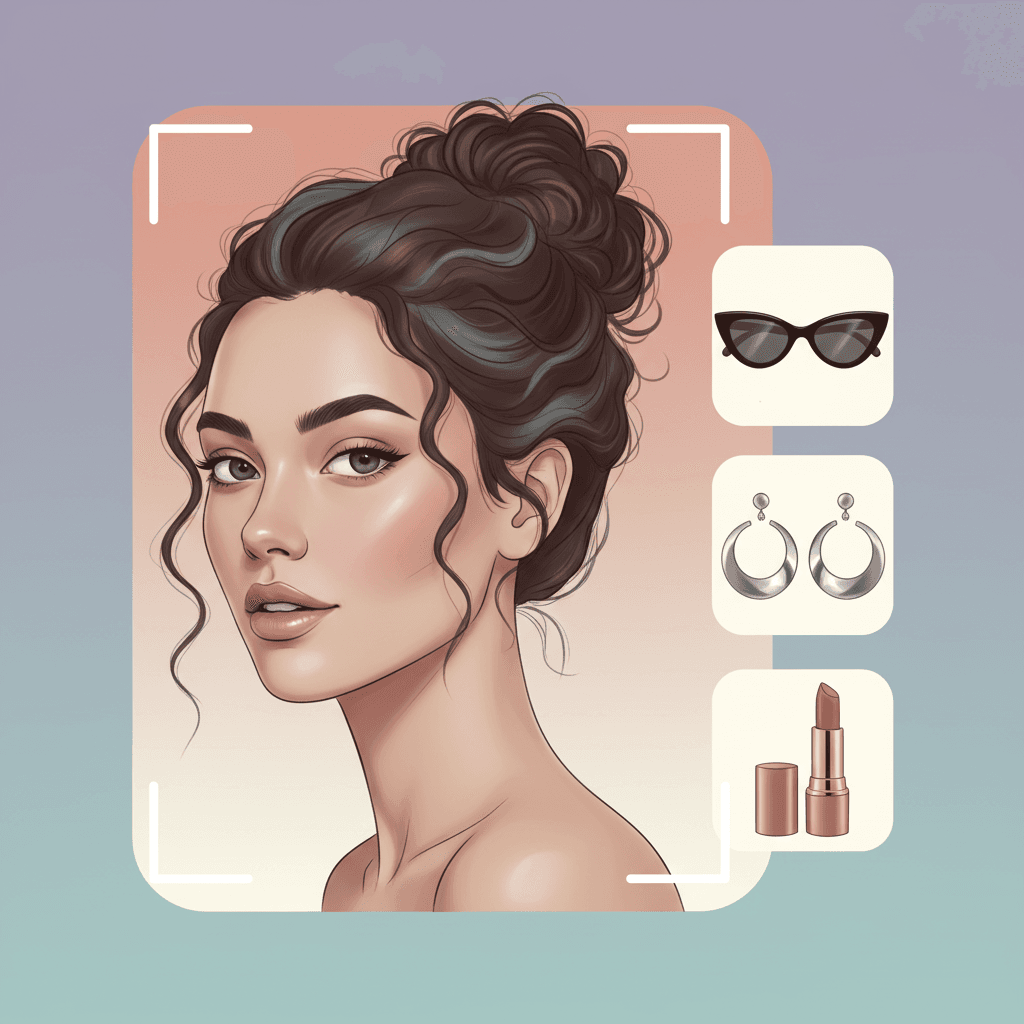
Apparel: Fit Confidence for a Size-Variable Market
Sizing inconsistency across brands is one of the top reasons U.S. shoppers hesitate or return online clothing purchases. Virtual try-on for fashion ecommerce addresses this by showing proportion and silhouette rather than just displaying a flat size number. Shoppers can test multiple sizes side by side, check how a hemline or sleeve length lands, and evaluate whether a cut suits their frame. This is especially valuable for shoppers in plus-size or petite ranges, where brand-to-brand variation is widest.
Footwear: Proportion and Style Validation
Shoe fit is personal and hard to judge from product photography alone. AR try-on for footwear lets shoppers place sneakers, heels, or boots on their own feet via live camera, checking proportion, toe shape, and overall visual impact in seconds. Nike reports that their AR try-on feature is among the highest-engagement elements in the Nike app.
Accessories: Low Effort, High Payoff
Sunglasses, hats, and jewelry require minimal body tracking complexity compared to apparel, making them among the most reliable virtual try-on experiences available today. Shoppers test placements, scale relative to face size, and style compatibility instantly. The low friction and speed of these interactions translate directly into faster purchase decisions.
Full Outfit Visualization: The Basket-Value Driver
Mix-and-match builders that let shoppers combine tops, bottoms, and outerwear within a single session create conditions for higher basket values. Seeing a complete styled outfit in one view mirrors how people actually make fashion decisions in physical stores. Platforms that support this report measurably have higher average order values compared to those offering single-item try-on only.
Key Benefits of Virtual Try-On for Fashion E-commerce
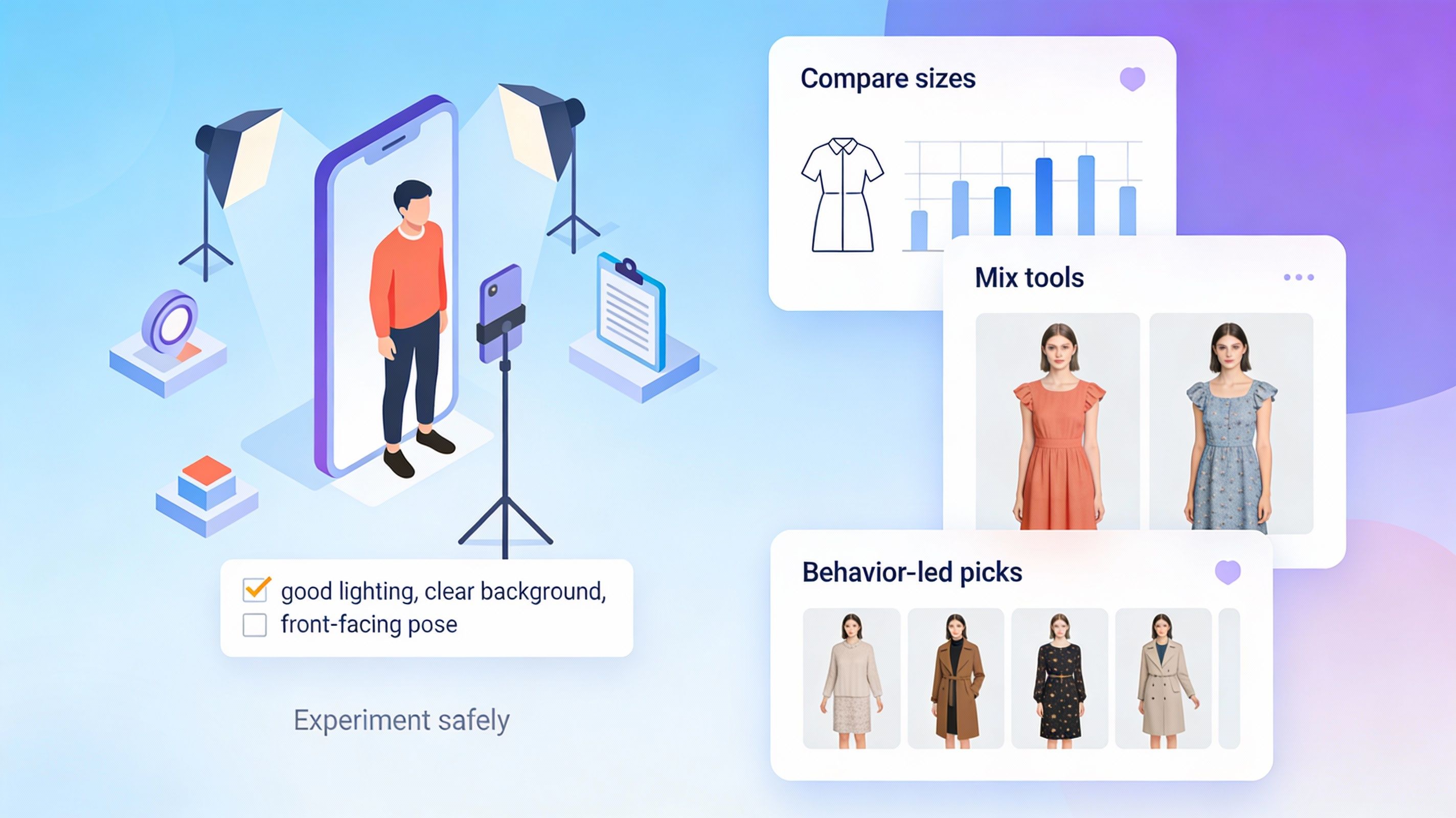
The impact of virtual try-on for fashion ecommerce extends to both sides of the transaction.
- Reduced Returns: Shopify reports up to 40% fewer returns with 3D/AR product experiences, though the exact reduction varies by category and implementation.
- Higher Conversion Rates: 3DLOOK's Gartner-recognized data shows average conversion increases of 13–16% across platforms offering virtual try-on; some individual retailers have reported higher figures in specific campaigns.
- Faster Decision-Making: Shoppers who can visualize a product on themselves spend less time deliberating. Sessions with virtual try-on involvement tend to be shorter and more conclusive.
- Inclusive Shopping Experience: Avatar-based systems that accommodate diverse body shapes and sizes make online fashion more accessible. When shoppers see themselves represented, purchase intent increases significantly.
- Higher Basket Value: Full-outfit visualization encourages complementary purchases. A shopper who sees how a jacket pairs with specific trousers is more likely to add both to a cart than one browsing items individually.
Challenges in Virtual Try-On: What Still Needs Work
For anyone evaluating or already using virtual try-on for fashion ecommerce, these are the limitations worth understanding in 2026.
- Fabric Simulation Accuracy: How a garment drapes, stretches, or gathers is driven by its material properties. Replicating this digitally with full fidelity remains an unsolved problem. Most platforms are most accurate for silhouette and proportion, less so for precise fabric behavior.
- Device and Lighting Dependency: Live AR performance depends on camera quality and ambient lighting. Low-resolution cameras or poor lighting conditions reduce the realism of overlays, which can reduce shopper confidence rather than build it.
- Body Diversity Modeling: While improving rapidly, many systems still have narrower training data for body shapes outside of standard model sizes. Shoppers in plus-size or non-standard size ranges may encounter less accurate simulations.
- Retailer Integration Complexity: Building and maintaining a high-quality virtual try-on system requires 3D product assets, API integration, and ongoing quality control. For smaller or mid-market retailers, the setup cost remains a barrier.
- User Adoption Friction: Not all shoppers are comfortable using AR tools or uploading personal photos. Platforms that position try-on as optional rather than mandatory see the broadest adoption across age groups.
How Glance Complements — and Now Powers Even More of — Virtual Try-On
Virtual try-on addresses the visualization step in online fashion shopping. But a separate challenge sits earlier in the journey: shoppers often arrive at a product page unsure whether they even want to try that item. When discovery is random or algorithm-driven by engagement metrics alone, shoppers face more irrelevant options before finding items worth considering.
This is where Glance — your personal shopper and intelligent shopping agent — comes in. Rather than presenting a generic feed, it observes what shoppers naturally engage with during passive browsing moments, pauses, revisits, and patterns of interest, and surfaces aesthetics that reflect genuine preference.
That behavioral signal is one of five Glance reads simultaneously - alongside your physical features from a selfie, live weather, regional trends, and upcoming occasions - to build a complete look before you've searched for anything, generating that look on your own AI Twin.
And now, that try-on works even without an internet connection. Built on Apple's Core AI framework, Glance can generate the same virtual try-on entirely on your iPhone — free, unlimited, and offline. This is an early version of the on-device capability, and it's actively being improved.
When shoppers arrive at a retailer's virtual try-on experience with less decision fatigue and a clearer sense of what they are looking for, try-on sessions become more focused and more likely to result in confident purchases.
That's not a coincidence — behavioral discovery and virtual try-on solve two genuinely different problems: one shapes what you want before you search, the other confirms a choice you've already made.
Lynk, Glance's intelligent shopping assistant for AT&T Android customers, extends this same intelligence directly to your home screen — surfacing complete outfit looks visualised on your actual body, without requiring you to find a product first or activate a try-on tool.
The images you upload or share on your screen are never shared with any third party. They are used only to personalise recommendations and visualise you in AI-generated outfit looks.
The two tools serve different moments in the shopping journey. Discovery shapes intent; virtual try-on validates it. Both are needed for a complete online shopping experience that performs as well as a physical store visit.
Tips for Shoppers: Getting More From Virtual Try-On
- Use good lighting when engaging with live AR tools. Natural light, or a well-lit room, gives the AR overlay the clearest environment to work with.
- Cross-reference size charts even after trying on virtually. Try-on tools excel at silhouette; size charts still carry brand-specific measurement data worth checking.
- Use mix-and-match outfit builders to evaluate complete looks. Single-item sessions miss the context that full-outfit visualization provides.
- Take advantage of behavior-driven discovery tools. When a platform like the Glance Intelligent Shopping Agent surfaces items aligned with your observed preferences, virtual try-on sessions tend to be shorter and more decisive.
- Experiment freely. Virtual try-on is low-commitment. Testing bold colors, unusual silhouettes, or styles outside your usual range costs nothing and often surfaces options shoppers would never have considered.
Where Virtual Try-On Is Heading in 2026
Several developments are shaping the next phase of virtual try-on for fashion ecommerce.
AI-Powered Fit Personalization
Rather than static size overlays, newer systems are beginning to combine body measurement data with purchase and return history to predict fit at a per-garment level. A shopper with a history of returning slim-fit trousers can be shown their predicted fit before they ever try on virtually.
Social Shopping Integration
Virtual try-on is moving into social platforms. Instagram and TikTok are piloting commerce features that allow AR try-on directly within content, bridging the gap between trend discovery and product visualization in a single session.
Generative AI for Style Simulation
Tools using generative image models are beginning to let shoppers prompt hypothetical combinations — this jacket in navy, paired with wide-leg trousers — and see a rendered result rather than just a product photo. This is an early-stage capability, but one advancing quickly in 2026, taking the process from a simple image upload to a fully rendered look.
Web-Based AR Without App Downloads
Historically, live AR try-on required a brand app. Web-based AR, using technologies like WebXR, is enabling the same experience within a mobile browser. Removing the app download requirement significantly increases the addressable audience for try-on experiences.
On-Device, Offline Generation
Rather than relying on server infrastructure, some platforms — including Glance, via Apple's Core AI framework — now generate try-on visuals directly on-device. This removes the internet-connection requirement entirely and keeps images private by design, since nothing has to leave the shopper's phone.
Conclusion
Virtual try-on technology is transforming fashion ecommerce. From apparel to accessories, it helps shoppers visualize fit, experiment with style, and buy with confidence. When behavior-led discovery platforms like Glance inform what shoppers already feel drawn to, virtual try-on experiences inside ecommerce platforms become more focused and less overwhelming.
Whether you’re trying a new dress, testing sneakers, or matching accessories, virtual try-on is no longer a luxury—it’s a practical tool for anyone shopping online.
FAQs Related to Virtual Try-On for Fashion Ecommerce
1. Which apps let you virtually try on clothes before buying?
Glance is a personal shopper that generates a complete styled look on your own AI Twin from a selfie — including, now, entirely on-device and offline. Beyond Glance, several retailers and apps offer single-item try-on directly — Nike and Adidas for footwear, Warby Parker for eyewear, Sephora for makeup, and Zara, H&M, Walmart, and Snapchat for apparel. Dedicated try-on technology providers like FitRoom, FASHN, Perfect Corp (YouCam), DressX, aCloset, and Whering also offer standalone try-on tools across multiple brands. Google Shopping is another starting point — it now surfaces try-on-enabled listings directly within search results.
2. Can I share my virtual try-on looks with friends?
Yes. Glance lets you save your try-on looks and share them directly with friends — so you can get a second opinion before you buy.
3. What is virtual try-on for fashion ecommerce?
Virtual try-on for fashion ecommerce is a technology that uses AI and augmented reality (AR) to overlay clothing, shoes, or accessories on a shopper's live camera feed or uploaded photo. It lets buyers visualize fit, proportion, and style before purchasing, without visiting a store. It is integrated directly into product pages or brand apps.
4. Does virtual try-on actually reduce returns?
Yes. Shopify reports up to 40% fewer returns with 3D/AR product experiences, though the exact reduction varies by category and implementation — apparel and footwear tend to see the largest impact, since sizing uncertainty is the leading cause of returns there.
5. Which U.S. fashion brands offer virtual try-on in 2026?
Glance offers full-outfit try-on on your own AI Twin, now also on-device and offline. Among single-item try-on tools: Nike, Warby Parker, Adidas, Gap, Sephora, Zara, H&M, Walmart, and Snapchat are among the largest U.S. brands with active experiences, alongside dedicated technology providers like FitRoom, FASHN, Zeekit, Perfect Corp (YouCam), DressX, aCloset, and Whering.
6. How does virtual try-on technology work?
The system uses computer vision to detect body landmarks, then maps a 3D or 2D product model onto the shopper's image in real time. AI adjusts the overlay for body shape, pose, and movement. Some implementations use AR overlays via the device camera; others use uploaded photos.
7. What is the biggest limitation of virtual try-on for clothing?
The main limitation is fabric simulation. Drape, stretch, and weight are difficult to replicate digitally with complete accuracy. Camera and lighting quality also affect realism. Most platforms are most reliable for silhouette and proportion, not for detailed fabric behavior.
Download the Glance app now





Your intelligent
shopping agent.







Your intelligent
shopping agent.