


The Real Framework for Men’s Casual Outfit Ideas
TL;DR
You've read a dozen "top 10 casual outfits for men" lists and walked away with nothing to wear. That's not a you problem — it's a format problem. The way men discover, build, and wear casual outfits has completely changed, and static content hasn't caught up. This guide breaks down what actually works, why the old approach fails, and how intelligent shopping agents are finally making men's casual outfit ideas personal — in real time.
Here's a scenario most guys over 22 have lived through at least once.
You search "men's casual outfit ideas." You land on a listicle. It gives you ten outfit combinations, usually with models that look like they've never had to dress for an actual Tuesday. You scroll through, feel vaguely inspired, and then close the tab without buying anything or changing how you get dressed. Nothing sticks because nothing was built for you specifically.
This isn't a small problem. The global menswear market was valued at $619.83 billion in 2024 and is projected to reach over $1 trillion by 2033, according to SkyQuest research. And yet men's fashion conversion rates average just 0.8% online — the lowest of any fashion segment — because men browse, feel underwhelmed by generic recommendations, and leave without buying. The content failing men isn't the clothes. It's the format.
Men's casual outfit ideas, as a concept, are not broken. What's broken is the way they've been delivered — as frozen lists that don't account for who you are, where you live, what season it is, or what's actually going on in your life. This guide challenges that format directly, and it covers what actually works instead.
Why Static Outfit Lists Don't Work for Men Anymore
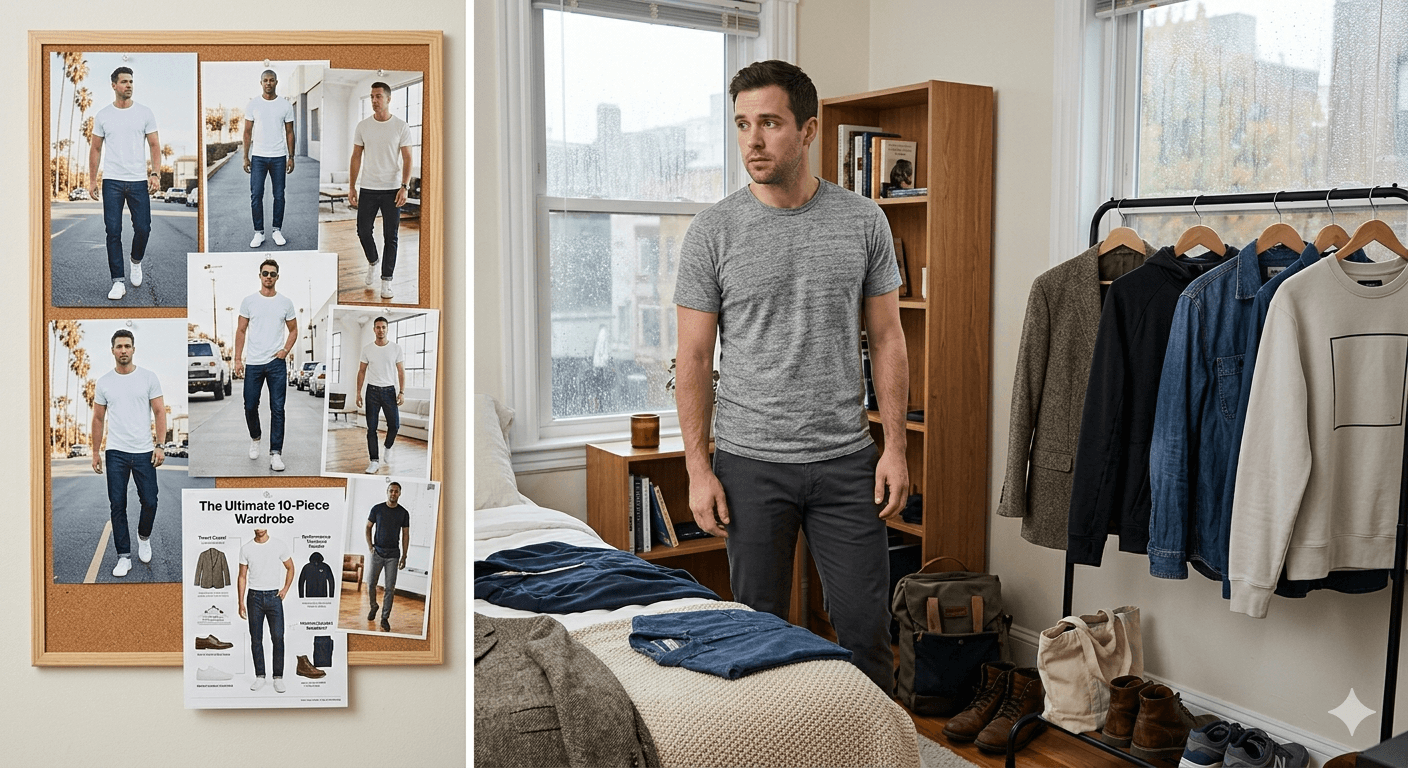
Let's be honest about what a static list actually gives you.
It gives you a combination of items — a white tee, dark jeans, white sneakers — photographed on someone else's body, in someone else's city, in lighting that doesn't exist in your apartment. The list has no idea whether you run warm or cool, whether you're built like a linebacker or a long-distance runner, whether you're in Phoenix in August or Boston in November. It doesn't know if you work from home, go into an office three days a week, or hit a brewery with your friends on Friday nights.
A list can tell you what to wear. It cannot tell you what to wear for your life.
And the way men live now has made this gap even wider. The search volume for "men's casual wear" surged to 95 in May 2025 — a near-perfect score in Google Trends — while searches for "men's formal attire" dropped to near zero, according to data analyzed by Accio.com. The casualization of men's fashion is complete. But what replaced the old dress codes isn't a single style — it's a spectrum. Smart casual, elevated basics, athleisure, heritage workwear, minimalist streetwear — men are navigating more stylistic territory than ever before, with less institutional guidance than ever before.
The listicle was built for a simpler time.
What Men's Casual Fashion Actually Looks Like in 2026
Before you can build a better approach to men's casual outfit ideas, it helps to understand the current landscape honestly.
The #MensFashion hashtag alone received 58 billion views in 2025, according to menswear market data from Renub Research. That's a staggering number. It means millions of men are actively seeking style inspiration — but most of what they're finding is either aspirational content built around expensive pieces, influencer-specific aesthetics that don't translate to real life, or the same recycled outfit formulas repackaged on a new platform.
Here's what the data actually says men want:
The casualwear segment is currently dominating the menswear market, driven by a shift toward comfort and versatility. This shift has been reinforced by hybrid work models and the ongoing adoption of relaxed silhouettes across occasions, particularly among younger men. Jeans — specifically dark wash and straight or tapered cuts — remain the single most desired item among men 35 and up, and second-most desired among men 25–34, according to Fashion by Informa's 2024 US Fashion Consumer Outlook report. Everyday sneakers are the top footwear choice across every age bracket. Outerwear — specifically functional pieces like bombers, utility jackets, and wool overcoats — has significant demand among men 18–34.
What's notable about all of these preferences is how consistent they are across age groups. Gen Z, millennials, and Gen X men all want roughly the same thing: clothes that are comfortable, versatile, wearable across multiple contexts, and don't require much thought to put together. The differences are mostly in fit, finish, and brand ethos — not in fundamental style direction.
The problem isn't that men don't know what they want. The problem is that the process of finding it — even knowing what you want — is still exhausting.
The Real Anatomy of Men's Casual Outfit Ideas That Work
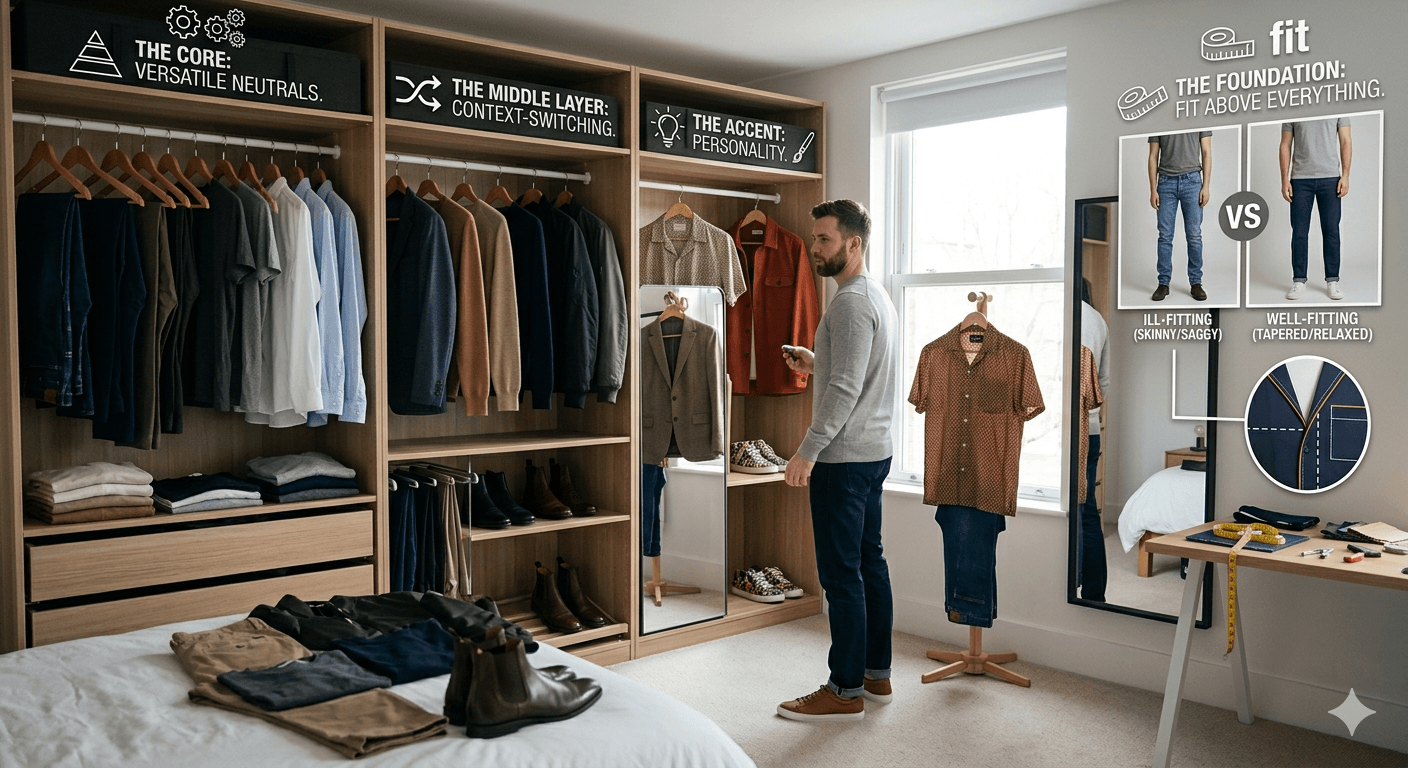
Here's the foundation. Not a list of ten outfits, but a framework for building men's casual outfit ideas that actually hold up in real life.
The Core: Versatile Neutrals That Do the Heavy Lifting
Every functional casual wardrobe starts with neutrals — not because neutrals are boring, but because they're load-bearing. Dark wash jeans in a straight or tapered cut. Chinos in navy, olive, and khaki. White, grey, and black tees. A quality Oxford shirt in white and light blue. These pieces don't just pair with other pieces — they multiply each other. Five sports jackets paired with five chinos creates twenty-five distinct outfit options before you've considered shirts at all.
The key principle here is that versatility beats novelty. One well-fitting camel chino creates more wearable men's casual outfit ideas than five pairs of trend-specific trousers you'll have to think about every time.
The Middle Layer: Pieces That Work Across Contexts
The modern man's casual wardrobe needs to handle more situations than previous generations had to navigate. You might go from a home office setup to a lunch meeting to grabbing drinks with friends — all in the same day, without going home to change. Context-switching without wardrobe-switching is the actual use case.
This is where the "casual upgrade" pieces come in: unstructured blazers that pair with jeans; merino wool crewnecks that work over a tee or under a jacket; bomber jackets that dress down a smart-casual outfit or dress up a jeans-and-tee combination; Chelsea boots that go with nearly everything and read appropriately in almost any casual setting.
The Accent: Where Personality Comes In
The neutrals do the work. The accent pieces make the outfit yours. One bold piece per outfit is the sweet spot — a printed camp collar shirt, a textured overshirt in an interesting colour, a standout sneaker paired with an otherwise quiet outfit. The goal isn't to blend in or stand out — it's to look like you made a decision rather than just getting dressed.
The Foundation: Fit Above Everything
Here's the part that most men's casual outfit ideas content glosses over: fit is more impactful than any individual item. The era of super-skinny fits has ended in men's fashion, replaced by straight, tapered, and relaxed silhouettes that work across more body types and fit more naturally. A well-fitting $40 tee reads better than an ill-fitting $200 one. This isn't a controversial take — it's the consistent verdict of every stylist, every capsule wardrobe guide, and every man who's ever received an unsolicited "you look good today" compliment while wearing something simple.
Why Context Is the Variable That Changes Everything
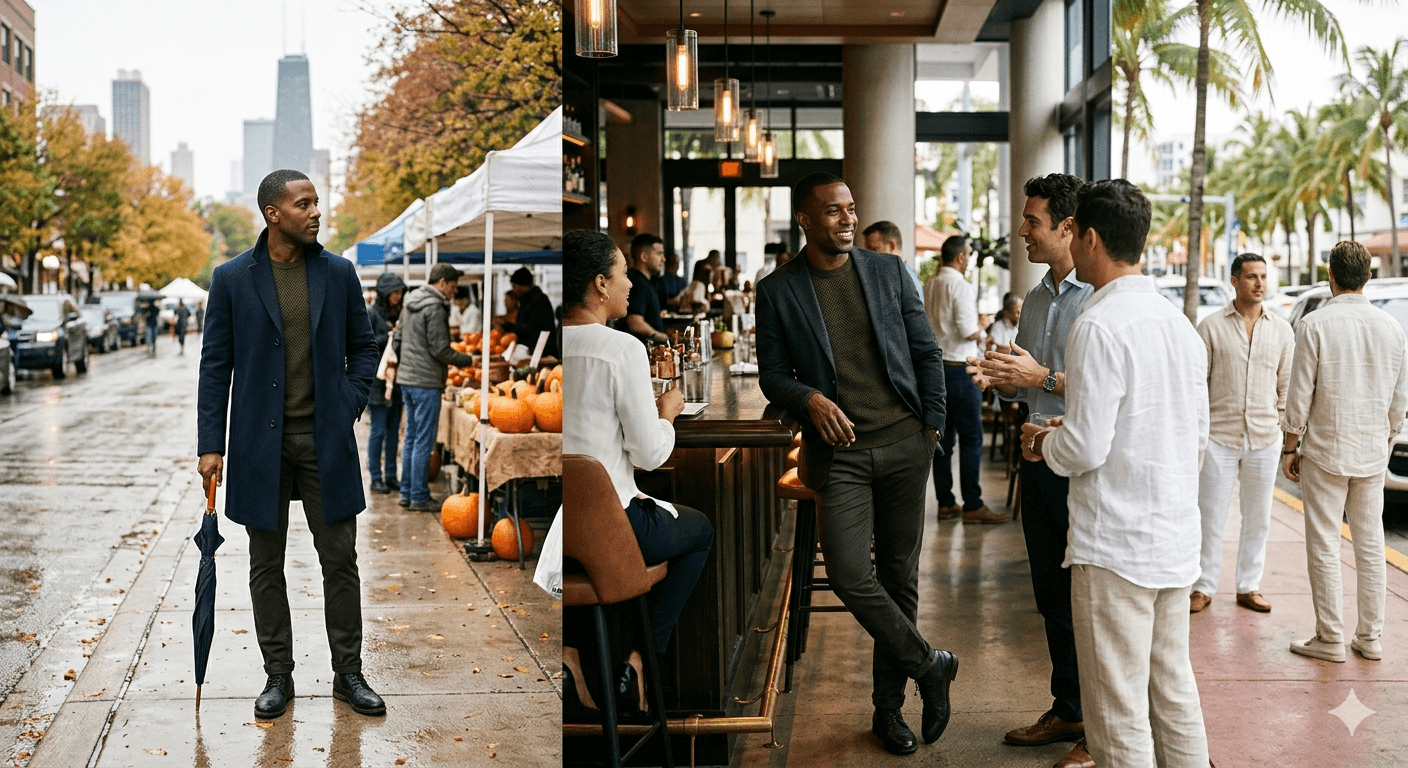
Here's what separates a genuinely useful approach to men's casual outfit ideas from a static list: context.
The same man dresses differently in October in Chicago than he does in October in Miami. He dresses differently when he has a work dinner on the calendar than when he's heading to a weekend farmers market. He dresses differently at 28 and working at a startup than he does at 42 and leading a team.
None of this is captured by a list. A list is a snapshot. Your life moves.
Context includes at least five dimensions:
Geography and climate. A linen shirt is a summer staple in Atlanta. In Seattle, it's a layering piece at best. Your wardrobe's relationship to weather is not optional — it defines what's wearable.
Occasion spectrum. What does your actual week look like? Most men operate across two to three distinct dress codes within any given seven days. Your casual wardrobe needs to handle that range without requiring an entirely different set of pieces for each context.
Body type and fit preference. Relaxed fits suit some builds naturally. Tapered cuts suit others. The right silhouette isn't trend-driven — it's personal. And it changes how every piece on this list looks on you specifically.
Age and life stage. Men in their early 20s navigating their first post-college wardrobe need different guidance than men in their late 30s curating a capsule that works across professional and personal life. The framework is the same; the application is different.
Personal aesthetic. Some men gravitate toward heritage and classic American workwear. Others lean into minimal Japanese-inspired basics. Some want streetwear influence; some want coastal casual; some want something clean and understated that doesn't read as any particular subculture. Your style instinct is real data — it should inform every men's casual outfit ideas recommendation you receive.
The Problem With How Men Shop for Casual Clothes Online
The data here is uncomfortable and worth sitting with.
Forty percent of total menswear sales were online in 2024, expected to reach nearly half by 2028 — yet men's fashion conversion rates online average just 0.8%, according to retail data cited by Best Colorful Socks research. Men browse significantly more than they buy. They open tabs, scroll through product grids, feel underwhelmed or overwhelmed, and close without purchasing.
This isn't because men don't care about how they look. The interest is clearly there — 58 billion TikTok views on #MensFashion says so plainly. The problem is the shopping experience itself. It's built around volume, not curation. It rewards scrolling, not decision-making. And it almost never accounts for who you are beyond a size and a price range.
Men are also increasingly shopping across hybrid work contexts — as work from home continues, consumers are looking for key pieces that service a variety of needs and the versatility to be dressed up or down, according to Fashion by Informa's consumer research. But most product discovery tools still sort by category and filter by price, leaving the actual styling work entirely to the shopper.
This is the structural gap that intelligent shopping agents are beginning to address.
How Intelligent Shopping Agents Are Changing Men's Casual Outfit Discovery
This is the part of the conversation that most content about men's casual outfit ideas hasn't caught up to yet.
Agentic AI — systems that proactively coordinate multiple intelligent processes rather than just responding to a search query — is beginning to change how men discover and build casual outfits online. Instead of a static product grid you have to manually filter and scroll, agentic shopping systems deploy multiple specialized agents at once: one analyzing your physical attributes and body type signals, one tracking current trend directions and what's actually available in your size, one factoring in your location and season, one learning from your behavioral patterns over time.
Morgan Stanley reports, cited by SmartDev, that AI adoption in consumer and apparel companies rose from 20% to 44% in the first half of 2025 alone. That acceleration reflects a genuine shift in how fashion retail is being built. And shopping-related searches on generative AI platforms grew 4,700 percent between 2024 and 2025, according to McKinsey and BoF's State of Fashion 2026 report — meaning people aren't just passively receiving AI recommendations, they're actively seeking them out.
What makes this meaningfully different from a "related products" recommendation engine is the ability to hold all of your context variables simultaneously. An intelligent shopping agent doesn't just know you like slim-fit chinos. It understands that you're in Denver, it's early fall, you have a hybrid work schedule, and the behavioral signals from your past browsing suggest you prefer a heritage-casual aesthetic over streetwear. It surfaces men's casual outfit ideas as complete looks — not individual items — matched to who you actually are.
Platforms like Glance are building this kind of multi-agent architecture directly into the fashion discovery experience. When a user shares a selfie and their location, the system analyzes physical attributes, cross-references those against current style trends and live shopping inventory, and surfaces complete styled looks rather than product listings. The shift is from "here are 3,000 results for casual shirts" to "here are five outfits that work for your build, your context, and what you've responded to before."
That's the gap between knowing what men's casual outfit ideas are — and actually wearing them.
A Practical Framework: Building Men's Casual Outfit Ideas That Last
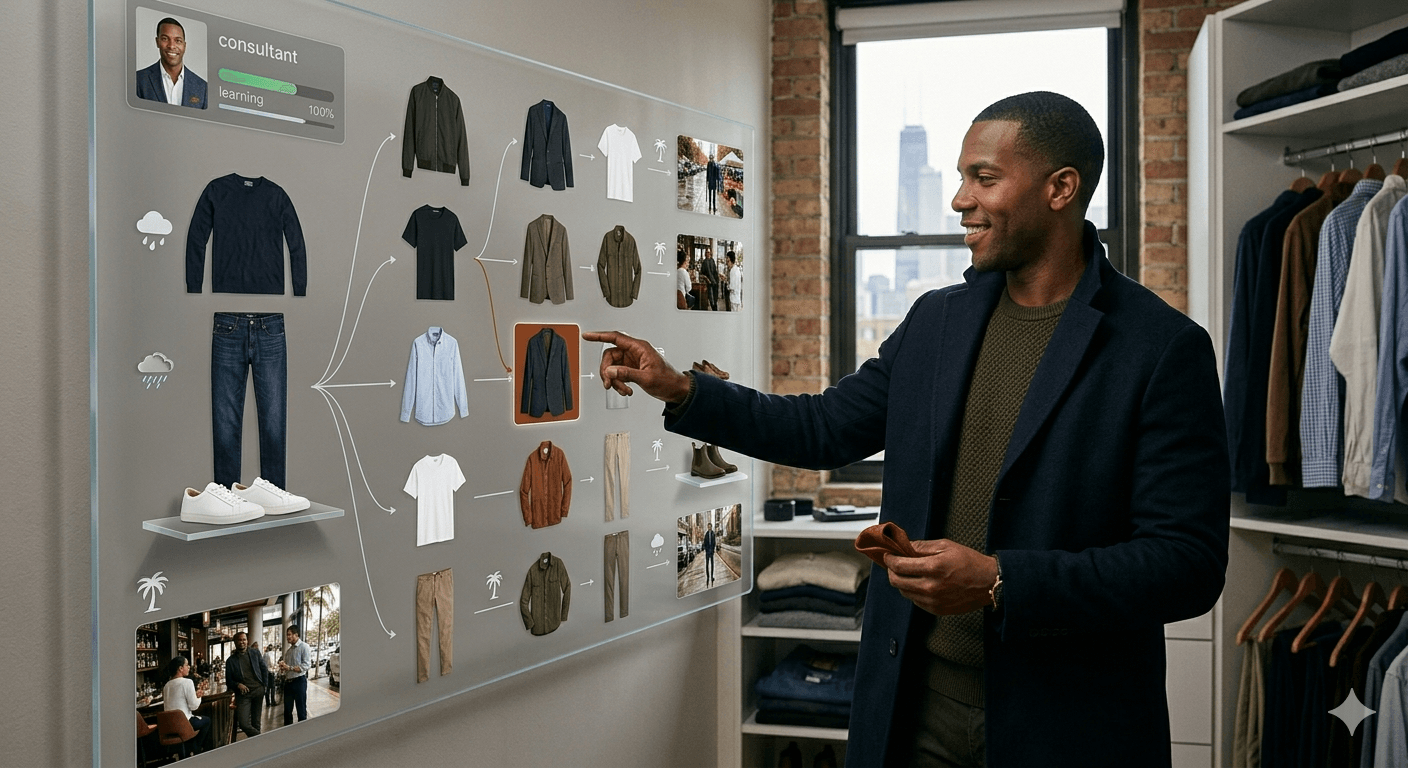
Here's the distilled version — a framework you can apply whether you're starting from scratch or editing an existing wardrobe.
Start with the anchors. Dark wash straight or tapered jeans. Chinos in two to three neutral colours. These are the most versatile bottom options available to men across every age group and every lifestyle context. Everything else rotates around them.
Add tops that work at two levels. For every casual outfit framework, you need tops that work in a dressed-down configuration (tees, casual button-fronts, hoodies) and tops that work slightly elevated (Oxford shirts, polos, merino crews). This isn't about having two separate wardrobes — it's about having tops that can shift the register of the same pair of pants.
Own two or three layering pieces that can dress anything up or down. An unstructured blazer. A well-fitting bomber or overshirt. A quality crewneck sweater. These mid-layer pieces are what allow casual outfits to become context-flexible without requiring a full outfit change.
Invest in two pairs of versatile shoes. White leather sneakers and Chelsea boots cover an enormous range of men's casual outfit ideas across virtually every lifestyle. Add a third shoe — loafers, desert boots, or clean running-style sneakers — based on your specific context.
Keep the accent genuine. One piece per outfit that's actually yours — a colour you're drawn to, a texture that interests you, a silhouette you've been curious about. Style without personality is just a uniform.
Let tools do the contextual work. Whether that's a style consultation, a curated shopping service, or an agentic AI platform that learns your preferences and surfaces complete looks in real time — use what's available. The cognitive overhead of dressing well every day shouldn't have to live entirely in your head.
Men's Casual Outfit Ideas Across Different Life Contexts
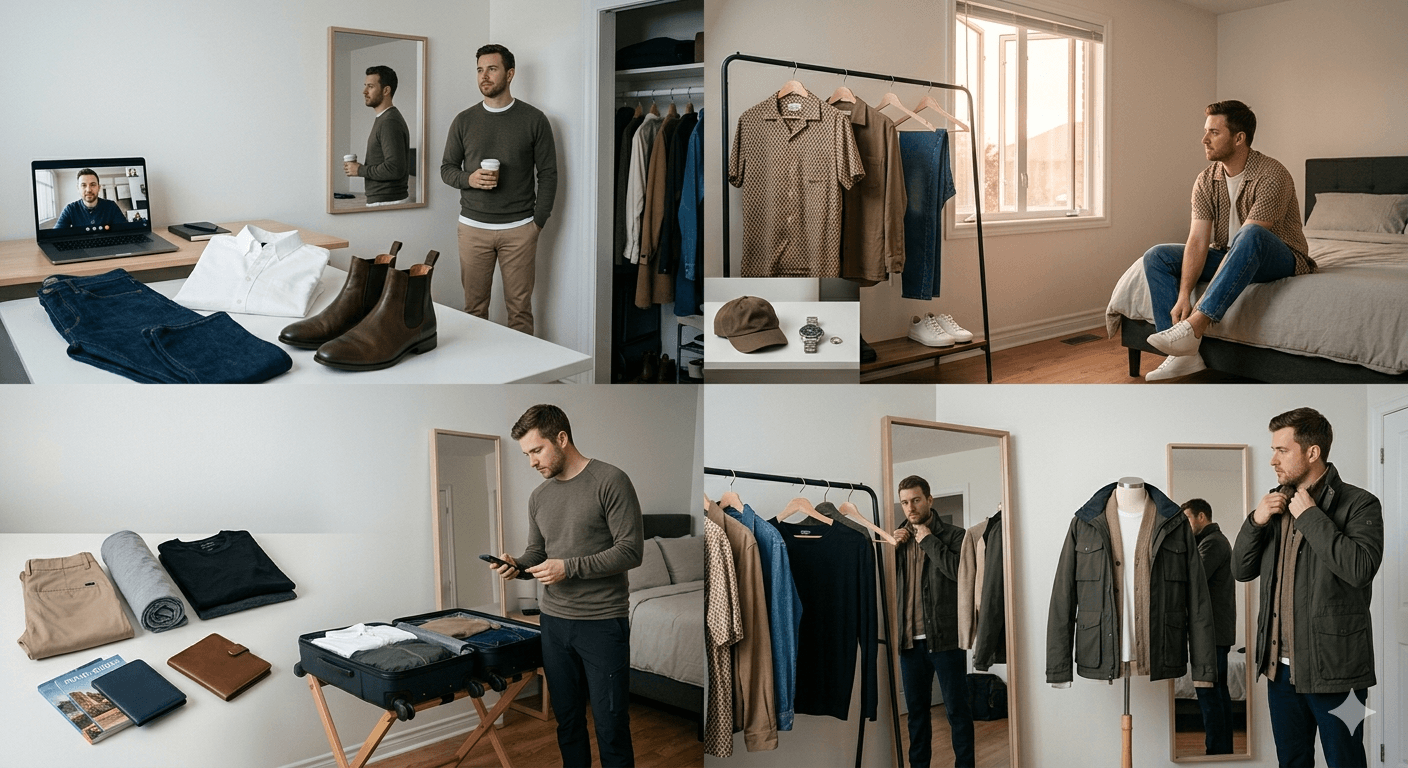
The Hybrid Work Week. The most common dressing challenge for American men right now. Dark wash jeans, an Oxford shirt, and Chelsea boots handle most hybrid office scenarios without any formal addition. A merino crewneck over a tee, chinos, and leather sneakers cover the work-from-home days that might turn into a video call. The goal is pieces that can cross the threshold without requiring a costume change.
Weekend and Social. This is where men's casual outfit ideas can breathe a little more. Straight-leg denim with a camp collar shirt or overshirt, clean sneakers, and a simple accessory — a watch, a cap, a ring — covers most casual social scenarios. Add a bomber for evening, switch the sneakers to loafers for something slightly more intentional.
Travel. The intersection of comfort, versatility, and visual competence. Chino-blend pants that don't wrinkle, a merino wool tee that handles temperature changes, a light jacket that compresses into a bag. The best travel casual outfits are built around fabric performance as much as visual aesthetics.
Seasonal transitions. The hardest dressing context for most men because the temperature range within a single day can span 25 degrees. Layering solves this systematically: a base, a mid-layer, and an outer piece you can add or remove. Doing this with pieces that look intentional together rather than thrown on requires exactly the kind of context-aware selection that static lists can't help with.
Conclusion: The Future of Men's Casual Outfit Ideas Is Personal
The static outfit list had its moment. It gave men a starting point when there wasn't much else available — a reference, a shorthand, a vague direction.
But the way men dress now is too context-dependent, too personal, and too varied for a frozen list to serve well. The casualization of men's fashion means the options have expanded dramatically. The shift to online shopping means the browsing volume has expanded dramatically. And the result — a 0.8% conversion rate, billions of views that don't translate into wardrobes that work — reflects a real mismatch between how men are trying to find men's casual outfit ideas and what would actually help them.
The answer isn't a better list. It's smarter, more contextual, more personalized discovery — the kind that understands your body, your life, your location, and your preferences simultaneously, and surfaces complete looks you can actually wear rather than concepts you'd have to translate.
That shift is underway. Agentic AI is building toward it. And the men who understand the framework — not just the items — will be the ones who stop browsing and start actually getting dressed.
Frequently Asked Questions
- What are the most versatile men's casual outfit ideas for everyday wear?
The most versatile foundation for everyday men's casual outfit ideas includes dark wash jeans or neutral chinos, a well-fitting tee or Oxford shirt, and either white leather sneakers or Chelsea boots. This combination covers most casual-to-smart-casual situations and works across body types, age groups, and lifestyle contexts without requiring much thought. - How do I build men's casual outfit ideas on a budget?
Start with the highest-impact pieces: one great pair of dark wash jeans, one or two neutral tees that fit well, and one clean pair of white leather sneakers. These three items create more wearable looks than a larger collection of cheaper, harder-to-combine pieces. Fit matters more than price point — a well-fitting $40 tee outperforms an ill-fitting $200 one every time. - How is agentic AI changing men's casual outfit discovery?
Agentic AI shopping systems deploy multiple specialized agents at once — analyzing your physical attributes, current trends, your location, and your behavioral patterns — to surface complete outfit recommendations rather than individual items. Instead of a product grid you have to manually filter, these systems present men's casual outfit ideas as curated looks matched to who you actually are and what your life actually looks like. - What's the difference between casual and smart-casual for men?
Casual leans toward comfort and relaxed styling — jeans, tees, sneakers, hoodies. Smart-casual adds polish without going formal — chinos instead of jeans, an Oxford shirt or unstructured blazer instead of a tee, loafers or Chelsea boots instead of athletic sneakers. The best men's wardrobes hold pieces that can work in both registers so a single outfit can shift between contexts. - How many pieces do I actually need for a solid casual wardrobe?
Research on capsule wardrobes consistently suggests 12–15 well-chosen pieces create enough combinations for everyday use without wardrobe fatigue. The key is that each item works with at least three to four other pieces. Five good tops, three great bottoms, and two pairs of versatile shoes get you further than a closet full of items that don't coordinate. - Why do men's casual outfit ideas from lists never quite work in real life?
Static lists are built for a generic person in a generic context. They don't account for your body type, your climate, your daily schedule, or your personal aesthetic. Men's casual outfit ideas that actually work are personalized — built around your specific anchors, your specific context, and your specific style instinct rather than a universal template. - What's driving the shift toward casualwear in men's fashion?
Several forces are converging: the normalization of hybrid and remote work has erased clear dress code lines; younger generations (Gen Z and millennials) have consistently prioritized comfort and versatility over formality; and social media exposure to a wider range of style references has raised aesthetic awareness while simultaneously expanding the definition of what's acceptable as casual. The casualwear segment is now the dominant category in global menswear.
Download the Glance app now






Your intelligent
shopping agent.







Your intelligent
shopping agent.