

Create AI Twins: Digital Versions of You for Shopping
TL;DR
Last updated: November 2026
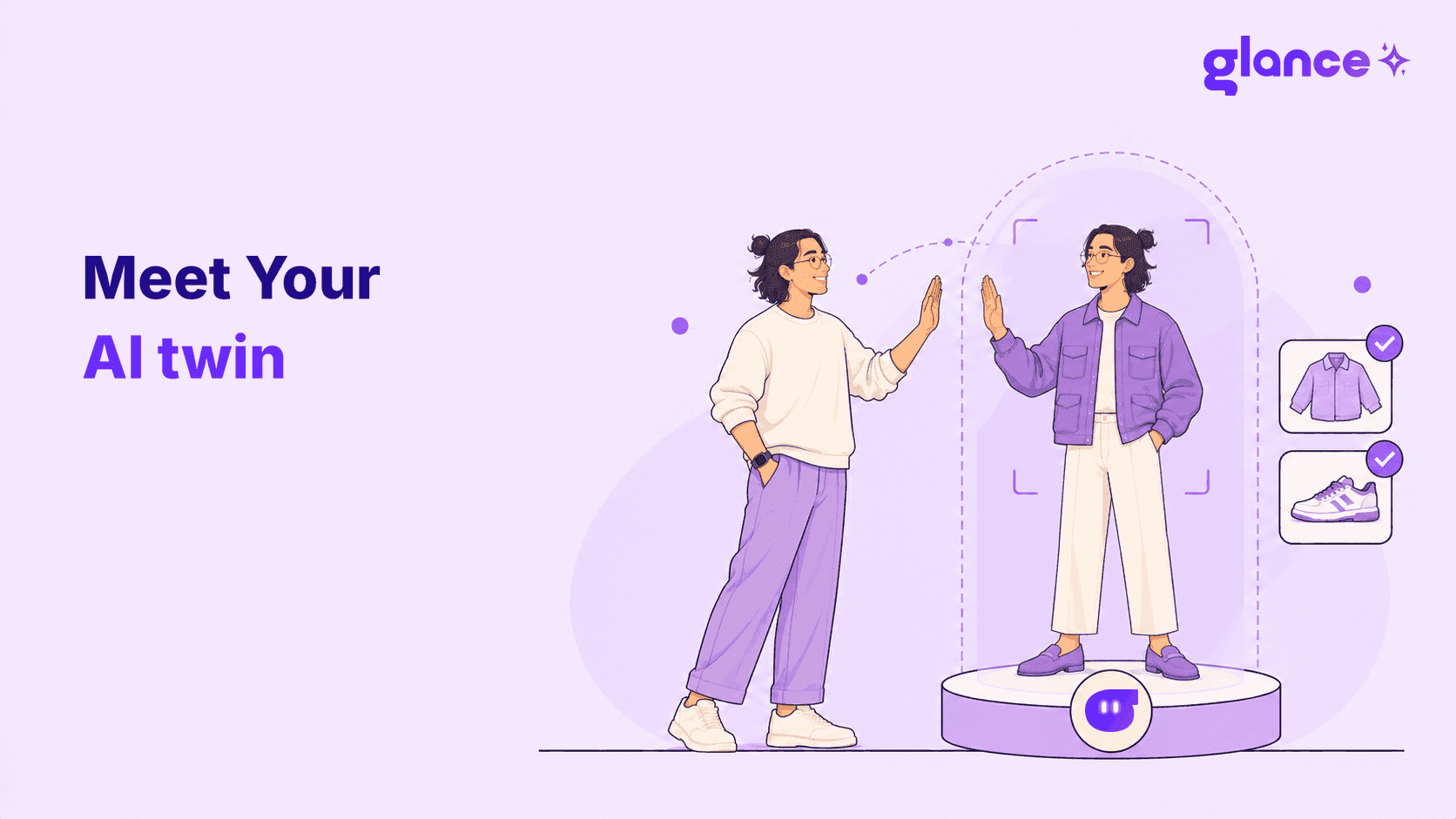
An AI Twin is a digital version of you that shows how clothes could look on your own body instead of a generic model. Glance, your personal shopper, is a consumer AI shopping agent that finds and styles looks and buys with your approval. It builds your AI Twin from a selfie you choose to share, then shows complete, shoppable looks on you, styled for your weather, local trends and occasions. It helps you decide with more confidence and less scrolling. It guides style and fit but cannot guarantee either, and the final choice stays yours.
Online shopping was supposed to make life easier. Instead, for many people, it quietly became exhausting.
You scroll, compare, save, forget, come back, and still hesitate. Not because there are no options, but because there are too many and none of them feel certain. Will this actually suit me? Will it sit right on my body? Will I wear it more than once?
This is the gap AI Twins are stepping into. Not to replace personal style or decision making, but to reduce the mental friction that comes with shopping online. As fashion becomes more expressive, inclusive, and fluid, the old way of browsing static images and size charts simply cannot keep up. People want context. They want to see themselves in the clothes before committing.
AI Twins exist because shoppers are no longer just looking for products.
What is an AI Twin in Shopping?

An AI Twin in shopping is a digital version of you that shows how products could look on your own body, face shape and skin tone, not on a generic model. On Glance, it is built from a selfie you choose to share and used to render complete outfit looks on you. It is built using visual cues, basic physical inputs, and interaction patterns to create a more personalized point of reference while browsing.
Unlike traditional virtual try-ons that place garments on standardized avatars, an AI Twin adapts to proportions, preferences, and styling behavior. Over time, it begins to understand how a person shops, what silhouettes they gravitate toward, and which styles they tend to avoid.
It is important to be clear about what an AI Twin is not. It is not a perfect replica, and it does not promise exact fit accuracy. Instead, it offers something more practical: a way to preview style, balance, and overall look in a context that feels closer to you than a mannequin ever could.
At its best, an AI Twin works like a reference mirror for decision making. It helps you move from imagining an outfit to understanding it.
AI Twin, Avatar and Digital Twin: Are They the Same?
- AI Twin (shopping): a digital version of you, built from a selfie you choose to share and your shopping signals, and used to show outfits on you.
- Avatar: a character or standard figure, often designed by you or picked from presets. It does not necessarily reflect your features or learn from your behavior.
- Digital twin (industry): a virtual model of a physical object or system, such as a machine or a building, used for monitoring and simulation. It is a different use of the word.
AI Twin vs Virtual Try-On vs Model Photos
Each one answers a different question. This is how they compare:
| Model photos | Standard virtual try-on | AI Twin on Glance | |
| What you see | A generic model wearing the item | One item placed on a standard avatar or a photo you upload | Complete looks rendered on you |
| Built from | The retailer's photo shoot | A product image and a photo of you | A selfie you choose to share, your style preferences, and context such as weather, location and trends |
| Personalization | None | Usually limited to the item you picked | Learns from what you view, like, skip and save |
| Starts when | You search or browse | You choose a product | Before you search, with looks built for you |
| Fit guidance | A size chart | Usually a visual preview only | A visual preview now, with True Fit size guidance planned from the 2026 holiday season |
| Best for | Checking product details | Checking one item you already chose | Discovering and judging complete looks |
They work together. Model photos show the product, a standard try-on checks one item, and an AI Twin helps you find and judge whole looks. None of them replaces checking the size details before you buy.
Why Do Online Shoppers Need an AI Twin?
Despite all the advancements in ecommerce, most fashion shopping experiences still rely on outdated assumptions. They assume everyone can visualize fit the same way. They assume a model wearing a size small communicates something meaningful to someone with a completely different body type. They assume more choice leads to better decisions.
In reality, the opposite often happens. Shoppers spend more time browsing but feel less confident when it comes time to buy. The lack of personalization leads to hesitation, over ordering, and returns. Style discovery becomes a guessing game rather than a guided experience.
Even recommendation systems often miss the mark. They suggest what is popular, not what is suitable. They highlight trends without helping users understand how those trends translate to their own bodies, lifestyles, or comfort levels.
This is where traditional online shopping begins to feel disconnected. It offers access, but not clarity. Products, but not perspective.
AI Twins emerged as a response to this gap in the retail market. Not as a flashy feature, but as a practical layer that helps bridge the distance between seeing clothes online and actually feeling confident wearing them.
Fit is the question shoppers ask most. According to True Fit's customer data, more than 70 percent of fashion shoppers' questions to AI agents relate to fit and sizing, as shared in True Fit's announcement with Glance.
Did you know? Morgan Stanley Research estimated in December 2025 that agentic shoppers could account for $190 billion to $385 billion of US e-commerce spending by 2030, or 10 to 20 percent of online retail.
How Does an AI Twin Work?

At a conceptual level, AI Twins work by connecting three things you already create while shopping but rarely think about: how you look, how you browse, and how you decide.
When you interact with an AI Twin, you are not teaching it in one go. You are shaping it gradually. The system begins with visual inputs like a photo or basic appearance details. From there, it layers behavioral signals over time.
Here’s what’s happening quietly in the background:
- Visual understanding
The AI studies proportions, general body structure, and how clothing shapes interact with those proportions. This is about silhouette and balance, not exact measurements. Inside the Glance Intelligent Shopping Agent, this visual layer is one of five specialized agents working simultaneously to build your look. - Preference learning
Every outfit you like, skip, save, or revisit sends a signal. Over time, the AI learns what “you” feels and what it doesn't. - Context awareness
The AI starts recognizing intent. Shopping for a party feels different from shopping for everyday wear or work. The recommendations adjust based on theme and mood, not just category. - Continuous refinement
The more you interact, the less generic the experience becomes. The AI Twin evolves as your taste evolves.
The key thing to remember is this: AI Twins do not predict your style. They observe it and respond.
How Does an AI Twin Fit Into Agentic Shopping?
In agentic shopping, an AI agent works on your behalf: it finds, compares and styles products instead of waiting for you to search. To do that well, the agent has to know who you are. Your AI Twin is how Glance knows. It holds your features, your taste and your context, and every look is built from it. Glance calls the combined picture of your shopping behavior and your personal context the Commerce Context Graph, and what it learns carries across sessions and surfaces.
This is a structural shift in agentic commerce, not a smarter recommendation engine and not a chat layer on top of shopping. The agent acts before you search, and you stay in charge: Glance is proactive, not autonomous. It builds the look, you decide whether to buy, and supported merchants offer native PayPal checkout so you can finish without leaving Glance.
What Are the Benefits of an AI Twin?
The real value of AI Twins shows up not in novelty, but in everyday decision making. They shine in moments where traditional shopping tools leave you guessing.
- Seeing outfits on a body that resembles yours
This makes it easier to understand how proportions, lengths, and cuts might translate to your own look. - Exploring looks by theme instead of endlessly browsing
Casual, party, office, travel. AI Twins allow you to explore complete looks rather than isolated products. - Reducing decision fatigue
Instead of scrolling through hundreds of options, you get a smaller, more relevant set that aligns with your preferences. - Experimenting without pressure
You can try bold colors, new silhouettes, or unfamiliar styles without committing money or mental energy.
Inside intelligent shopping agents like Glance, this value becomes more practical. You are not just trying clothes on a digital version of yourself. You are comparing looks, understanding styling choices, and narrowing decisions faster across categories.
It turns shopping into exploration rather than effort.
How Are AI Twins Changing the Way People Shop?

AI Twins are subtly shifting how people approach fashion shopping. The biggest change is not what people buy, but how they decide.
You start spending less time browsing and more time evaluating. Instead of chasing trends, you focus on what fits your life, your comfort, and your identity. Shopping becomes more intentional and less impulsive.
Some noticeable behavior shifts include:
- Fewer but better purchases
When you understand how something might look on you, you are less likely to buy “just to try.” - Increased confidence at checkout
Visual reassurance reduces hesitation and second guessing. - More experimentation with less risk
You feel safer exploring new styles digitally before committing in real life. - A move away from endless scrolling
Curated, context driven exploration replaces fatigue driven browsing.
AI Twins are not making decisions for you. They are helping you make decisions with more clarity.
How Do You Create an AI Twin in Glance?
In Glance, you can create an AI twin effortlessly.
1. Start With a Selfie
The AI Twin begins with a visual input.
You choose to share a selfie. Sharing one is optional: without it, Glance can still help you find and style looks, but it cannot show them on you. The system extracts attributes from your selfie such as:
- Skin tone
- Body type
- Face shape
- Hair color
- Overall appearance cues
These attributes are used to understand what clothing, colors, silhouettes, and accessories are likely to suit you visually.
The images you upload or share on your screen are never shared with any third party. They are used only to personalise recommendations and visualise you in AI-generated outfit looks.
You can read how Glance handles your photos and data in its privacy policy.
2. Set Your Style Preferences
During onboarding, the system asks a short questionnaire.
This step captures declared preferences, such as:
- Preferred styles
- Favorite brands
- Categories you shop most (dresses, sneakers, jackets etc.)
- Budget sensitivity
- Occasions you shop for
This helps the AI Twin move beyond appearance and start mapping taste and intent.
3. Context Awareness Is Added Automatically
Your AI Twin is not static. It adapts using contextual signals such as:
- Location
- Weather
- Local trends
- Upcoming Occasions
For example:
- A winter wardrobe recommendation in New York
- A beach vacation look for Miami
- Festival outfits for a music event
These signals help the system understand situational style needs, not just general fashion preferences.
4. Interaction Builds the Twin Over Time
The AI Twin improves with use.
Every interaction becomes a learning signal:
- What outfits you view
- What looks you like or dislike
- Browsing depth
- Categories you explore
- Purchases or saved items
This creates a feedback loop where the system continuously refines your style identity.
The more you interact, the closer the AI Twin gets to reflecting your evolving taste.
Tips for Getting Better Looks From Your AI Twin
- Answer the onboarding questions. Your preferred styles, favorite brands and occasions give Glance a starting point beyond your selfie.
- Use a clear, front-facing selfie. Good lighting gives any image-based tool more to work with. Confirm with Glance's own selfie guidance.
- Like and skip. Every like, skip and save sharpens the next set of looks.
- Tell Glance the occasion. A trip, a wedding or a work week gives it context to style for.
- Refine by chat. Ask for something more casual, a different color or another pair of shoes, and Glance updates the look.
- Check the size details. A preview shows style and proportion, not exact fit.
What's New for AI Twins and Glance in 2026
Glance has added several things since this guide was first published in May 2025:
- Hey Siri, Let's Glance (iPhone and iPad). Announced September 30, 2026: with iOS 27, say "Hey Siri, Let's Glance" and Glance takes over, gives you the shopping information and leads you from there, including recommendations and virtual try-on. Glance says its on-device try-on, built on Apple's Core AI framework, is rolling out progressively to eligible devices.
- Fit guidance with True Fit. In September 2026, Glance and True Fit announced a collaboration to bring True Fit's size and fit recommendations into Glance's try-on experience. The first experiences are planned for the 2026 holiday season, with broader availability for True Fit merchants in 2027. Confirm the release date and swap this link to the Business Wire original.
- Checkout with PayPal. Since October 15, 2026, shoppers can buy from supported merchants with native PayPal checkout without leaving Glance.
- More screens. Glance reached Samsung smart TVs in June 2026, Android TV in October 2026 as an opt-in experience, and Lenovo and Motorola's Qira on October 29, 2026, where Glance's discovery, styling and recommendations appear when you express shopping intent and you finish on the retailer's site.
Where and How Can You Use Your AI Twin?
AI Twins are not just a fun feature. They are tools that make your shopping smarter.
Inside Glance, your AI Twin works with the Intelligent Shopping Agent to help you explore outfits quickly and easily. You are not just looking at clothes.
Glance is free to use, with no subscription. Its website cites more than 13 million active users across mobile worldwide, more than 125 million TV devices and more than 2.5 million AI-generated styles a day. Looks come from a catalog of more than 40 million products from various brands, each shown on your AI Twin.
You can use your AI Twin in these places:
- Samsung Galaxy phones (S22 and later): launched in June 2025 as an opt-in lock screen feature and a standalone app, through the Galaxy Store.
- Select Motorola devices: pre-installed through Verizon, with no download required.
- iPhone and iPad: as an app, and by voice with iOS 27: say "Hey Siri, Let's Glance" (announced September 30, 2026).
- Android phones: through the Google Play Store.
- TVs: Samsung smart TVs and Android TV, through partners including DirecTV.
You are preparing for real moments—workdays, weekends, parties, or trips.
With Glance, you can explore looks by theme instead of scrolling endlessly, for every body type:
- Casual everyday wear that fits your daily routine
- Office outfits that balance comfort and style
- Party looks that feel bold without overdoing it
- Seasonal or weather-ready outfits that match your plans
Your AI Twin shows how each outfit might look on a body similar to yours. At the same time, Glance filters options, compares items, and gives you the best picks from partner brands.
This makes shopping feel effortless. You can try multiple looks, mix and match styles, and decide faster. It's less browsing and more guided discovery.
Example: Day Looks for a Tokyo Trip
In the Glance app, you can ask for something specific, such as "Give me day looks for my Tokyo trip." Glance replies that it is creating a set of stylish day looks for the trip, with outfits that suit your complexion and hair, and shows them on you. From there you can keep chatting to refine the looks and shop in an instant. The example comes from the brand book screens. Confirm it still matches the current app.
Did you know? In Amperity's 2026 State of Personalization in Retail report, as reported by EMARKETER, 57% of U.S. adults still report largely generic experiences, and 74% say they are more likely to buy when they get personalization.
On AT&T Android devices, Lynk, Glance's home-screen shopping assistant, has been free to AT&T Android customers since the week of June 17 to 20, 2026. It puts virtual try-on from a selfie, visual search, outfit building and chat on top of the shopping apps you already use, so you don't have to leave the page you're on.
What are the Limits of AI Twins?
As helpful as AI Twins are, they are not magic.
Here’s where AI Twins still fall short:
- Fabric behavior is approximated
Movement, weight, and texture are simulated, not felt. A digital preview cannot fully capture how a fabric drapes or stretches in real life. - Color accuracy can vary
Lighting, screens, and image quality affect how colors appear digitally versus in person. - Fit precision is directional, not exact
AI Twins help you understand overall look and style compatibility, but they do not replace tailoring or physical try ons for perfect fit. . Glance is working on this: it is adding True Fit's size and fit guidance, with the first experiences planned for the 2026 holiday season. - Style is emotional, not just visual
Confidence, comfort, and personal expression are deeply human. AI can guide, but it cannot feel for you. - New features arrive in stages On-device try-on on iPhone is rolling out progressively and depends on your device and iOS version.
The best way to think about an AI Twin is as a decision support tool, not a decision maker. It helps you move closer to confidence, but the final choice is always yours.
Conclusion: An AI Twin Supports Your Choice
At their best, AI Twins do not remove the human element from shopping. They support it.
Fashion is personal. It reflects mood, comfort, culture, and self expression. No technology can replace that. What AI Twins can do is remove unnecessary friction, reduce uncertainty, and help you see yourself more clearly in the choices you are considering.
Smarter shopping is not about automation or speed alone. It is about confidence. Confidence that what you choose aligns with how you want to feel and show up.
Glance is proactive, not autonomous: it builds looks and puts them in front of you, and you decide what to buy.
When AI Twins are used thoughtfully inside intelligent shopping agents, they do not tell you what to wear. They simply help you understand your options better. And that shift, from guessing to knowing, is what makes shopping feel human again.
AI Twin FAQs
1. What is Glance’s AI Twin?
Glance's AI Twin is a digital version of you, built from a selfie you choose to share. Glance uses it to show complete outfit looks on your own body, skin tone and proportions instead of a stock model, so you can judge a look before you buy. Sharing a selfie is optional.
2. How is an AI Twin different from standard virtual try-ons?
Standard virtual try-ons usually place one item on a generic model or on a photo you upload. An AI Twin keeps your features and preferences, and Glance builds whole looks on you from its catalog, styled for your weather, trends and occasions, before you search. It guides fit and style but cannot guarantee either.
3. Can I use my AI Twin to mix and match outfits?
Yes. In Glance you can chat to refine a look, such as swapping shoes, going more casual or changing a color, and see the updated look on you. On supported AT&T Android devices, Lynk also builds a full outfit around a product you are viewing, with shoes, bags and jackets you can shop.
4. Does the AI Twin adapt over time?
Yes. Glance learns from what you view, like, skip, save or buy, and from your location, weather and local trends, so looks get more relevant the more you use it. Your tastes change, and your AI Twin keeps up, with suggestions tailored for shoppers in the US market.
5. Can an AI Twin help reduce returns and shopping mistakes?
It can help. Seeing a look on your own body takes some guesswork out of style, color and proportion. For size, Glance is adding True Fit's fit guidance, with the first experiences planned for the 2026 holiday season. No tool can guarantee a perfect fit, so check size details before you buy.
6. How does Glance create outfit looks on my actual body?
You share a selfie, and Glance reads your face shape, skin tone, hair color and body proportions. Four other AI agents read your weather and location, local trends, upcoming occasions and style signals. A central layer combines all five, searches a catalog of 40 million-plus products, and renders complete looks on you.
7. What AI apps show outfits on my actual body, not a model?
Many try-on tools work as overlays: you upload a photo of yourself and a product image, and the tool shows that item on you. Glance starts with one selfie instead, then builds complete, shoppable looks on you from its catalog before you search. Choose the approach that fits whether you already know what you want.
8. What is new with Glance's AI Twin in 2026?
With iOS 27, you can say "Hey Siri, Let's Glance" on iPhone and iPad, and Glance takes over with shopping information and next steps. Glance is also adding True Fit's size guidance, PayPal checkout for supported merchants, and TV and Qira surfaces. On-device try-on on iPhone is rolling out progressively to eligible devices.
9. Is an AI Twin the same as a digital twin or an avatar?
No. A digital twin usually means a virtual model of a machine or system. An avatar is a character or standard figure. A shopping AI Twin is a digital version of you, built from a selfie you choose to share and your style signals, and used to show outfits on you.
10. How do AI Twins relate to agentic shopping?
In agentic shopping, an AI agent finds, styles and buys on your behalf, with your approval. An AI Twin gives Glance's agent the personal context it needs: your features, taste and situation. That lets it build looks on you before you search, while you keep the final decision.


Download the Glance app now





Your intelligent
shopping agent.







Your intelligent
shopping agent.