


Top 10 Sustainable Fashion Trends 2026: You Must Know
TL;DR
Sustainable fashion in 2026 is shifting from trend-driven consumption to smarter, longer-term wardrobe building. Circular design, eco-friendly materials, resale growth, regenerative textiles, digital sampling, and ethical production are reshaping the industry. The focus is moving toward durability, transparency, and cost-per-wear value. Instead of buying more, consumers are buying better — prioritizing longevity, versatility, and informed decisions over impulse and hype.
Sustainable fashion has officially moved from the margins to the main stage. In 2026, it’s no longer a niche conversation about organic cotton and reusable tote bags. It’s about supply chain transparency, regenerative systems, resale economics, digital sampling, and you who ask harder questions before clicking “buy.”
This isn’t trend-chasing. It's a structural change.
But What are the sustainable fashion trends you must know about?
No worries! Here, we listed top 10 sustainable fashion trends shaping 2026. So, let's get started.
Did you know? The global sustainable fashion market reached USD 12.46 billion in 2025 and is projected to hit USD 53.37 billion by 2032, growing at a 23.1% CAGR.
Top 10 Sustainable Fashion Trends Shaping 2026
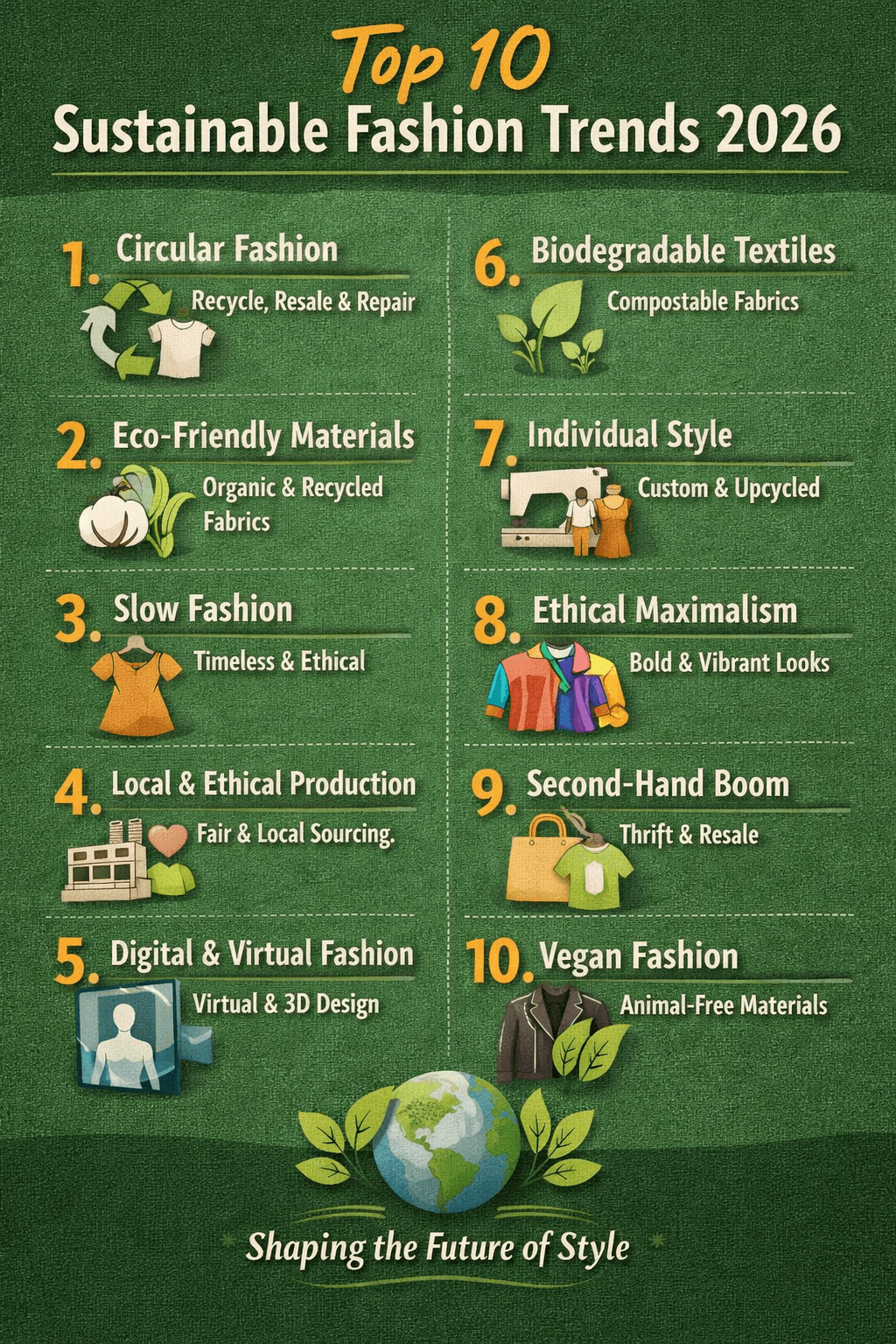
1. Circular Fashion: Clothes Designed to Come Back
What’s most remarkable right now is how many brands are rethinking the end of a garment’s life before it’s even made.
Circular fashion focuses on extending garment lifecycles through:
- Recycling and fiber-to-fiber innovation
- Brand-operated resale platforms
- Take-back programs
- Modular, repairable designs
Instead of “buy, wear, discard,” the system becomes “buy, wear, return, renew.”
You’re seeing brands like Patagonia, Levi's, and The North Face accept their own products back. You’re seeing resale integrated directly into retail websites. The shift feels subtle — but structurally, it’s significant.
2. Eco-Friendly Materials: Smarter Fiber Choices
Material science is moving quickly.
Organic cotton, hemp, Tencel (lyocell), recycled polyester — these aren’t niche anymore. They’re scaling.
Here’s how some key materials compare:
| Material | Why It’s Gaining Attention | What to Check |
| Organic Cotton | Lower pesticide use | Certification like GOTS |
| Hemp | Durable, low water | Fabric blend quality |
| Tencel | Closed-loop production | Source transparency |
| Recycled Polyester | Reduces virgin plastic | Microplastic shedding |
What’s important here is nuance. A sustainable fiber still needs good construction. If a garment falls apart after five washes, the material advantage disappears.
It’s an evolution from “natural equals good” to “durability equals impact.” Fashion brands like Everlane, Reformation, Outerknown use these eco-friendly materials; redefining fashion.
3. Slow Fashion: The Return of Longevity
There’s a noticeable fatigue with constant micro-trends. People are not tired of fashion — they’re tired of replacing it.
Slow fashion focuses on:
- Timeless silhouettes
- Higher construction standards
- Ethical labor conditions
- Smaller, intentional collections
You can feel the shift toward cost-per-wear thinking. Instead of asking, “Is this cheap?” shoppers are asking, “Will this last?”
That mental recalibration is powerful.
4. Local and Ethical Production: Transparency Matters
Supply chains are no longer invisible.
Brands are publishing factory lists. They’re disclosing wage policies. They’re investing in regional production hubs.
Local or regional manufacturing offers:
- Lower transportation emissions
- More oversight
- Support for skilled artisans
- Reduced overproduction risk
But transparency matters more than geography alone. A “Made in USA” label is meaningful only when labor practices are verifiable.
We are reading the fine print now.
5. Digital and Virtual Fashion: Reducing Waste Before It Exists
This is where things get fascinating.
Before a garment reaches a store, it often goes through multiple physical sample iterations. That creates waste.
In 2026, brands are increasingly using:
- 3D garment prototyping
- AI-driven demand forecasting
- Digital sampling
- Digital product passports for traceability
The waste reduction begins at the design phase. That’s a systems-level improvement — and one of the most impactful shifts happening quietly behind the scenes.
6. Biodegradable and Regenerative Textiles: From Less Harm to Active Repair
Sustainability is no longer just about minimizing damage. It’s about restoration.
Regenerative agriculture focuses on:
- Improving soil health
- Enhancing biodiversity
- Sequestering carbon
You’re also seeing biodegradable textiles and innovations like mycelium-based leather alternatives entering commercial production.
But here’s the nuance: biodegradability only works under the right conditions. A compostable garment blended with synthetic fibers won’t break down properly.
The direction is promising — but scrutiny remains essential.
7. Individual Style Expression: Personal Over Algorithmic
There’s a subtle rebellion happening.
Instead of dressing for trends, more we are leaning into:
- Vintage curation
- Tailored alterations
- Made-to-order garments
- Upcycled pieces
Personal style is becoming an antidote to overconsumption.
When clothing reflects identity instead of impulse, it stays in rotation longer. Emotional durability is as real as physical durability.
8. Ethical Maximalism: Sustainability Doesn’t Mean Minimal
For a while, sustainable fashion was associated with neutral tones and pared-back aesthetics.
Now? Color is back. The texture is back. Boldness is back.
The difference is construction and sourcing. Maximalism is being executed within ethical lines — with quality fabrics and thoughtful production.
It proves something important: sustainability is not a style. It’s a framework.
9. Second-Hand Becomes Standard
Resale is no longer secondary.
It’s built into the business model.
Brands are launching:
- Integrated resale platforms
- Take-back incentives
- Rental programs
- Trade-in credits
Second-hand is no longer a compromise. It’s a strategic decision.
Financially, it also makes sense. Higher-quality garments retain resale value better than fast fashion equivalents.
The idea of clothing as an asset is re-emerging.
10. Vegan Fashion: Innovation Beyond Animal-Derived Materials
Vegan fashion avoids leather, wool, silk, and fur.
But the conversation has matured beyond simple substitution.
The real innovation is happening in:
- Mycelium leather
- Plant-based biomaterials
- Lab-developed alternatives
Some synthetic leather alternatives remain petroleum-based, so durability and lifecycle impact matter more than the “vegan” label alone.
Did you know? MooShoes , VONI , and Doshi are some of the top vegan fashion brands.
How to Engage With Sustainable Fashion Trends
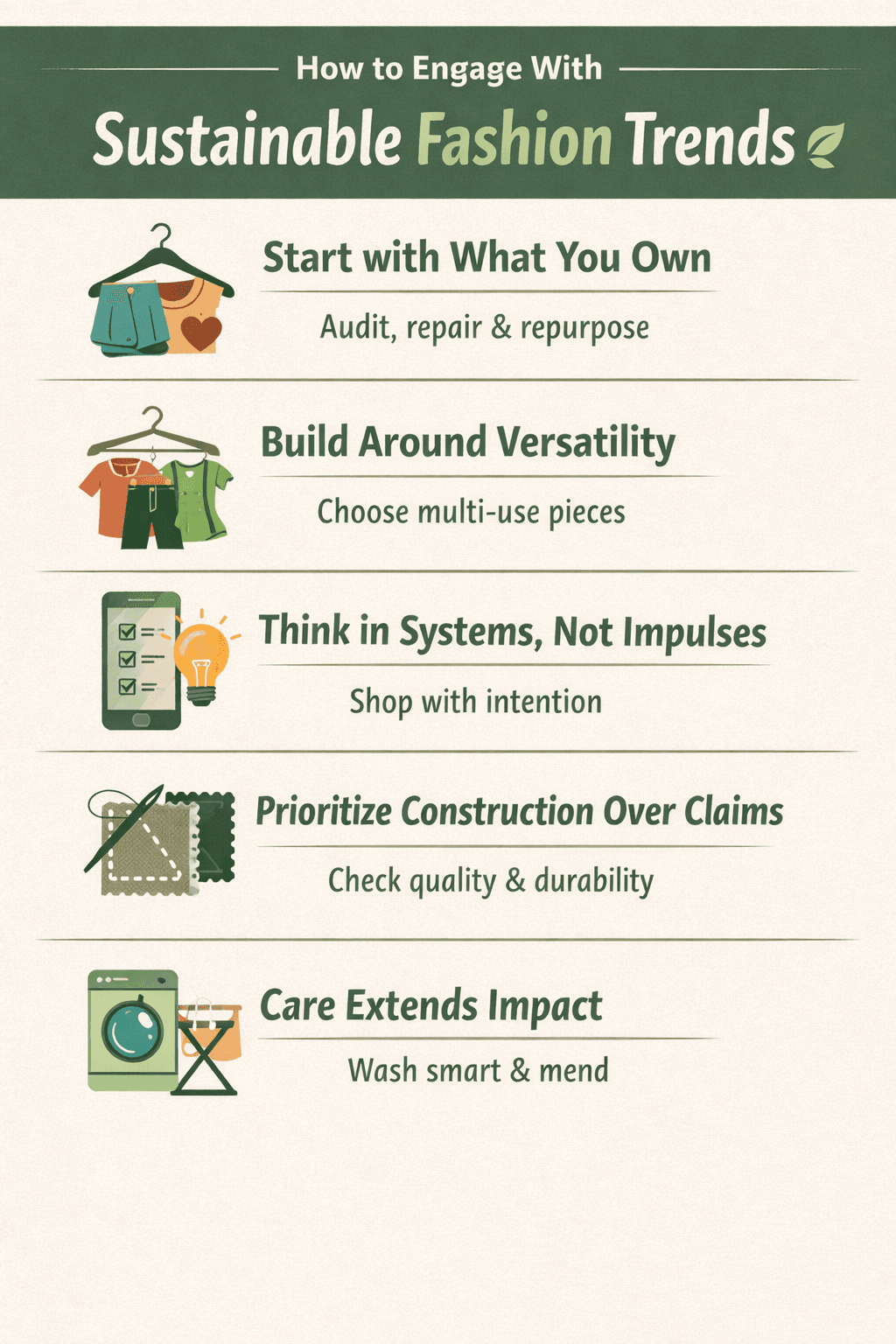
Trends are informative. But participation should be intentional.
Here’s how to approach sustainable fashion thoughtfully.
Start With What You Own
The most sustainable garment is already in your closet.
Before buying:
- Audit what you wear most
- Identify gaps honestly
- Repair or tailor what you can
- Resell or donate responsibly
This step alone reduces unnecessary consumption.
Apply the 30-Wear Test
Before purchasing, ask:
- Will I realistically wear this 30 times?
- Does it integrate with at least three outfits I already own?
- Does it serve multiple contexts?
If the answer is uncertain, pause.
Impulse is the enemy of sustainability.
Use Decision Intelligence, Not Just Inspiration
Discovery drives desire. But decision platforms reduce regret.
Platforms like Glance help reduce overconsumption by:
- Surfacing need-based recommendations
- Highlighting versatile pieces
- Reducing endless scroll fatigue
- Aligning purchases with real usage patterns
It’s a subtle but meaningful shift — from trend exposure to decision clarity.
And clarity is sustainable.
Build Structure Into Your Wardrobe
A sustainable wardrobe often follows a simple balance:
- 60–70% foundation pieces
- 20–30% expressive items
- 10% seasonal experimentation
This structure allows creativity without chaos.
Care Extends Impact
After purchase, maintenance matters.
- Wash less frequently
- Use cold water
- Air dry
- Repair small issues early
- Rotate garments between wears
Garment care can significantly extend lifespan; which directly lowers environmental impact.
Why Sustainable Fashion Is Still Complex
Even with progress, barriers remain:
- Sustainable materials often cost more
- Full traceability across global supply chains is difficult
- Certifications vary in rigor
- Marketing can outpace measurable impact
Perfection is unrealistic. Progress layered over time is achievable.
But, did you know? 66% of consumers consider sustainability in clothing purchases, with 35% of U.S. consumers willing to pay more for biodegradable or recyclable items.
Conclusion
Today, we as consumers are no longer trying to build bigger wardrobes. We’re trying to build better ones.
We’re comfortable repeating outfits. We're reselling. We’re asking brands harder questions. We’re accepting that sustainability involves trade-offs; not perfection.
Sustainable fashion in 2026 feels less like a movement and more like a recalibration.
Less urgency. More intention.
And that may be the most powerful trend of all.
Because when fashion moves from impulse to intelligence, style doesn’t disappear.
It deepens.
FAQs Related to Sustainable Fashion Trends
1. Where can I buy eco-friendly clothing made from recycled materials online?
You can buy eco-friendly clothing made from recycled materials through sustainable fashion marketplaces and certified brand websites in the US. Many online retailers now feature collections made from recycled polyester, regenerated nylon, recycled cotton, and ocean plastics. Look for product pages that clearly mention recycled content percentages and sustainability certifications. Resale platforms and circular fashion marketplaces are also strong options if you want lower environmental impact at a lower cost.
2. What are the latest trends in sustainable fashion?
The latest sustainable fashion trends in 2026 focus on circular design, low impact dyeing processes, regenerative agriculture fabrics, and transparent supply chains. Capsule wardrobes, rental fashion, and resale platforms are growing rapidly in the US. Consumers are also prioritizing durability over fast trends, investing in versatile pieces that reduce long term waste while maintaining style relevance.
3. What are the most popular sustainable fabrics currently used in fashion?
Some of the most popular sustainable fabrics include organic cotton, TENCEL Lyocell, hemp, recycled polyester, ECONYL regenerated nylon, and linen. These materials are valued for lower water usage, reduced chemical processing, and recyclability. In the US market, brands increasingly highlight biodegradable fibers and blended fabrics that balance durability with environmental responsibility.
4. What are the top sustainable fashion brands available in the US?
Several US based and globally available brands lead in sustainable fashion by focusing on ethical labor practices, recycled materials, and transparent sourcing. Popular names often include brands known for organic basics, performance wear made from recycled fibers, and companies committed to carbon reduction goals. When evaluating brands, check for public sustainability reports and third party certifications rather than marketing claims alone.
5. Where can I find affordable and ethical clothing brands?
Affordable and ethical clothing brands can be found through sustainable fashion directories, resale platforms, outlet sections of eco focused brands, and emerging direct to consumer labels. Many US brands now offer budget friendly lines using recycled materials while maintaining ethical production standards. Shopping during seasonal sales and combining secondhand finds with new sustainable basics can significantly lower costs while staying aligned with ethical values.
6. Is sustainable fashion more expensive in 2026?
Sustainable fashion in 2026 is not more expensive, though price can vary by material and production scale. Premium brands using certified fibers or ethical manufacturing may cost more upfront, but wider adoption in the US market has reduced entry barriers through resale platforms, circular collections, and budget conscious eco lines. When evaluated across durability and wear cycles, sustainable garments often deliver stronger long-term value compared to fast fashion replacements.
7. How to tell if a brand is truly sustainable?
To verify whether a brand is genuinely sustainable, move beyond marketing claims and look for measurable transparency. Check third party certifications, traceable sourcing details, lifecycle impact disclosures, and published sustainability reports. Brands that share factory information, material breakdowns, and environmental targets demonstrate stronger credibility.
8. Are vegan leather alternatives actually sustainable?
Vegan leather alternatives are not universally sustainable and must be evaluated by composition. Petroleum based synthetics can reduce animal harm but still carry environmental costs. Newer plant derived options using cactus, mushroom, pineapple fiber, or apple waste offer improved lifecycle profiles, though scalability and durability vary. The most balanced approach is assessing material origin, biodegradability, and manufacturing footprint rather than assuming vegan automatically means eco friendly.
Download the Glance app now




Your intelligent
shopping agent.







Your intelligent
shopping agent.