


Agentic Shopping: How AI Is Changing the Way We Buy
TL;DR
You've been doing the shopping. Searching, filtering, scrolling, abandoning. Agentic shopping flips that completely — an intelligent shopping agent does the heavy lifting for you, proactively finding what you actually want before you ask. This is the complete guide to what agentic shopping is, how agentic AI powers it, and exactly how to start using it right now.
You already know the drill. You need something — a new outfit, a pair of sneakers, a gift for your sister's birthday — so you open a tab, type something into the search bar, and spend the next 40 minutes scrolling through results that are technically in the right category but completely wrong for you. You close the tab. You either settle or give up entirely.
That experience is broken. And it's not getting fixed by better search filters.
Agentic shopping — powered by agentic AI that acts autonomously on your behalf — is the model replacing it. Instead of you running down a rabbit hole of search results, an intelligent shopping agent reads your behavior, understands your context, and surfaces exactly what you need before you type a single word. Rather than reacting to queries, it proactively builds a picture of who you are and delivers accordingly.
This isn't a feature update. It's a paradigm shift. The global agentic commerce market, valued at $547.3 million in 2025, is projected to reach $5.2 billion by 2033, growing at a 32.5% CAGR — and Morgan Stanley estimates that agentic shoppers could represent $190 billion to $385 billion in U.S. e-commerce spending by 2030, capturing 10–20% of market share.
The agentic shopping vs ecommerce gap isn't theoretical anymore. It's already playing out in real platforms, real behaviors, and real dollars. And the future of agentic shopping — zero-search, fully personalized, proactive discovery — is arriving faster than most people realize.
This is your complete guide to understanding it, using it, and getting ahead of it. For deeper context on the foundational technology behind all of this, check out Glance's deep-dive on agentic AI and autonomous decision-making.
What Is Agentic Shopping — And What Makes It Different From Everything Before It?

Agentic shopping is a model of commerce where AI systems act autonomously on your behalf — not just responding to what you search for, but proactively understanding your preferences, reading contextual signals, and surfacing relevant products or complete outfits without you having to ask.
Think of it this way. Traditional ecommerce is like walking into a massive warehouse with no staff, no signage, and a search box at the entrance. You type in something vague, hope for the best, and do all the work yourself.
Agentic shopping is like walking in and having a stylist who's been studying you for months — knows your color preferences, your upcoming plans, where you live, what season it is — hand you a curated selection before you've even looked around.
The key word is agentic. These systems don't wait. They act.
Platforms built on this model — including Glance, which uses a multi-agent architecture to analyze a user's physical attributes, location, behavioral signals, and real-time trend data to surface complete styled looks without a search query — represent what this category looks like in practice. The system doesn't need you to tell it what you want. It reads who you are and delivers accordingly.
That's what separates agentic shopping from every previous version of personalization or product recommendation. It's proactive, contextual, and self-improving.
What Is Agentic AI — And Why Does It Matter for Shopping?
Before we go deeper into agentic shopping specifically, it's worth understanding what agentic AI actually is — because it's the engine making all of this possible.
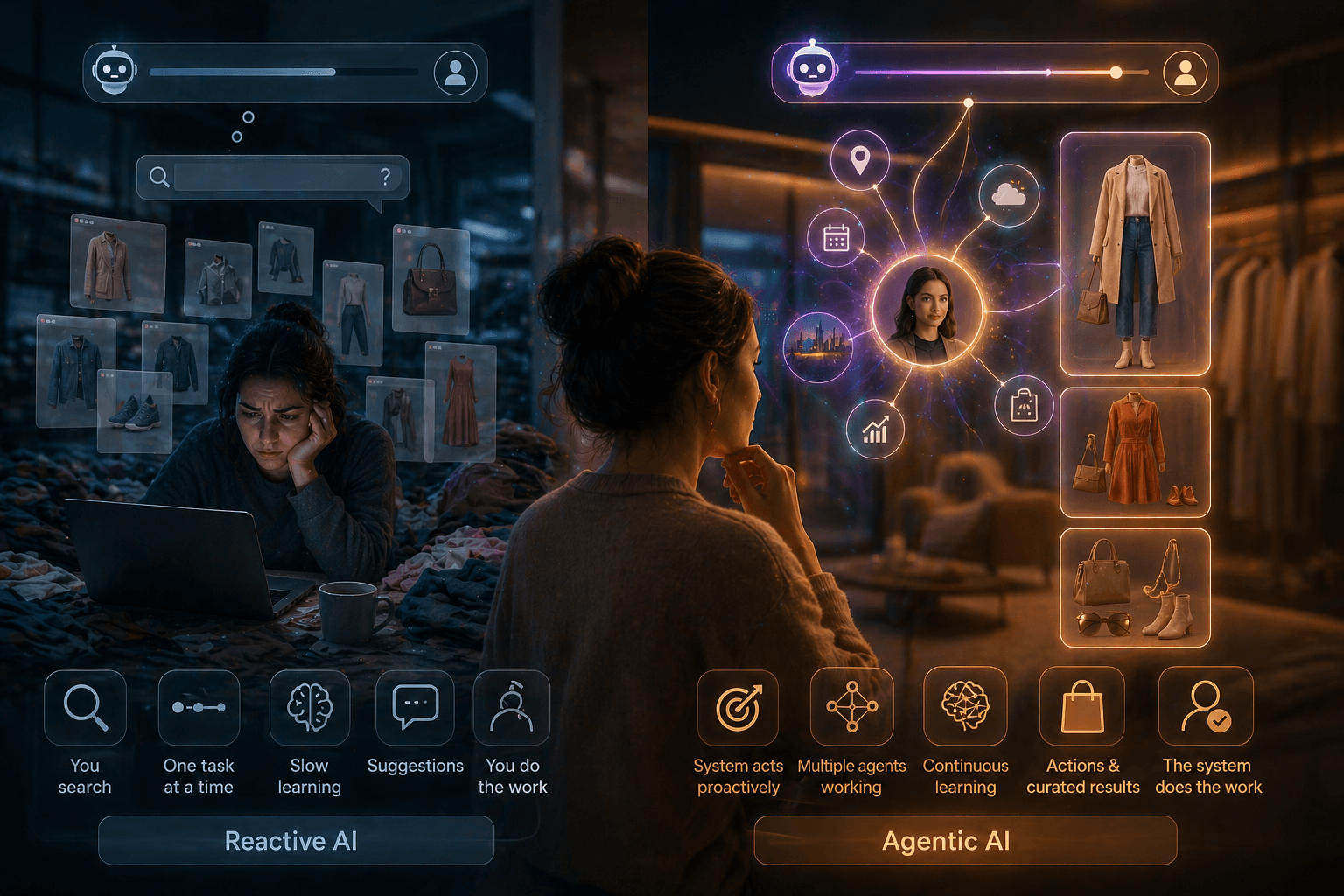
Most AI you've used so far is reactive. You ask it something, it responds. ChatGPT answers your question. A recommendation engine shows you "similar items." A chatbot responds to your support ticket. All of these are useful. None of them act on your behalf without being asked.
Agentic AI is different. It's designed to:
- Set goals and pursue them autonomously
- Coordinate multiple specialized processes simultaneously (not just one model doing one thing)
- Take action — not just generate suggestions
- Learn continuously from every interaction and refine its behavior over time
In a shopping context, that means an agentic AI system isn't waiting for you to search "fall outfit ideas." It's already tracking your dwell time on certain colors, noting that a cold front is hitting your city this weekend, seeing that you've been browsing occasion-specific looks, and proactively building a feed of complete outfits that match your life right now.
Reactive AI vs. Agentic AI: The Real Difference
| Reactive AI | Agentic AI | |
| Trigger | You ask or search | System acts proactively |
| Scope | One task at a time | Multiple agents working simultaneously |
| Learning | Static or slow-updating | Continuous, real-time |
| Output | Answers or suggestions | Actions and curated results |
| Shopping experience | "Here are results for your query" | "Here's what you actually need right now" |
According to the BoF-McKinsey State of Fashion 2026, shopping-related searches on generative AI platforms grew 4,700% between 2024 and 2025 — and 85% of consumers express higher satisfaction with AI-assisted shopping journeys than conventional ones.
The infrastructure is maturing fast. The global agentic AI market is projected to grow from $9.14 billion in 2026 to $139.19 billion by 2034, at a 40.5% CAGR — with North America leading adoption at 33.6% market share. We're not talking about a distant future. This is happening right now.
Why Is Traditional Ecommerce Failing Modern Shoppers?
Let's be real about why people are checked out on the traditional ecommerce experience.
The average American spends over 6.5 hours online per day. A meaningful chunk of that is spent shopping — browsing, clicking, comparing, abandoning carts, and starting over. It's exhausting. And the data reflects exactly how broken the experience is:
- 74% of customers walk away from online purchases because of the sheer volume of choice, according to the BoF-McKinsey State of Fashion 2025 report
- 76% of consumers feel frustrated when shopping experiences aren't personalized, per McKinsey's 2024 personalization research
- Only 14% of consumers rate retailers' search and product discovery as "A" grade, according to Envive's 2025 AI product discovery data
- Nearly 80% of shoppers spend more than half of their shopping journey just searching before they evaluate a single item, per Insider's 2025 commerce analysis
The root issue isn't too many products. It's that the model itself was never designed for how people actually make fashion decisions.
The Broken Loop Nobody Talks About
Here's what really happens when most people shop online:
- Open app or website → feel vaguely overwhelmed before typing anything
- Type a keyword → get thousands of results, none quite right
- Add filters → still 800 results
- Scroll for 20 minutes → find something okay
- Second-guess it → open three other tabs
- Abandon all of them → wear what you already own
Sound familiar? You're not alone. This is the default experience for millions of Americans every single day — and it's why agentic shopping vs ecommerce isn't just a tech debate, it's a quality-of-life conversation.
How Does an Intelligent Shopping Agent Actually Work?

Here's where it gets interesting. Agentic shopping isn't powered by one smart AI — it's powered by a network of specialized agents, each handling a different dimension of personalization, all feeding into a single coordinated output.
Here's what that looks like broken down simply:
Step 1: You as the Starting Point
Instead of a keyword, an intelligent shopping agent starts with you — your physical attributes, your behavioral history, your location, your context. No form to fill out. The system reads signals you're already generating.
Step 2: Multiple Agents, Simultaneously
Each agent in the network has a specific job:
| Agent | What It Does |
| Physical attribute agent | Analyzes skin tone, undertone, body type, face shape, hair color |
| Weather + location agent | Reads real-time climate in your specific city |
| Calendar + context agent | Tracks upcoming holidays, events, cultural moments |
| Trend intelligence agent | Monitors city-level and global fashion signals |
| Behavioral learning agent | Tracks dwell time, swipe speed, repeat color engagement, browse sequences |
Step 3: Synthesized Output — Not Products, Complete Looks
The agents don't hand you a product list. They produce complete styled outfits — color-matched to your undertone, weather-appropriate for your city, trend-aligned for the current moment, and contextually calibrated to what's coming up in your life.
Step 4: Continuous Learning
Every interaction — every pause, every swipe, every item you engage with or skip — feeds back into the system. It gets smarter with each session. Not because you adjust settings. Because you live your life and it learns.
This is what Glance's platform does in practice. A user shares a selfie and their location. The multi-agent system kicks in, cross-referencing physical attributes against trend data, weather, and behavioral signals from past sessions. What surfaces isn't a search result — it's a personalized discovery feed of complete looks that are genuinely built around that specific person. No search bar. No filters. No cognitive overhead.
As Google Cloud VP Carrie Tharp described it at the U.S. Chamber of Commerce in early 2026: AI is evolving "from a passive tool that offers prediction, to active, autonomous resources that can execute complex, multi-step, prescriptive actions across every consumer and operational touchpoint."
What Makes Agentic Shopping Different From Regular "AI Recommendations"?
This is a question worth answering directly — because a lot of platforms slap "AI-powered" on what is essentially a "customers also bought" widget with a new coat of paint.
Real agentic shopping is categorically different. Here's how to tell them apart:
"You Might Also Like" vs. Agentic Intelligence
| Feature | Standard AI Recommendations | Agentic Shopping |
| Data source | Past purchases, basic demographics | Behavioral micro-signals, location, weather, timing, attributes |
| Output | Individual products | Complete, contextual looks |
| Personalization depth | Category-level | Individual-level |
| Context awareness | None or minimal | Real-time (weather, events, season) |
| Learning speed | Slow, batch updates | Continuous, session-by-session |
| Search required | Yes | No |
| Who does the work | You | The system |
The difference isn't subtle. Standard recommendation engines show you more of what you already bought. Agentic shopping shows you what you actually want next — even when you don't know it yet.
McKinsey data shows AI-generated product recommendations deliver 4.4x higher conversion rates versus traditional search. That gap exists because the intent match is fundamentally better — the system isn't guessing, it's reading.
Where Is Agentic Shopping Already Showing Up in Real Life?
This isn't theoretical. Agentic shopping is live, in production, and changing how people discover and buy right now.
Macy's: From Search to Curated Discovery
Macy's recently introduced Ask Macy's, an AI agent enabling product discovery, personalized recommendations, and virtual try-on. At Shoptalk 2026, Macy's chief customer and digital officer Max Magni said: "It's not about search. It's about curated discovery. We're not just giving customers what they're searching for, but what they need and what they want."
Target + OpenAI: Shopping Inside the Conversation
OpenAI and Target announced a partnership to create a Target shopping experience within ChatGPT — where customers can receive recommendations, build carts, and check out directly through the interface. The product discovery now happens inside a conversation, not a search bar.
Gap Inc.: Agentic Commerce at Checkout
Gap Inc. made its products shoppable through Google Gemini via Google's Universal Commerce Platform (UCP), enabling seamless checkout across AI-native environments. A shopper asking Gemini for outfit recommendations can now complete the purchase without ever touching a traditional product page.
Daydream: Fashion Discovery at Scale
Daydream, a fashion-specific ai shopping agent, lets users enter preferences and interact with AI models specialized in fit, fabric, silhouette, and occasion — surfacing recommendations across 8,000 brands and 200 retail partners. It evolves with user behavior, functioning more like an ongoing style relationship than a search engine.
Glance: Discovery Without the Search Bar
Glance takes a distinct approach to the agentic shopping model — one that's less about conversational prompting and more about zero-input discovery. The platform's multi-agent system reads a user's selfie and location, then autonomously synthesizes physical attributes, trend signals, behavioral history, and real-time context to surface complete styled looks. Users don't type what they want. They engage with a feed that already knows them. The result is a discovery experience that feels like a personal stylist rather than an algorithm — and one that gets more accurate the more you use it.
What Does the Future of Agentic Shopping Look Like?
The future of agentic shopping isn't a single dramatic moment. It's a steady transition already underway — and the trajectory is clear.
The Numbers Tell the Story
- The agentic AI in retail and eCommerce market is estimated at $60.43 billion in 2026, projected to reach $218.37 billion by 2031 at a 29.29% CAGR
- According to eMarketer, AI platforms are expected to account for $20.9 billion in retail spending in 2026 — nearly quadrupling 2025 figures
- Roughly 23% of Americans already made purchases using AI in the past month
- BCG forecasts that by 2030, AI agents could mediate 15–25% of all U.S. e-commerce sales
- Shoppers arriving from AI services are 49% more likely to buy than those from traditional channels, according to eMarketer 2026
What's Next: The Zero-Search Era
The destination that all of this is building toward is zero-search commerce — a shopping experience where you never type a query because the system already knows what to surface.
This doesn't mean passive or generic. It means the opposite: a system so well-calibrated to your behavior, preferences, and context that the right products arrive in the right form at the right moment — consistently.
The behavioral learning compounds over time. The more sessions the system has, the more accurate it gets. Early adopters of agentic shopping platforms aren't just getting a better experience today — they're building a more personalized system for tomorrow.
Shopping as Delegation, Not Labor
McKinsey describes this as a shift from "personalization" — where a human is shown tailored options — to "delegation," where the agent autonomously researches, compares, and in some cases completes the purchase.
For fashion specifically, this means the cognitive overhead of getting dressed — figuring out what works together, what works for your coloring, what's appropriate for the occasion — moves from your brain to the system. You show up for the result. Not the research.
How Do You Actually Start Using Agentic Shopping Today?
Enough theory. Here's your action plan — practical, straightforward, and ready to implement right now.
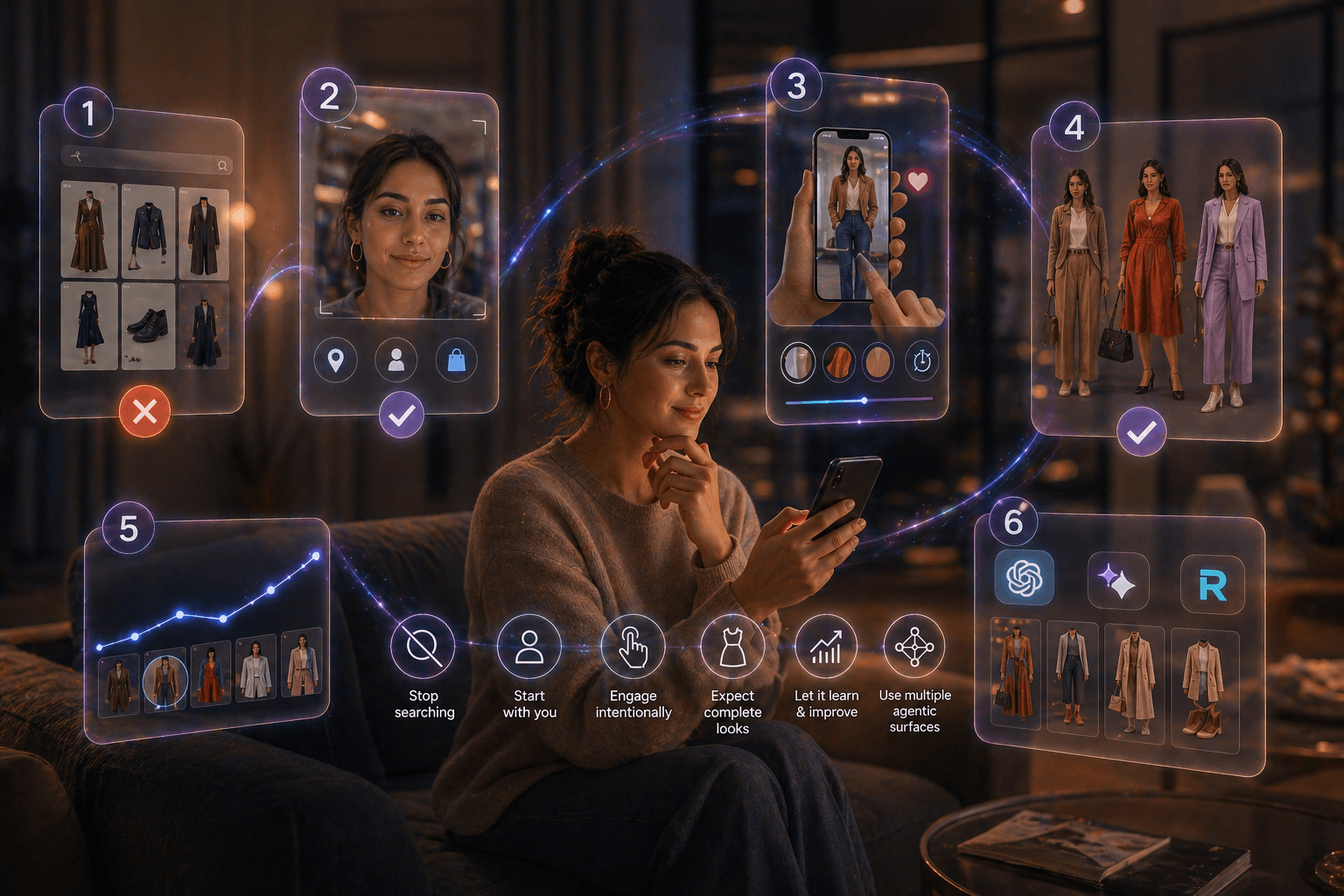
Action 1: Stop Starting With the Search Bar
The search bar is a high-intent tool for when you already know what you want. For fashion discovery — especially when you just know you want "something new" — it's the worst possible starting point. Break the habit.
Action 2: Find a Platform That Starts With You, Not a Keyword
Look for shopping experiences that begin with your attributes — a photo, your location, your behavioral history — rather than a text input. Platforms built on agentic shopping architecture don't need your keywords. They need your context.
What to look for:
- Does it surface complete looks, not just individual items?
- Does it factor in your location and real-time context?
- Does it get more accurate the more you use it?
- Does it require zero search to deliver relevant results?
If yes to all four — you're dealing with an actual agentic shopping system.
Action 3: Engage Intentionally — Your Behavior Is Your Input
In an agentic shopping system, every interaction is data:
| What you do | What it signals |
| Pause on an image for 5+ seconds | Genuine interest |
| Swipe fast past multiple looks | Not your vibe |
| Return to the same color family repeatedly | Color preference building |
| Linger on a complete styled outfit | Context + style alignment |
| Skip everything in a certain silhouette | Clear dispreference |
The more intentionally you engage, the faster the system learns. Think of it less like scrolling and more like a conversation you're having through your behavior.
Action 4: Expect Looks, Not Lists
If a platform is serving you individual products with no context — a blazer with no suggestion of what it goes with, a color with no consideration of your undertone — it's running old recommendation logic. Agentic shopping surfaces complete, styled, contextual looks. That's the bar.
Action 5: Let the System Compound
The biggest mistake people make with intelligent discovery platforms is dipping in once and expecting magic. The behavioral learning in these systems is cumulative — each session makes the next one better. Give it a few genuine sessions before you judge it. The compounding is real.
Action 6: Use Multiple Agentic Surfaces
Agentic shopping isn't one app. It's a growing ecosystem:
- Conversational agents (ChatGPT with integrated shopping, Google Gemini) — great for specific, described needs
- Behavioral discovery platforms (Glance, Daydream) — great for proactive, zero-search discovery
- Retailer-specific agents (Ask Macy's, Target in ChatGPT) — great for within-brand exploration
Use them differently, based on what you actually need. Conversational when you have a described intent. Discovery platforms when you want to be surprised by something that actually works.
Conclusion: You Shouldn't Have to Work This Hard to Find What You Want
Agentic shopping is the answer to a question most people have been living with for years without fully articulating it: why is online shopping this exhausting?
The search-first model put all the labor on you. The filtering, the scrolling, the comparison, the second-guessing. And it still delivered results that were mostly wrong for your actual life.
Agentic shopping moves that labor to intelligent systems — systems that know your undertone, read your city's weather, track what you've been drawn to, and surface complete outfits before you type a single character.
During the 2025 holiday season, AI was credited with driving 20% of all retail sales globally and generating $262 billion in revenue through personalized recommendations and better customer engagement. That number is going up every quarter. The behavior shift is already underway.
The shoppers who lean into agentic shopping now — building behavioral profiles, engaging with discovery-first platforms, letting intelligent systems do the heavy lifting — are the ones who'll spend less time frustrated and more time actually wearing things they love.
You deserve a shopping experience that works as hard as you do. Go find one that does.
Frequently Asked Questions
- What is agentic shopping and how is it different from regular online shopping? Agentic shopping is a model where AI systems act autonomously on your behalf — reading your behavioral signals, location, and context to proactively surface relevant products without you searching. Regular online shopping starts with a keyword you type. Agentic shopping starts with who you are and what your life looks like right now. The result is dramatically less effort and dramatically more relevance.
- What is an intelligent shopping agent?
An intelligent shopping agent is an AI system that autonomously handles the discovery, curation, and sometimes purchase of products on your behalf. Rather than waiting for a search query, it reads micro-behavioral signals — how long you pause on images, which colors you return to, what you browse in sequence — and builds a continuously improving model of your preferences to surface recommendations proactively. - How does agentic AI make shopping more personal?
Agentic AI coordinates multiple specialized processes simultaneously — one analyzing your physical attributes, one tracking local trends and weather, one monitoring your behavioral patterns, one identifying upcoming events. Together, they produce outfit recommendations calibrated to who you actually are, not a demographic approximation. The system gets more accurate with every session, compounding personalization over time. - What is the difference between agentic shopping and regular ecommerce?
In regular ecommerce, you do the work — searching, filtering, comparing, deciding. In agentic shopping vs ecommerce, the work moves to the system. An agentic platform proactively surfaces complete, contextual looks based on your behavior and real-world context. It requires no search query and improves automatically over time, compared to static product grids that treat every visitor the same. - Where is agentic shopping already available in 2026?
Multiple real platforms are live: Macy's Ask Macy's agent for curated discovery and virtual try-on; Target's integration with ChatGPT for in-conversation shopping; Gap's connection to Google Gemini via Universal Commerce Platform; Daydream for fashion-specific agentic discovery across 8,000 brands; and Glance, which uses a multi-agent system to deliver zero-search, behavior-driven fashion discovery. The ecosystem is expanding rapidly. - What does the future of agentic shopping look like?
The future of agentic shopping points toward zero-search commerce — where the right products arrive before you ask, driven by systems that know your context, preferences, and upcoming needs. By 2030, analysts project that 15–25% of all U.S. e-commerce transactions will involve some form of AI agent mediation, according to BCG. Behavioral learning compounds over time, meaning the experience gets meaningfully better the more you use it. - How do I start using agentic shopping today?
Start by finding platforms that begin with your context rather than a keyword — look for ones that surface complete styled looks, factor in your location and weather, and learn from your behavioral signals over time. Engage intentionally: pause on things you like, move quickly past things you don't. Every interaction teaches the system. The more genuine sessions you have, the more accurate the results become — and the less work you have to do yourself.
Download the Glance app now




Your intelligent
shopping agent.







Your intelligent
shopping agent.