


Agentic AI vs Generative AI: From Conversation to Action
TL;DR
In 2026, the Agentic AI vs Generative AI debate centers on "doing" versus "talking." While generative AI reacts to prompts to create content, agentic AI proactively executes complex goals like cross-platform shopping. By using persistent memory and tool integration, an intelligent shopping agent like Glance acts as a supportive side-character, transforming passive discovery into autonomous action for the modern US consumer.
In the rapidly shifting digital landscape of 2026, the American consumer is no longer just "searching"—they are delegating. While the previous two years were dominated by the novelty of chatbots, the current US market has bifurcated into two distinct technologies: Generative AI and Agentic AI.
Understanding the difference between Agentic AI vs Generative AI is the key to mastering what McKinsey calls the "Agentic Commerce" era, a market projected to mediate between $3 trillion and $5 trillion in global consumer spending by 2030.
However, the shift isn't just about the size of the market; it’s about the shift from conversation to action. While Generative AI has taught us how to talk to machines, Agentic AI is teaching machines how to work for us. To truly understand how this evolution is redefining the American shopping experience, we must look beyond the code and into the specialized roles these "intelligence layers" play in our daily lives—starting with the move from reactive chats to proactive results.
This shift is why the conversation around Agentic AI vs Generative AI has become central to understanding how modern commerce operates.
Agentic AI vs Generative AI: Content vs. Capability

To grasp the "Real Difference," one must look at the fundamental intent of each system. In the US fashion sector, this is the difference between an AI that can describe a "New York Autumn" look and one that can actually assemble it for you.
- Generative AI (The Informer): This technology is "prompt-bound." It excels at creating content—text, images, or summaries—but only when specifically asked. It is reactive.
- Agentic AI (The Executor): This is goal-oriented. Once it understands a high-level objective (e.g., "I need a wardrobe for a three-day tech summit in San Francisco"), it plans, reasons, and executes multi-step workflows autonomously.
Feature | Generative AI | Agentic AI (Intelligent Shopping Agent) |
Logic | Reactive (Responds to prompts) | Proactive (Acts on goals) |
Persistence | Session-based (Forgets once the tab closes) | Continuous (Learns and evolves over time) |
Integration | Isolated (Lives within a chat box) | Connected (Interacts with APIs, calendars, and brands) |
This comparison clarifies why the discussion around Agentic AI vs Generative AI is fundamentally about execution rather than output.
The US Market Landscape: Who is Leading the Charge?
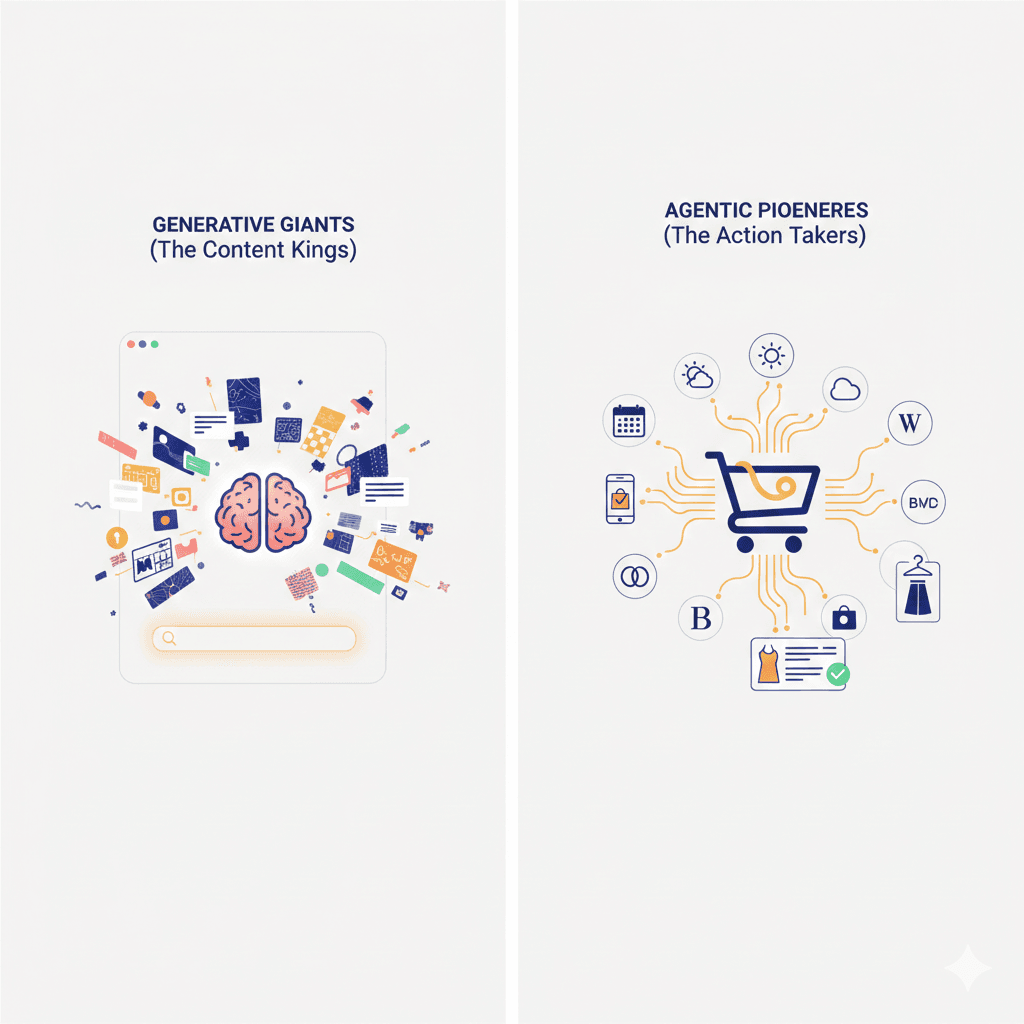
In the broader conversation around Agentic AI vs Generative AI, the US market has become a testing ground for both approaches.
1. The Generative Giants (The Content Kings)
Tools like OpenAI’s ChatGPT and Google’s Gemini initially focused on the generative layer. In the US, brands like Stitch Fix have integrated generative AI to analyze customer preferences and generate personalized styling descriptions. However, these systems still largely rely on the user to drive the conversation.
2. The Agentic Pioneers (The Action Takers)
The real shift toward "Agentic Shopping" is happening through specialized tools:
- Daydream: Launched by retail veteran Julie Bornstein, this fashion-focused agent uses conversational intelligence to navigate over 2,000 brands and 2 million items, acting as a personal stylist that understands "mood" and "occasion" rather than just keywords.
- Amazon’s "Buy For Me": A 2026 release that allows users to authorize an agent to shop across third-party websites, managing the checkout process autonomously.
- Glance: Glance is an intelligent shopping agent that operates in the fashion sector. It doesn't wait for a prompt; it uses ambient intelligence to surface trends based on your schedule and weather, ensuring the intelligence layer is always working in the background.
Data Insights: Why "Agentic" is the 2026 Standard
The transition from generative to agentic isn't just a trend—it's backed by significant market data.
- Productivity Gains: According to McKinsey’s January 2026 report, early adopters of agentic AI in retail have seen merchants reclaim up to 40% of their time by offloading manual data tasks to autonomous systems.
- Decision-Grade Usefulness: A Gartner study finds that 15% of IT leaders are already deploying autonomous agents, with a shift toward "outcome-driven" experiences where the AI resolves customer issues with 99.8% accuracy says Crescendo.ai.
- The Conversion Leap: Research from Envive indicates Brands using AI agents report 100%+ conversion rate increases, 70% search conversion improvements, and 38x return on spend.
The shift in measurable ROI further strengthens the argument in the Agentic AI vs Generative AI debate.
Real-World Case Study: Amazon’s Rufus and the "Agentic" Shift
The most significant proof of the Agentic AI vs Generative AI evolution is found in the 2025–2026 rollout of Amazon’s Rufus.
Initially, Rufus launched in early 2025 as a Generative AI assistant. It was designed to help users "evaluate" products by answering research-heavy questions like, "What are the best running shoes for trail marathons?" While this reduced research time, it created a new friction: users still had to manually compare 90-day price trends, check Prime delivery windows, and execute the final checkout.
In late 2025, Amazon deployed over 50 technical upgrades to shift Rufus toward an Agentic AI model. Instead of just being a "knowledgeable expert," the system became an autonomous delegate by integrating three core capabilities:
- Goal Setting: Users no longer just asked questions; they set objectives. By setting a "Target Price," the agent understood the desired outcome and monitored inventory 24/7.
- System Orchestration: The agent was granted "Buy For Me" authorization, allowing it to navigate third-party brand sites and bridge the gap between discovery and purchase when an item wasn't in the Amazon warehouse.
- Outcome Execution: For Prime members, the agent now tracks historical price data and automatically completes the purchase the moment a target discount is hit, managing the default payment and shipping without further human intervention.
The Result: According to Amazon’s Q4 2025 earnings report, customers who engage with this agentic workflow are 60% more likely to complete a purchase during their shopping journey. By moving from a generative "answering" tool to an agentic "buying" partner, Amazon generated nearly $12 billion in incremental annualized sales in 2025 alone.
Technical Architecture: How They Differ
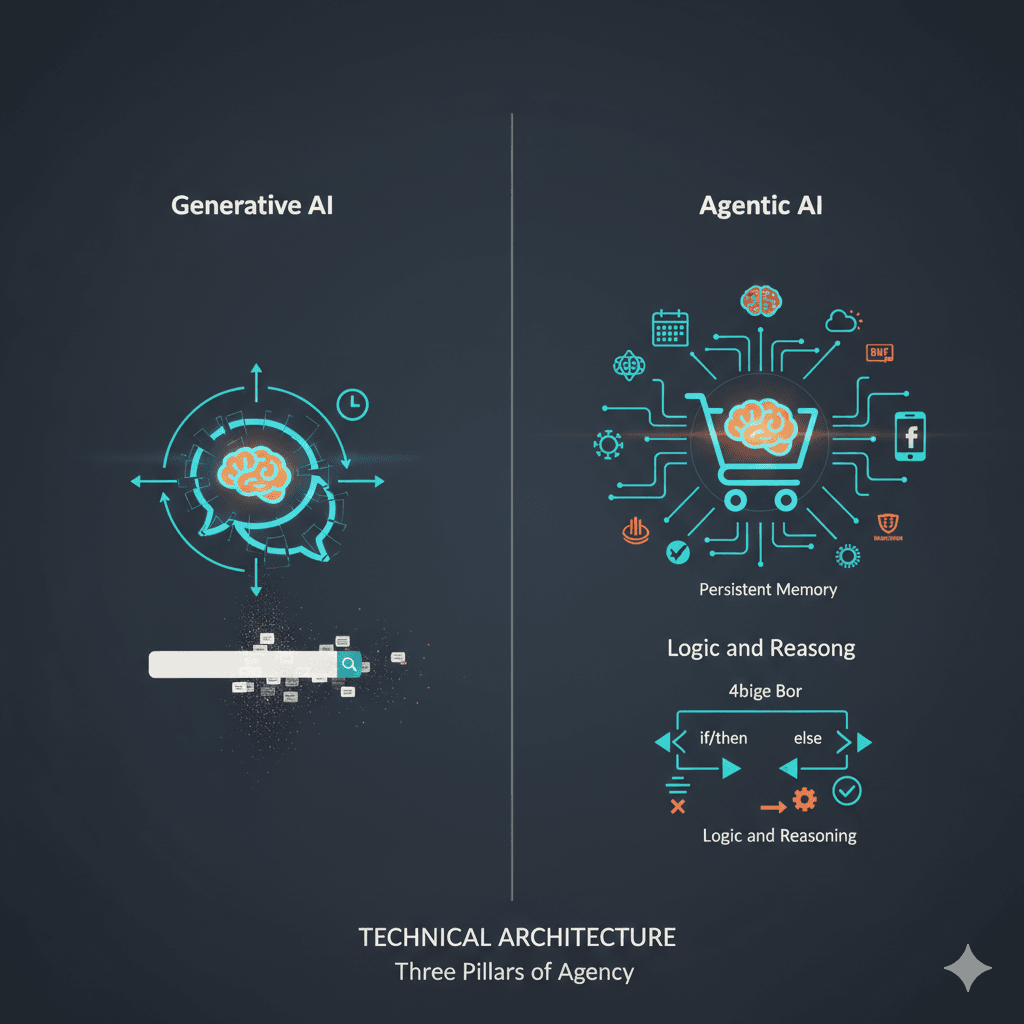
To understand the core of Agentic AI vs Generative AI, we must look at the "Three Pillars of Agency" that standard Generative AI lacks.
I. Persistent Memory
Generative AI is typically "stateless." It treats every prompt as a new interaction. An intelligent shopping agent, however, maintains a "Digital Body Language" profile. It remembers your preferences across sessions, meaning you never have to explain your favorite fabrics or "off-limit" colors twice.
II. Tool Integration (Action)
Generative AI stays in its box. Agentic AI uses System Orchestration. It can talk to your calendar (to see you have a wedding), your weather app (to see it's raining), and brand APIs (to see what's in stock).
III. Logic and Reasoning
If a Generative AI hits a "404 error" or a sold-out item, it simply reports the failure. An agentic system perceives the obstacle, adjusts its plan, and finds an alternative that still meets the user's original goal.
Fun Fact: The 400 BCE "Robot"
While the debate over Agentic AI vs Generative AI feels modern, the dream of "agentic" machines is ancient. In 400 BCE, Archytas of Tarentum created a mechanical pigeon that could fly independently using steam. It was an "agent" because it had a goal and the autonomy to act without a human pulling a string for every wing-flap. Today, our "pigeons" are digital agents like Glance, navigating the vast US fashion market on your behalf.
Conclusion: The Luxury of Delegation
For the busy US professional, the choice between Agentic AI vs Generative AI is ultimately a choice between more work and less friction. While generative tools give you something to read, an intelligent agent gives you something to wear. By acting as a supportive side-character that understands your context, an agent like Glance allows you to skip the search bar and move directly to discovery.
Glance It – Shop It.
FAQs related to Agentic AI vs Generative AI
1. What is the core difference between Agentic AI vs Generative AI?
According to IBM, Generative AI is primarily reactive and focuses on creating content (text, images) based on specific prompts. AI agents are proactive and goal-oriented; they can use tools, access APIs, and execute multi-step tasks autonomously to achieve a specific result, such as finding and purchasing a product, without needing a human to prompt every step.
2. How does an intelligent shopping agent like Glance fit into this?
Glance functions as an intelligent shopping agent within the fashion sector. While many AI tools are "hero" apps you must talk to, Glance acts as a supportive side-character. It uses ambient intelligence to learn your style and schedule, surfacing relevant fashion finds in the background so you don't have to spend time searching.
3. Which AI shopping agents are popular in the USA right now?
As of 2026, the US market features several specialized agents. Daydream is a leader in conversational fashion search, while Amazon has introduced "Buy For Me" for cross-platform shopping. These agents differ from basic chatbots because they can interact with brand APIs to handle real-time inventory and pricing.
4. Why is Agentic AI seeing a higher ROI than Generative AI?
BCG research shows that AI agents deliver an average ROI of 13.7% because they move beyond "content creation" and into "process transformation." While Generative AI helps individuals write faster, Agentic AI automates entire workflows—like the discovery-to-checkout journey—reducing the manual effort required from the consumer.
5. Does an AI agent manage my privacy during a purchase?
Yes. A key feature of an intelligent shopping agent is the "Invisible Hand-off." Once the agent helps you discover an item, it redirects you directly to the original brand's website. This ensures your payment and personal data remain with the retailer you trust, while the agent only manages the "intelligence layer" of discovery.
Download the Glance app now






Your intelligent
shopping agent.







Your intelligent
shopping agent.