


Agentic AI: From Prompting to Autonomous Action
TL;DR
- Agentic AI moves beyond chat and content generation to autonomously plan, execute, and optimize multi-step goals.
- Unlike generative AI, agentic AI integrates memory, tools, and feedback loops to act in dynamic environments.
- U.S. enterprises are deploying agentic AI to improve productivity, reduce operational friction, and enhance decision speed.
- Commerce and fashion are emerging as everyday proving grounds for agentic AI due to high-frequency, constraint-driven decisions.
From Reactive AI to Autonomous Agents: Why This Shift Is Happening Now
For most of the past decade, artificial intelligence has answered questions. It recommended movies. It summarized emails. It wrote code snippets. It responded when prompted.
But in 2025 and 2026, something shifted.
According to the Stanford 2024 AI Index, global private investment in AI reached $67.2 billion in 2023, with the United States leading overall AI investment activity. This surge reflects not just interest in generative models, but expanding enterprise deployment of systems capable of decision support and automation.
The evolution toward agentic AI marks a turning point. Instead of reacting to prompts, systems now:
- Interpret goals
- Plan multi-step tasks
- Use external tools
- Evaluate outcomes
- Adjust autonomously
This is not incremental improvement. It is structural change.
The story of agentic AI is not about better chat. It is about autonomy in decision-making.
What Is Agentic AI?
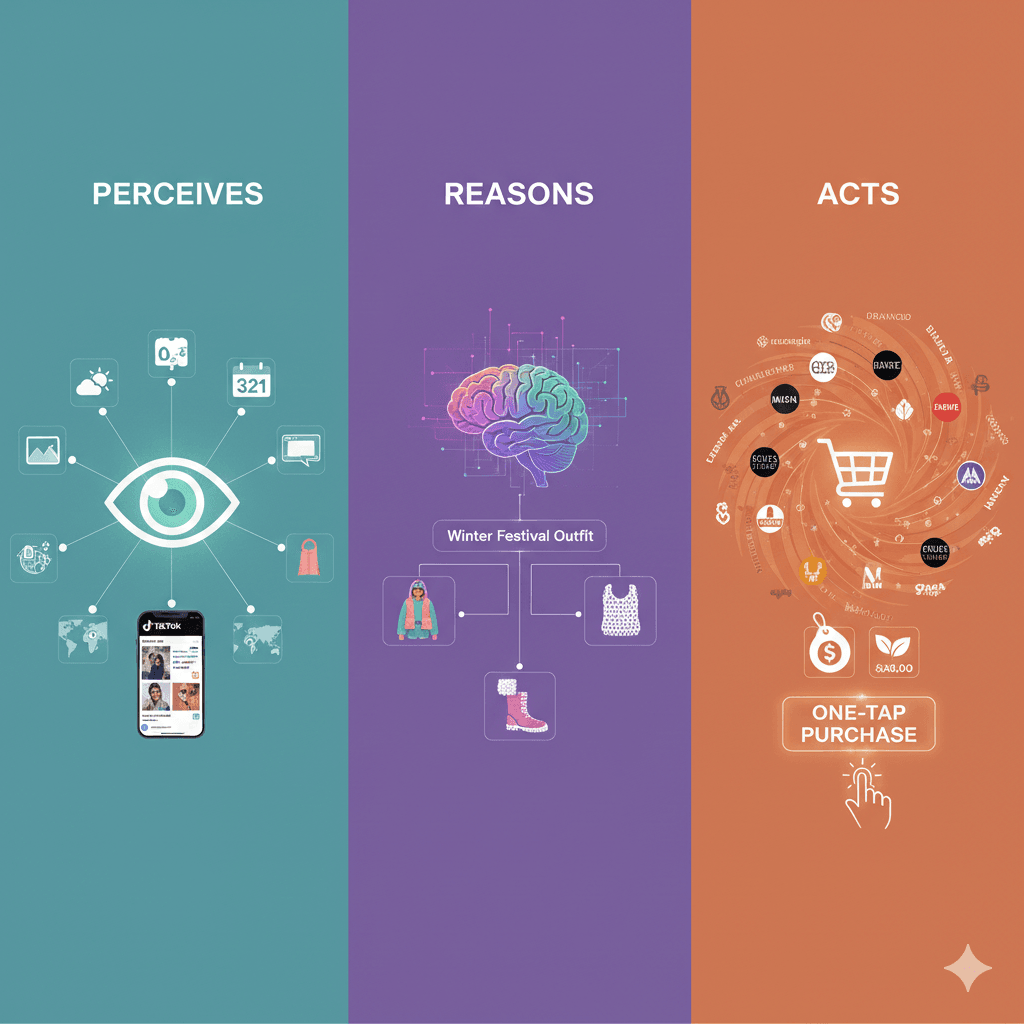
Agentic AI refers to artificial intelligence systems designed to pursue goals autonomously, using planning, memory, and tool integration to execute tasks with limited human intervention.
Unlike traditional generative systems that produce outputs in isolation, agentic AI operates through:
- Goal interpretation
- Task decomposition
- External tool usage
- Feedback monitoring
- Iterative decision refinement
The National Institute of Standards and Technology (NIST) emphasizes in its AI Risk Management Framework that AI systems increasingly operate in dynamic environments where risk must be continuously assessed rather than statically defined. This aligns closely with the operational model of agentic AI, which relies on adaptive reasoning.
Put simply:
Generative AI talks.
Agentic AI acts.
Evolution of AI: From Rules to Autonomy
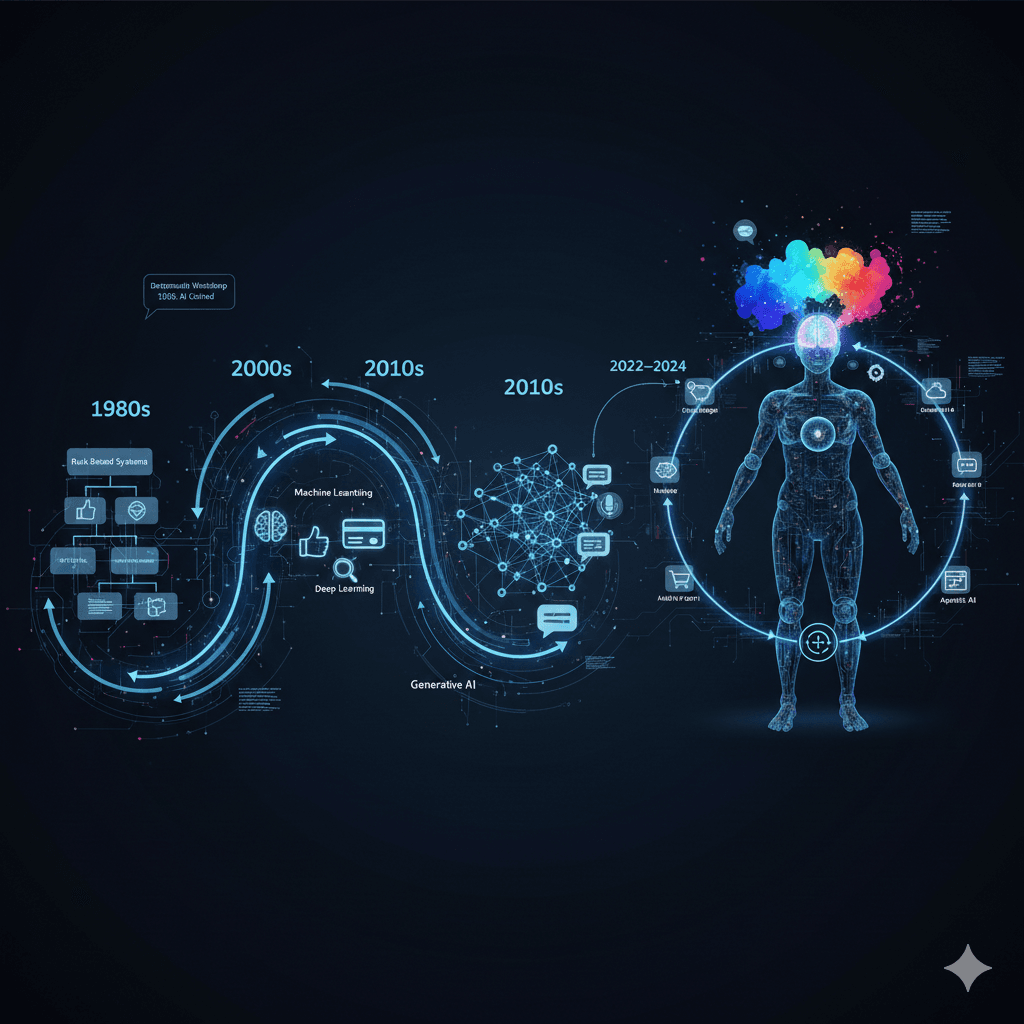
The journey to Agentic AI wasn't a random leap. It was a disciplined march across decades of computing milestones. To understand where we are, we have to see how we got here. Many of the conceptual diagrams used to explain this evolution are often created using stock vectors, which help visualize complex AI systems in a clearer and more structured way.
- Rule-Based Systems (The Logic Gate Era): Think of the 1980s "Expert Systems." They followed strict "If-Then" logic. If the light is red, stop. If the stock drops 5%, sell. No nuance, no learning.
Did you know?
In 1956, the Dartmouth Workshop officially coined the term “artificial intelligence.” Researchers believed machines could simulate human reasoning within a generation. That optimism was premature—but foundational.
- Machine Learning (2000s): The era of pattern recognition. This is how Netflix knows you like 90s rom-coms and how your bank flags a "suspicious" purchase in a state you've never visited.
As of 2024, Machine Learning still accounted for a 30.4% revenue share in the global market because it remains the backbone of prediction. According to the Stanford AI Index, the growth of large-scale datasets and GPU computing power in the 2010s dramatically accelerated AI performance benchmarks.
- Deep Learning (2010s): The "Neural Network" boom. Machines started "seeing" (computer vision) and "hearing" (natural language processing) with human-like accuracy.
Companies like OpenAI and Google DeepMind advanced transformer-based architectures that power modern large language models.
- Generative AI (2022–2024): This is the ChatGPT moment. Systems like OpenAI’s GPT and Google’s Gemini taught us that machines could be creative and conversational.
According to a McKinsey report, GenAI could add up to $4.4 trillion annually to the global economy. But GenAI is a "passive" tool—it waits for your prompt.
- Agentic AI (2025–Present): This is the next stage. Unlike a standard chatbot that answers a question, an Agentic AI system takes a goal—like "organize a business trip to Seattle"—and executes it. It books the flight, finds a hotel, and manages the calendar.
- The era of Action. We have moved from Generating content to Executing goals.
Did You Know? The concept of an "agent" actually dates back to 400 BCE! Archytas of Tarentum created a mechanical pigeon that could fly independently using steam. It was an "agent" because it had a goal (flight) and the autonomy to act without a human pulling a string for every wing-flap.
Agentic AI vs Generative AI
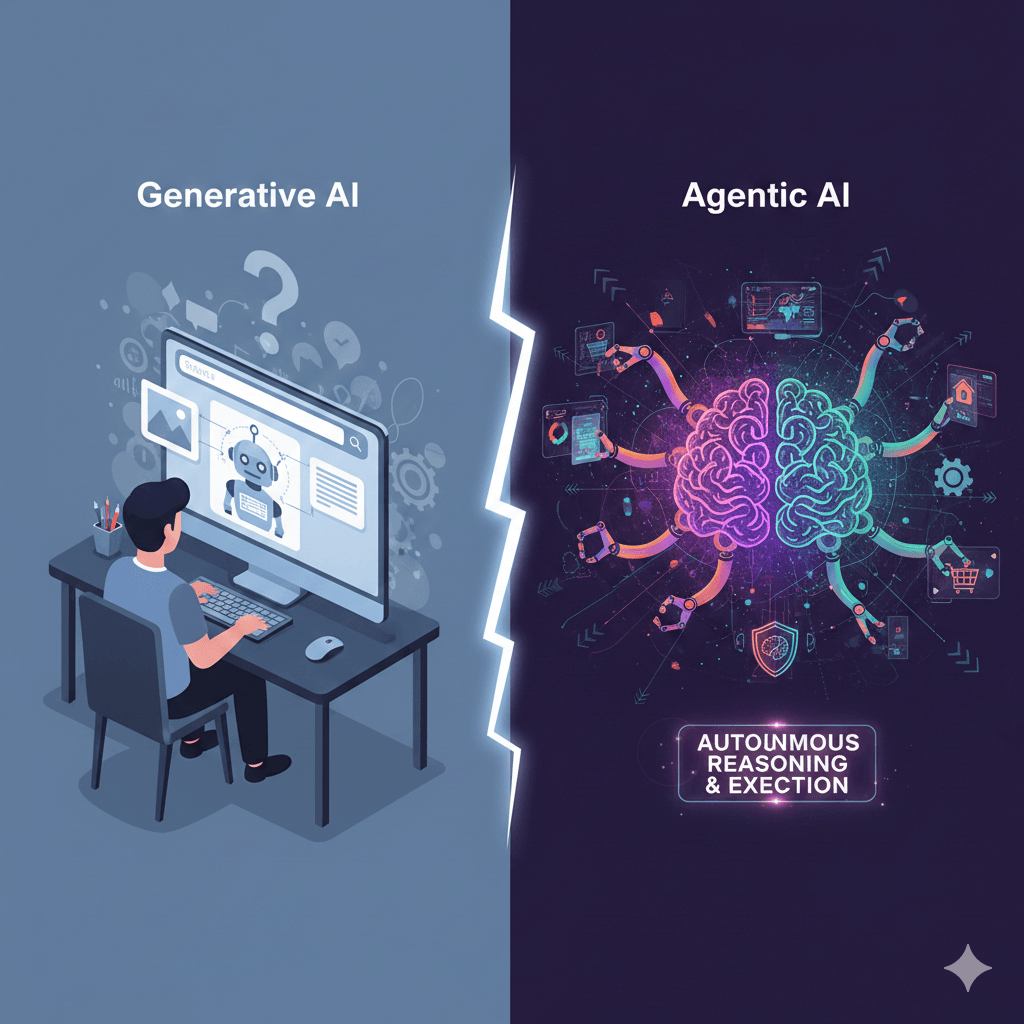
While generative AI remains valuable, the distinction is operational:
Feature | Generative AI | Agentic AI |
Trigger | Prompt-based | Goal-based |
Memory | Session-limited | Persistent |
Tool Usage | Limited | Integrated |
Autonomy | Low | High |
Execution | Text/Image Output | Multi-step Task Completion |
The Stanford AI Index notes increasing research into AI agents capable of complex reasoning tasks beyond single-step generation.
The difference is not scale—it is structure.
Technical Architecture of Agentic AI

What makes Agentic AI different from a standard chatbot? It’s all in the plumbing. While a chatbot is mostly just a "mouth" (the LLM), an agent is a full "body" with a nervous system and memory.
The Core Components
- LLM (The Brain): This provides the reasoning logic. It’s the engine that understands context and intent.
- Memory Layer (Short & Long-Term): Traditional generative systems are often session-based.
By contrast, agentic AI uses memory layers:
- Short-term: "In-context" memory that tracks the current conversation.
- Long-term: Utilizes Vector Databases (like Pinecone) to store user preferences and historical data.
Persistent memory enables contextual continuity across sessions.
- Planning Module: This is where the agent breaks a big goal into small steps. "Buy a coat" becomes: 1. Check budget. 2. Scan weather. 3. Find wool-free options. 4. Compare reviews.
- Tool Integration Layer (APIs, Browser, Apps): This is the layer that connects the brain to the world. It’s the reason the agent can actually click "Add to Cart," check your Google Calendar, or pull real-time weather data.
- Decision Engine & Feedback Loop: Unlike static models, agents use a feedback loop to self-evaluate. If a chosen tool fails, the agent reasons why and tries a different path.
Single-Agent vs. Multi-Agent Systems
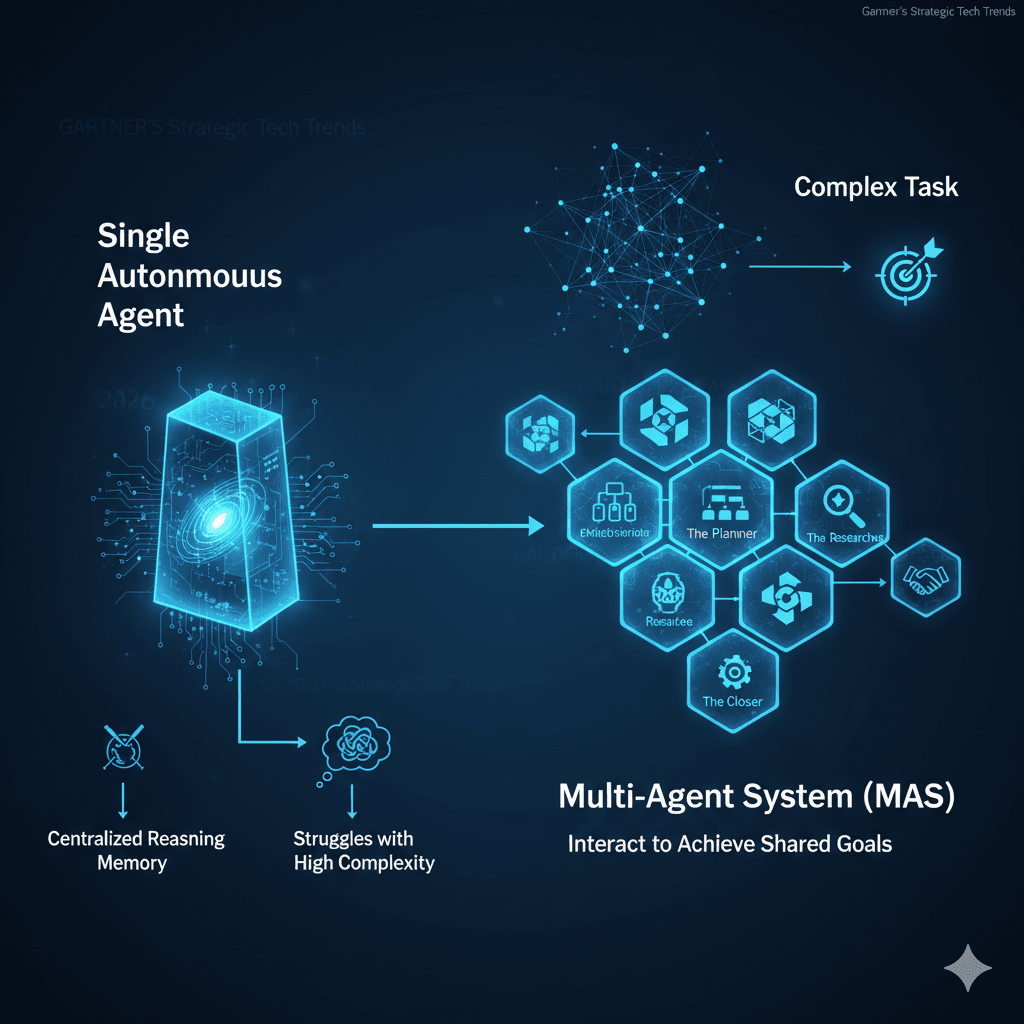
In the U.S. market, we are seeing a shift from "one AI for everything" to specialized "AI teams."
- Single Autonomous Agent: Think of this as a highly skilled freelancer. It takes a centralized approach, consolidating all reasoning and memory into one instance. These are simpler to design but can struggle with high-complexity tasks that require diverse expertise.
- Multi-Agent Systems (MAS): This is a corporate office. According to Gartner’s 2026 Strategic Tech Trends, multi-agent systems consist of multiple agents that interact to achieve individual or shared complex goals. One agent (The Planner) gathers info, another (The Researcher) validates data, and a third (The Closer) executes.
Milvus highlights that while single-agent systems reduce coordination overhead, MAS offers inherent scalability and robustness—if one agent fails, the entire system doesn't necessarily crumble.
Business Impact & ROI: The American Bottom Line
For US enterprises, Agentic AI isn't a hobby—it’s a competitive necessity. The data shows that companies moving past "chatting" into "doing" are seeing massive returns.
Economic Impact by the Numbers
- Productivity Gains: According to a January 2026 McKinsey report, early adopters in the US retail sector have seen merchants reclaim up to 40% of their manual task time by delegating data entry and inventory management to agents.
- Operational Efficiency: Deloitte found that retailers implementing AI-driven supply chain optimization achieved a 30% reduction in stockouts and a 20% decrease in excess inventory.
- Market Growth: Fortune Business Insights projects the global agentic AI market to grow from $9.14 billion in 2026 to $139.19 billion by 2034, at a CAGR of 40.50%.
- Profit Impact: McKinsey notes that AI-led dynamic pricing alone can increase retail margins by 2–5%, a significant jump in low-margin industries.
Case Study: Walmart’s "Super Agents" (2025-2026)
Walmart's actual Super Agents rollout, confirmed across Reuters, the Wall Street Journal, and Walmart's own statements, is real and substantial — just not the specific scenario above. In July 2025, Walmart consolidated over 200 task-specific bots into four domain-level "Super Agents": Sparky (customer-facing), Marty (supplier and advertiser-facing), an associate agent, and a developer agent. Walmart U.S. CEO John Furner told the Wall Street Journal that these agents are expected to drive both revenue growth, through more personalized customer interactions, and cost savings, through operational efficiencies like inventory and supply chain management.
The real weather-related precedent: during Hurricane Ian in 2022, Walmart's AI systems automatically rerouted shipments and adjusted inventory across its network within hours — not because the response was pre-programmed for hurricanes specifically, but because the models had learned from historical disruption patterns and real-time data. A damaged distribution center stayed offline for seven days without customers noticing supply disruptions, according to reporting originally from CIO Dive (December 13, 2022), cited here via a secondary source.
On Sparky specifically, Furner provided real, current performance numbers in May 2026: weekly active users were up over 100% quarter-over-quarter, and Walmart's continued investment had improved "Sparky intelligence and response quality by 40%" that year — a genuine 40% figure, just attached to a different metric than the one originally claimed here.
Human-in-the-Loop vs. Fully Autonomous
As Agentic AI takes on more power, the question of supervision becomes critical.
- Fully Autonomous: Ideal for low-risk, high-frequency tasks like reordering office supplies or managing email filters.
- Human-in-the-Loop (HITL): Essential for high-stakes decisions. Ganesh Velayudham, a technical architect, notes that "human approval gates aren't bottlenecks—they're quality control points where business judgment adds real value to automated decisions."
Risk Thresholds: US systems are increasingly built with triggers where any transaction over a certain dollar amount or any decision affecting safety (like medical dosage) requires an explicit human "Green Light."
Governance, Ethics & Safety
Trust is the currency of 2026. To build it, Agentic AI must follow strict governance frameworks.
- AI Alignment: Ensuring the agent's goals stay aligned with human values and specific company policies.
- Data Privacy: US shoppers are rightfully concerned. The "Invisible Hand-off" model ensures agents never "own" your credit card data; they simply facilitate the connection to the brand's secure checkout.
- Regulatory Landscape: The White House’s December 2025 Executive Order emphasizes "Explainability." If an agent denies a mortgage or flags a transaction, it must be able to explain the "why" to the user.
Limitations & Real-World Constraints
Balanced authority requires acknowledging risk.
- Over-Automation Risk: Excessive reliance can reduce human oversight.
- Hallucinations: LLM-driven reasoning layers may still produce incorrect assumptions.
- Infrastructure Costs: Deploying persistent memory and orchestration layers requires significant cloud investment.
- Regulatory Uncertainty: While the EU AI Act provides structured regulation, U.S. federal AI regulation is still evolving.
- Accountability Questions: If an autonomous system makes a decision, who is responsible?
Agentic AI introduces operational gains—but also governance complexity.
Why Commerce Becomes the First Everyday Expression of Agentic AI
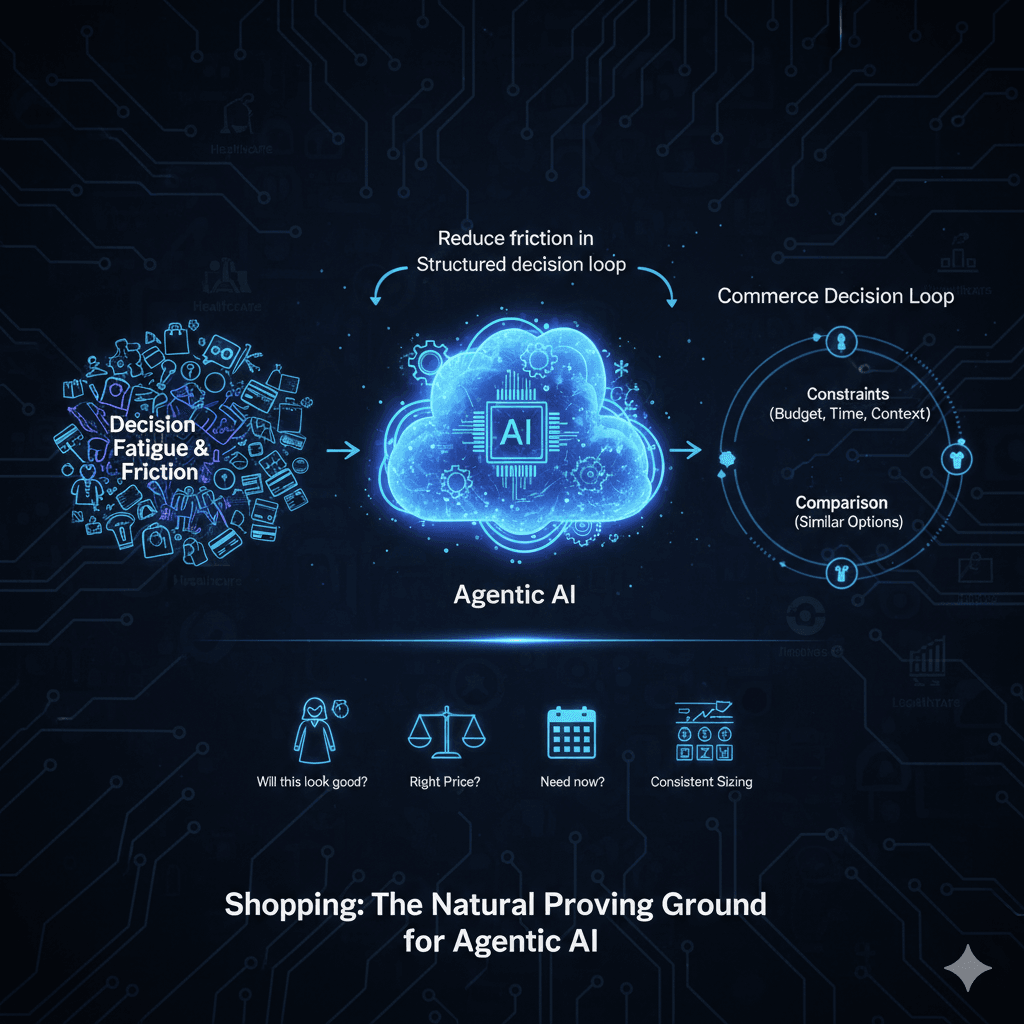
Up to this point, we’ve looked at agentic AI through the lens of architecture, autonomy, and enterprise deployment.
But agentic AI doesn’t exist to impress engineers.
It exists to reduce structured decision loops.
A structured decision loop has three traits:
- It happens frequently.
- It involves constraints (budget, time, context).
- It requires comparison across similar options.
Healthcare has them.
Finance has them.
Logistics has them.
But the most repeated structured decision loop in daily American life?
Shopping.
Shopping is where decision fatigue shows up fastest.
You’re not just buying a product. You’re asking:
- Will this actually look good on me?
- Is this the right price?
- Do I need this now or am I impulse buying?
- Why does every brand size differently?
Multiply that across work clothes, weekend outfits, travel, gifts, and seasonal shifts — and suddenly shopping becomes one of the most repetitive, mentally draining tasks in everyday life.
That’s why commerce becomes the most natural proving ground for agentic AI.
Because shopping isn’t just about products.
It’s about reducing friction.
And friction is exactly what agentic AI is built to handle.
The Logic of Delegation: Why We’re Letting AI Help Us Shop
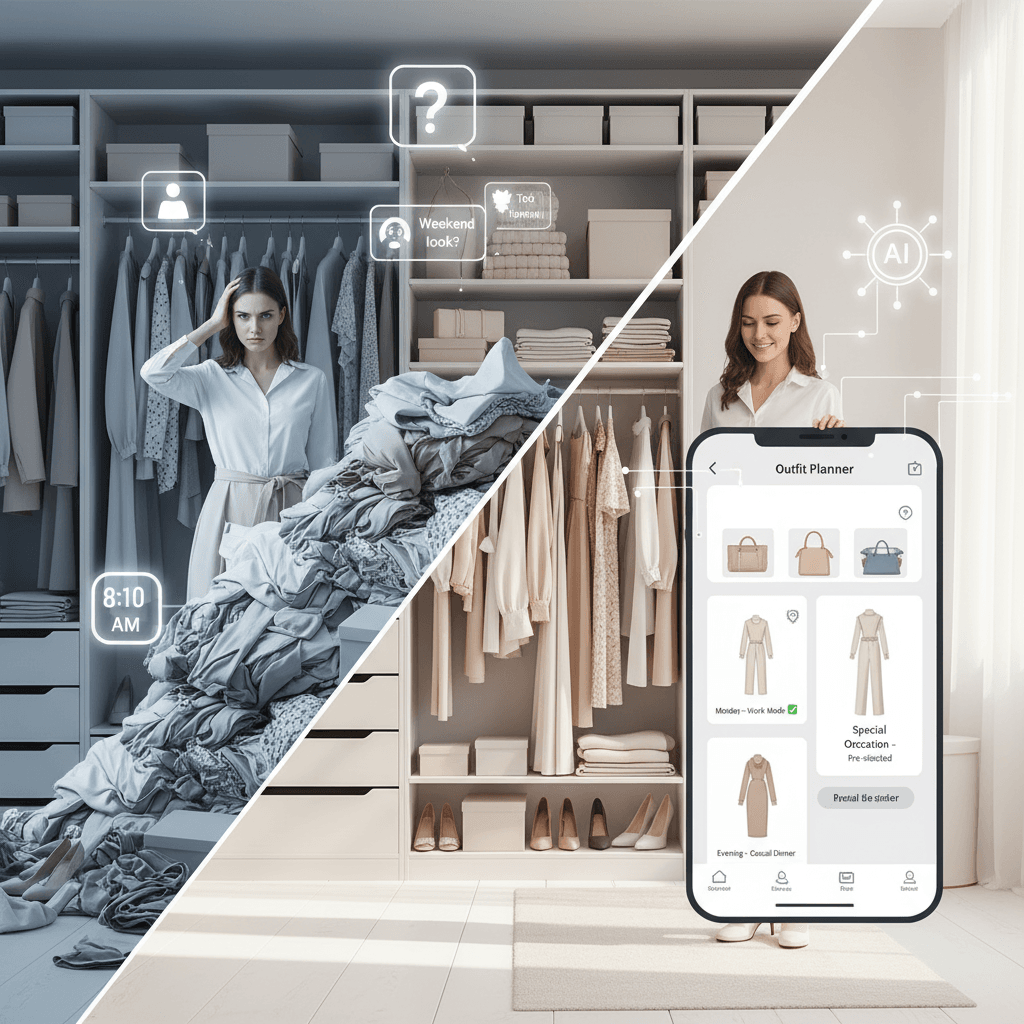
The shift from a general-purpose AI to a specialized Intelligent Shopping Agent is driven by one thing: the exhaustion of the American consumer. A study dating back to 2006 — still the most-cited figure on this — found the average person makes about 227 decisions a day on food alone; when you add fashion into the mix, "Choice Overload," a concept detailed by The Decision Lab, leads to a total shutdown of the shopping experience.
What is Agentic Shopping? (The 2026 Reality)
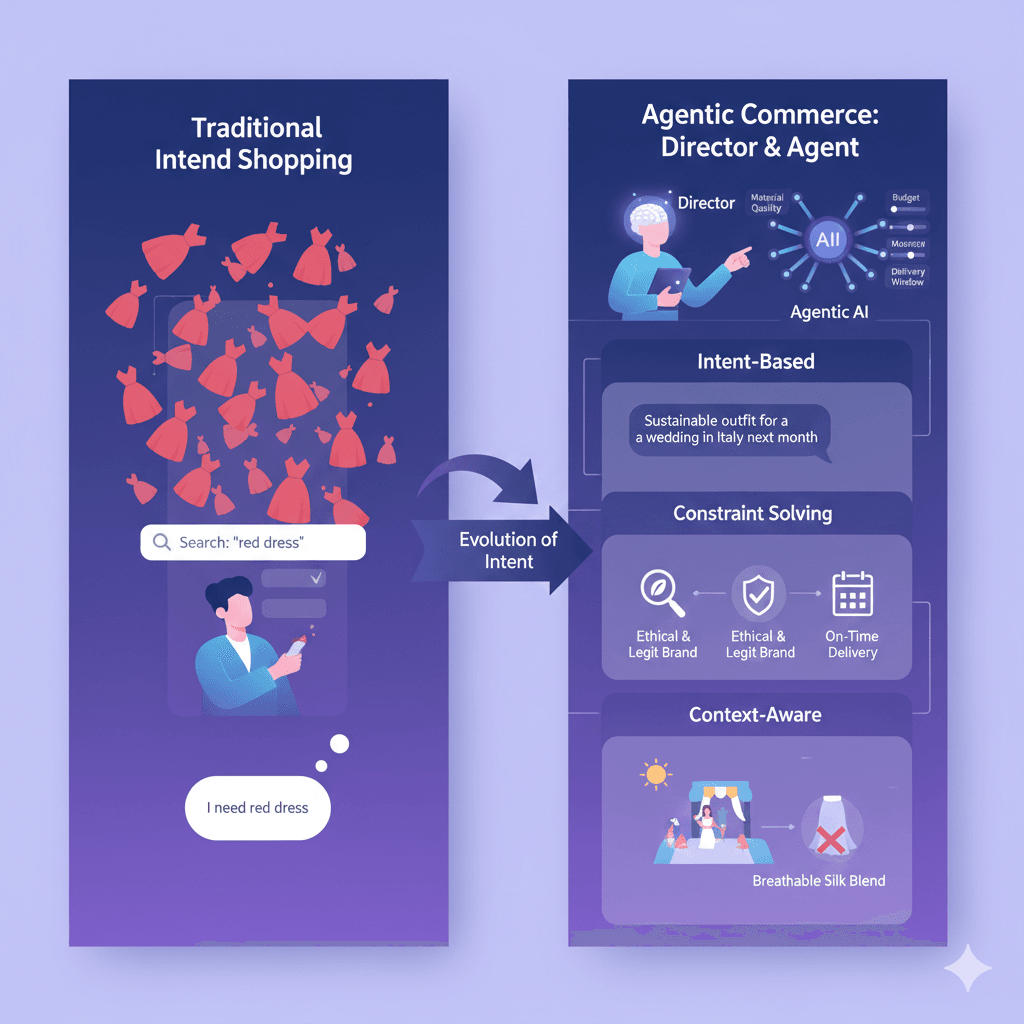
Agentic shopping is the evolution of commerce from a "Librarian" model (where you find the book) to an "Assistant" model (where the book is summarized and delivered). At its core, it means deploying an intelligent digital agent—think of it as an always-on, highly trained personal shopper—to handle the "Messy Middle" of research, comparison, and checkout on your behalf.
How the Shopping Flow Actually Changes
Traditional e-commerce is Product-Driven (Search → Filter → Compare → Buy). Agentic commerce is Outcome-Driven.
Step | Traditional E-commerce Flow | Agentic AI Shopping Flow |
Trigger | "I need to search for a blue waterproof jacket." | "I'm going hiking in Acadia next week." |
Workload | User scrolls 50 reviews and compares prices. | Agent scans weather, checks size, and finds top-rated items. |
Logic | Static keyword matching. | Dynamic intent reasoning (Planning Module). |
Outcome | 15 minutes of manual labor. | 15 seconds of curated discovery. |
Main Use Cases for Agentic Commerce and Autonomous AI Shopping
Across every real deployment so far, the same handful of use cases keep showing up:
1. Autonomous shopping concierges
An agent takes a stated goal — not a keyword — and researches, compares, and narrows options on its own. Amazon Rufus and Walmart's Sparky are both live examples of this today.
2. Fit, sizing, and compatibility assurance
Agents cross-reference body data, prior purchases, and return patterns to resolve "will this fit me" before checkout — the single biggest driver of the $816 billion annual returns problem described above.
3. Agent-initiated checkout and payment
Google's Agent Payments Protocol lets an agent complete a purchase on a merchant's own site without the user manually checking out — a "buy for me" flow rather than a "show me options" one.
4. Subscription and replenishment automation
Fully autonomous reordering of household staples — detergent, pet food, vitamins — is one of the most mature near-term use cases, since the low stakes make it a natural fit for zero-oversight automation.
5. B2B procurement and vendor negotiation
Agentic AI in B2B settings automates purchasing workflows, invoice reconciliation, and vendor negotiation — extending the same autonomous-decision model from consumer shopping into enterprise purchasing.
6. Proactive, zero-search fashion discovery
Glance's multi-agent model reads physical features, context, and behavior to surface complete outfit looks before a user searches at all — the fashion-specific expression of the same underlying shift.
Why Marketplaces are Pivoting to Agency
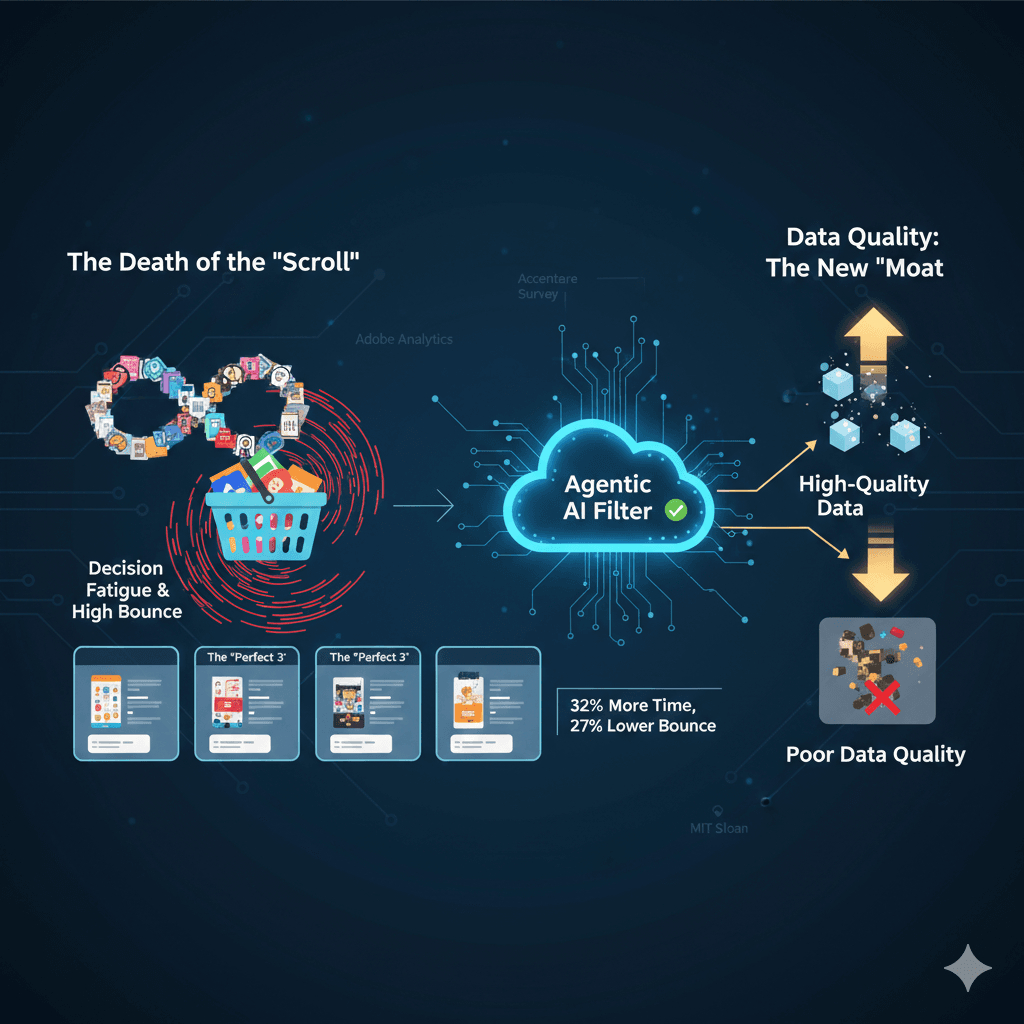
The shift isn't just for consumers; it’s a survival strategy for the world’s biggest platforms. In 2026, Adobe Analytics reports that visitors arriving via generative AI tools spend 32% more time on-site and have a 27% lower bounce rate.
The Death of the "Scroll": Beating Decision Fatigue
The "Infinite Aisle" of the internet has become a burden. A 2024 Accenture survey found, 74% of consumers abandoned their shopping baskets in the last three months simply because they felt bombarded by content, overwhelmed by choice and frustrated by the amount of effort they need to put into making decisions. Agentic AI acts as a filter, reducing the cognitive load from 500 choices down to the "Perfect 3."
Data Quality as the New "Moat"
Agentic shopping is only as good as the data it ingests. In 2026, MIT Sloan research notes that 82% of executives identify "data quality" as the primary barrier to AI success. For brands, this means accuracy and structure are no longer optional—if an agent can’t "read" your product, it won’t recommend it.
Agentic Shopping Across the US Giants
The "Big Three" of US retail have already integrated these agents into their core infrastructure:
- Amazon (Rufus & Help Me Decide): Amazon Rufus has generated over $12 billion in incremental sales by facilitating natural-language discovery. It moves past simple filters to answer context questions like, "Is this backpack good for a rainy commute?"
- Walmart (Super Agents): Walmart’s "Sparky" speeds up decision-making for complex scenarios, like finding a family-sized rice cooker with specific safety ratings.Weekly active users are up over 100% quarter-over-quarter, with Walmart crediting continued investment for a 40% improvement in Sparky's intelligence and response quality this year, according to CEO John Furner.
- Google (AI Mode): Google's Agent Payments Protocol now allows for secure, "Buy for me" functionality, enabling agents to execute purchases directly on merchant sites without the user ever touching a checkout button.
Where Glance Fits: The Shift from Platforms to Agents

As marketplaces embed AI tools inside their own walls, a different category is emerging: agents built around Behavioral Intelligence and Dynamic Personalization. Glance operates as a crucial layer in this ecosystem. It is an intelligent shopping agent, not a marketplace. Its role is to bridge the gap between your real-world behavior and the infinite inventory of the web Glance It – Shop It.
The "AI Twin": Your Evolving Style Counterpart
Glance is structured around a dynamic AI Twin—a digital counterpart that learns continuously from your behavior. Unlike static recommendation systems that rely on what you say you like, Glance’s Self-Learning Personalization Engine adapts based on micro-behavioral signals:
- Dwell Time: How long you pause on a specific silhouette or color.
- Swipe Speed: Recognizing the difference between "just browsing" and "actively seeking."
- Tempo & Timing: Understanding that your "Monday Morning" style energy is different from your "Friday Night" vibe.
Note: The AI Twin is a behavioral model, not a "costume simulator." It doesn't just overlay clothes on a photo; it models your aesthetic evolution so that discovery feels like an intuition, not a search.
The Structural Difference: How Glance Redefines the Journey
Traditional E-commerce | Glance’s Agentic Layer |
Search-First: User does the labor of typing keywords. | Behavior-First: Observe micro-signals to anticipate intent. |
Filter-Heavy: Manual sorting by size, price, and color. | Context-Aware: Interpret weather, location, and timing. |
Product Tiles: A grid of isolated items. | Contextual Looks: Surface fully styled, cohesive outfits. |
Static Results: Same results regardless of your "vibe." | Dynamic Adaptation: Real-time matches to live inventory. |
Fashion: The High-Friction Frontier
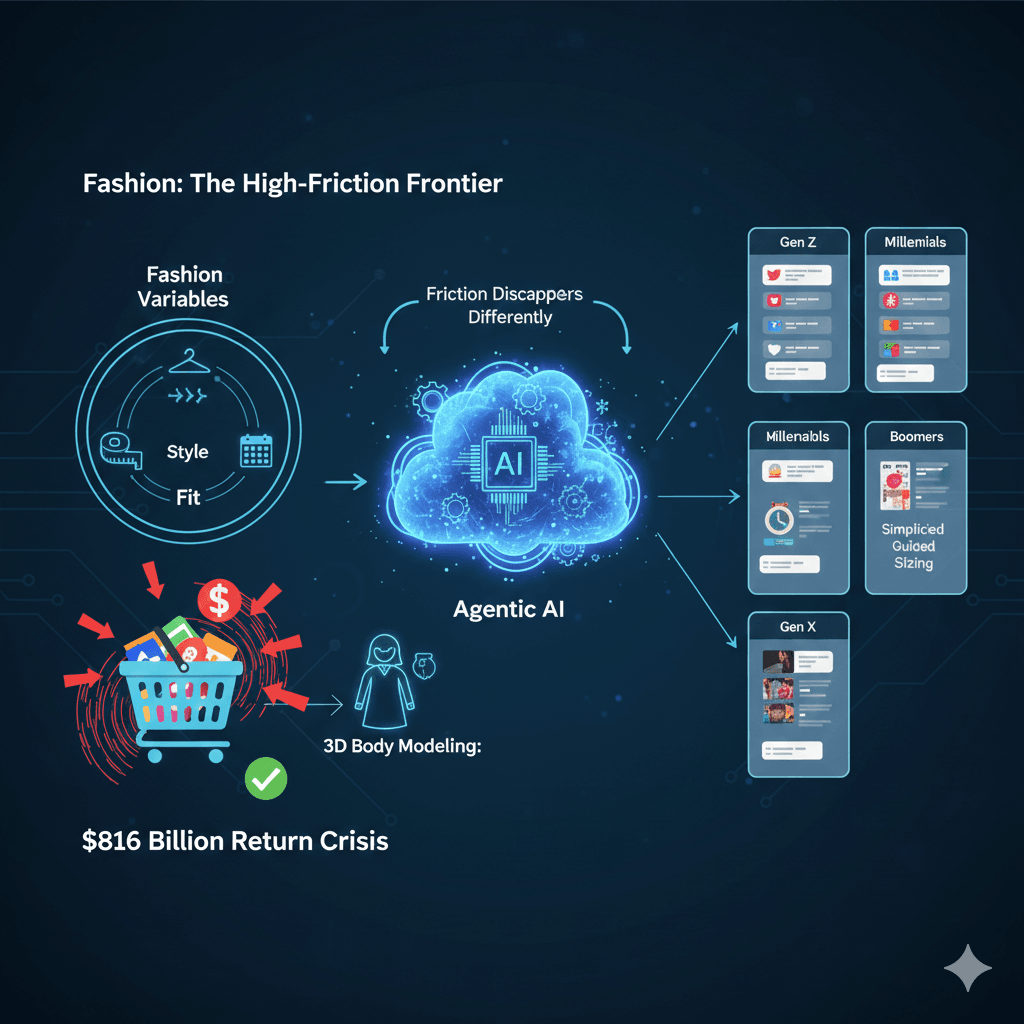
If Agentic AI is the solution, Fashion is the ultimate problem. In the US, fashion is the "Highest-Friction" category because it involves three volatile variables: Fit, Style, and Occasion.
Glance's dedicated fashion AI piece goes deeper into how this plays out across Style DNA, fit prediction, and complete-outfit generation specifically.
- The $816 Billion Return Crisis: Returns cost retailers an estimated $816 billion annually worldwide, per Fortune's reporting on 2022 retail data — a figure covering all of retail, not fashion specifically, though apparel's return rates (averaging 26% globally, among the highest of any category) make it one of the largest contributors to that total. High return rates due to "sizing anxiety" cost the industry billions. 2026 winners are those using AI-powered fit revolutions—like 3D body modeling—to ensure "fit-first" delivery.
- Demographic Needs: This isn’t one-size-fits-all technology.
Gen Z
Trend-driven. Socially influenced.
Agents help filter social velocity into structured choices without endless scrolling.
Millennials
Time-constrained. Balancing career and family.
Agents reduce decision fatigue around workwear, travel packing, and coordinated outfits.
Gen X
Practical and quality-focused.
Agents prioritize durability, brand consistency, and sizing reliability.
Boomers
Less interested in navigating complex interfaces.
Agents simplify discovery through guided intent rather than layered filters.
The system adapts to behavior.
The friction disappears differently.
By acting as a supportive side-character that understands these nuances, an agent like Glance ensures you spend less time "shopping" and more time actually "wearing."
Future Outlook: The $1 Trillion A2A Economy
The next frontier is Agent-to-Agent (A2A) Commerce. Gartner Predicts By 2028 AI Agents Will Outnumber Sellers by 10X. We are moving from a world where we "go shopping" to a world where "shopping happens for us."
Conclusion: The Luxury of Delegation
The era of "Artificial Intelligence as a Librarian" is over. We have entered the age of the Agentic AI assistant—a transition that is fundamentally redefining the American experience from one of constant searching to one of seamless discovery. Whether it is Walmart’s "Super Agents" optimizing national supply chains or Glance acting as a supportive side-character for your wardrobe, the goal remains the same: reducing friction.
By delegating the "labor of looking" to intelligent agents, consumers reclaim their most valuable resource—time. As we move toward a future where agents outnumber sellers, the act of "going shopping" is being replaced by the luxury of having shopping happen for you. In this new reality, the friction of choice disappears, leaving only the satisfaction of the find.
This same shift — from static product search to proactive, context-aware discovery — is what's covered in more general terms across the broader e-commerce landscape in Glance's piece on AI in e-commerce, including visual search, voice commerce, and dynamic pricing.
FAQs related to Agentic AI
1. What is agentic AI in simple terms?
Agentic AI refers to artificial intelligence systems that can autonomously pursue goals. Unlike generative AI, which produces responses based on prompts, agentic AI plans tasks, uses tools, monitors outcomes, and adjusts actions to achieve a defined objective with limited human intervention.
2. How is agentic AI different from generative AI?
Generative AI focuses on producing content such as text or images in response to prompts. Agentic AI, by contrast, is goal driven. It integrates memory, planning modules, tool usage, and feedback loops to execute multi-step tasks rather than simply generating outputs.
3. Why is commerce an early use case for agentic AI?
Commerce involves frequent, constraint-based decisions such as price comparison, sizing evaluation, and delivery timing. Because these decisions are repetitive and data-heavy, agentic AI can reduce cognitive load by evaluating options autonomously and narrowing choices intelligently.
4. How does an intelligent shopping agent like Glance help with decision fatigue?
Glance acts as an intelligent shopping agent by using a self-learning engine to filter thousands of options into a curated shortlist. By observing behavioral signals like dwell time, it surfaces what you need before you have to search for it.
5. Is agentic AI fully autonomous?
Not always. Many agentic AI systems operate within “human-in-the-loop” frameworks. High-risk decisions — such as financial approvals or medical actions — often require human validation to ensure accountability and regulatory compliance.
6. What industries are adopting agentic AI the fastest?
Retail, logistics, finance, and customer support sectors are early adopters. According to McKinsey and Deloitte research, organizations using AI-driven automation are seeing improvements in operational efficiency, supply chain optimization, and response times.
7. Is agentic AI regulated in the United States?
Federal AI regulation in the U.S. is evolving. The White House Executive Order on AI emphasizes explainability and responsible development, while NIST provides risk management frameworks to guide safe implementation.
8. What are the risks of agentic AI?
Risks include over-automation, hallucination errors from underlying language models, infrastructure costs, and accountability challenges. Responsible deployment requires governance frameworks, auditability, and transparent decision logic.
9. What are the main use cases for agentic commerce and autonomous AI shopping by 2026?
Six use cases show up consistently across real deployments: autonomous shopping concierges that research and compare without a keyword search (Amazon Rufus, Walmart's Sparky); fit and sizing assurance that resolves return-driving uncertainty before checkout; agent-initiated checkout, where an agent completes a purchase directly on a merchant's site (Google's Agent Payments Protocol); subscription and replenishment automation for low-stakes household reordering; B2B procurement and vendor negotiation; and proactive, zero-search fashion discovery, which is Glance's specific expression of the same shift.
Download the Glance app now






Your intelligent
shopping agent.







Your intelligent
shopping agent.