


What Is Discovery Shopping? The Agentic AI Shift
TL;DR
You open an app, type something vague like "cute fall outfit," scroll through 4,000 results, and close the tab with nothing in your cart. Sound familiar? That's not a you problem — that's a broken system. Discovery shopping flips the whole thing: instead of you hunting for products, an intelligent shopping agent brings the right products to you. This is the agentic shopping shift — where AI-driven discovery commerce replaces the search bar entirely. And AI is finally making that real. This guide breaks down exactly how.
Let's paint a picture you've probably lived inside of.
You need a new outfit. Maybe it's for a birthday dinner. Maybe it's just that your closet has been annoying you for three weeks straight. You open your go-to shopping app or pull up Google. You type something. "Women's fall outfits." "Casual dinner look." "Trendy but not trying too hard." And then... you drown.
Page after page of results that are technically in the right category but completely wrong for you — your body, your coloring, your city's weather right now, the vibe you're actually going for. You spend 45 minutes clicking, abandoning carts, and second-guessing everything. You close the app. You wear what you already own. You feel vaguely defeated.
This is the search model failing you in real time. And it's not fixable with better filters or smarter keywords — because the problem is structural. Search was built for high-intent queries. Fashion doesn't have those. What fashion needs is discovery commerce: a model where an intelligent shopping agent reads your context, your behavior, and your surroundings — and surfaces the right look before you think to look for it. That's agentic shopping. And it's replacing the search bar faster than most people realize.
Here's the thing: 74% of customers report walking away from online purchases because of the sheer volume of choice, according to the BoF-McKinsey State of Fashion 2025 report. And nearly 80% of shoppers spend more than half of their entire shopping journey just searching — before they've even started evaluating whether something is actually right for them.
The search bar was not built for fashion. Discovery shopping — powered by agentic AI — is the model that's finally replacing it.
What Is Discovery Shopping — And Why Does It Actually Matter?
Discovery shopping is a fundamentally different relationship between you and the products you buy — and it starts with a different question. Instead of asking "what do I search for?", an intelligent shopping agent asks "what does this person actually need right now?" That shift — from search-initiated to agent-initiated — is the core of what discovery commerce means.
Instead of you initiating a search with a keyword and hoping the algorithm surfaces something useful, an agentic shopping system proactively brings you things you'll actually want — before you ask.
Search Shopping | Discovery Shopping |
You start with a keyword | The intelligent shopping agent starts with you |
Results are ranked by SEO, ads, popularity | Results are ranked by personal relevance |
Thousands of options, zero curation | Curated selections matched to your context |
You do the filtering work | Behavioral intelligence does it for you |
You find what you're looking for | You find things you didn't know you'd love |
Think about the last time you actually discovered something on TikTok or Instagram — a piece you weren't looking for but immediately wanted. That feeling? That's discovery shopping working. The difference between the random scroll and a truly intelligent system is that one is luck, the other is engineered.
This is why discovery vs search shopping is one of the most important behavioral shifts in retail right now. According to HubSpot's Consumer Trends Report, 43% of Gen Z now begin product discovery on TikTok or Instagram instead of Google. They're not searching. They're being found.
Platforms like Glance are taking this further — building agentic shopping experiences where the intelligent shopping agent doesn't wait for a trend feed to catch your attention. It starts with a selfie, reads your physical attributes, layers in real-time context, and builds a personal discovery commerce feed that's calibrated to you just after you open the app.
Why the Old Search Model Is Fundamentally Broken for Fashion?

Search was designed for high-intent queries. You know what you want, you type it, you find it. That works great for buying a USB cable or reordering your favorite shampoo.
Fashion doesn't work like that.
When you're shopping for clothes, you rarely know exactly what you want. You know a feeling. A vibe. A context — "something to wear to my friend's engagement party that doesn't look like I tried too hard but also doesn't look like I forgot." You can't type that into a search bar and get a useful result. The keyword-based model collapses immediately.
And the numbers back this up hard:
- Only 14% of consumers rate retailers' search and product discovery as an "A" grade, according to Envive's AI product discovery research
- 76% feel frustrated when shopping experiences aren't personalized, per McKinsey's 2024 personalization report
- Half of shoppers feel overwhelmed by choice online, per Insider's 2025 product discovery analysis
The volume problem is real. Fashion e-commerce platforms carry hundreds of thousands of SKUs. A mid-size retailer might have 50,000 products. Even with good filters, narrowing that to something relevant to you specifically — your undertone, your city's weather this week, your upcoming plans — is nearly impossible through manual browsing.
The search model asks you to do the work. Discovery commerce flips that. The intelligence moves to the agent.
The Science Behind How Discovery Shopping Actually Works
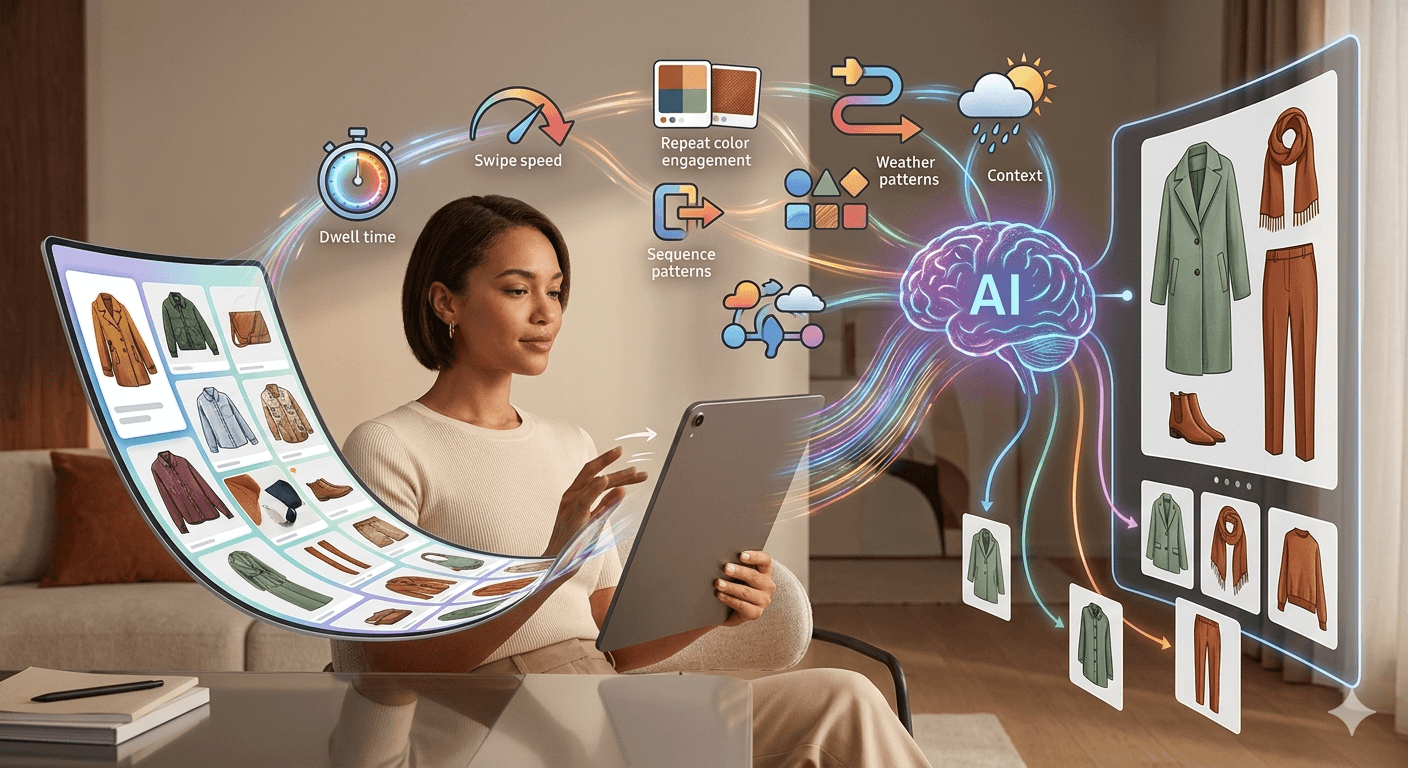
So how does a platform actually discover things for you rather than waiting for you to search?
It comes down to reading signals you're already sending — most of which you don't even consciously register.
Behavioral Micro-Signals
Every interaction you have with a shopping interface generates data that, when read correctly, reveals exactly what you actually like versus what you're passively scrolling past.
- Dwell time: How long you paused on an image. Two seconds is browsing. Eight seconds is interest. Glance's intelligent shopping agent reads this signal continuously — learning from every look you linger on to refine what appears in your feed next.
- Swipe speed: Moving fast through a feed signals nothing caught. Slowing down signals engagement — even if you don't click.
- Repeat color engagement: If you consistently pause on rust, sage, and chocolate brown over multiple sessions, the system is building your color profile in the background. Not from what you told it. From what you did.
- Sequence patterns: What you looked at right before something is as revealing as whether you clicked. Browsing oversized coats → checking wide-leg trousers → pausing on earth-tone palettes tells a story. A smart system reads that story and completes it.
This is where Glance's agentic shopping model does something most platforms don't. Its intelligent shopping agent doesn't just read weather as a filter — it factors in your city's live context, upcoming local events, and seasonal moment simultaneously, then adjusts your entire discovery commerce feed in real time. The result isn't a tweaked recommendation. It's a completely re-calibrated experience.
This is the intelligence layer that separates ai product discovery from a recommendation widget that just shows you "customers also viewed."
Real-Time Contextual Intelligence
The best discovery shopping systems don't just know who you are — they know when and where you are.
- It's 38°F in Chicago right now → surfacing linen shirts is useless
- Coachella is three weeks out for a user in Southern California → festival-adjacent looks become relevant
- A cold front is hitting Atlanta this weekend → transitional layers move up the priority queue
This context isn't static. It changes daily. And the recommendations it generates should change with it.
Sequential Recommendation Logic
There's a concept in discovery commerce called sequence-based recommendation — and it's one of the most powerful things an intelligent system can do.
The logic: what you're likely to want next is predictable from what you've already been browsing. If the system knows you've been exploring a certain color palette this week and recently looked at occasion-specific outfits, it can predict the type of complete look you're building toward — and surface it before you articulate it.
No search query needed. The agentic shopping system already knows.
Discovery Shopping in Fashion: The Color and Fabric Dimension

Here's where it gets genuinely interesting for fashion specifically — and where most platforms still underperform.
Fashion choices aren't just about silhouette or occasion. Color is one of the most personal, context-sensitive variables in any outfit decision. The right shade of burgundy on the right skin undertone under the right lighting can be the most confident thing you own. The wrong shade of the same color family can wash you out entirely.
This is what makes AI fashion fabric color decisions particularly complex to get right. A platform that surfaces a chocolate brown wool coat to everyone in the fall is doing trend reporting. A platform that surfaces it to you specifically — knowing your warm undertone, your city's particular light quality this season, and the fact that you've paused on earth tones six times in the last week — is doing discovery.
This is precisely what Glance's intelligent shopping agent was built to solve. When you upload a selfie, Glance analyzes your skin tone, face shape, and natural coloring — then cross-references those attributes against city-level trend signals and real-time inventory. The result is a personal color palette surfaced through complete, shoppable looks that are built for your undertone, your city's current light quality, and your behavioral history. This is agentic shopping applied to color intelligence — and it's one of the hardest problems in fashion AI to get right.
Understanding fashion color psychology at the individual level is one of the highest-value problems AI can solve. According to Glance’s Future of Fashion Aesthetics article, AI already analyzes behavioral signals like dwell time, swipe speed, and past engagements to tailor fashion recommendations uniquely to each user. The gap between "trending colors this season" and "these specific colors will work for you right now" is exactly what behavioral discovery intelligence is built to close.
Case Study: How Stitch Fix Proved the Discovery Model
Before agentic AI became mainstream conversation, Stitch Fix was doing something most fashion platforms weren't leading with discovery instead of search.
Their model combined machine learning with human stylists to curate clothing based on behavioral data, purchase history, and continuous feedback — not keyword searches. The result was a recommendation engine accurate enough that it drove a 9% year-over-year increase in average order value and a repeat customer rate of approximately two-thirds of their client base, according to SmartDev's AI in fashion analysis.
What Stitch Fix proved was simple: when you remove the search burden from the shopper and replace it with intelligent curation, people find things they love and they come back. The discovery commerce model isn't just a better user experience. It's a better business. And where Stitch Fix used human stylists to fill the gap, agentic shopping systems like Glance do it entirely through AI — at scale, in real time, starting from a single selfie.
How Glance Defines the Agentic Shopping Experience
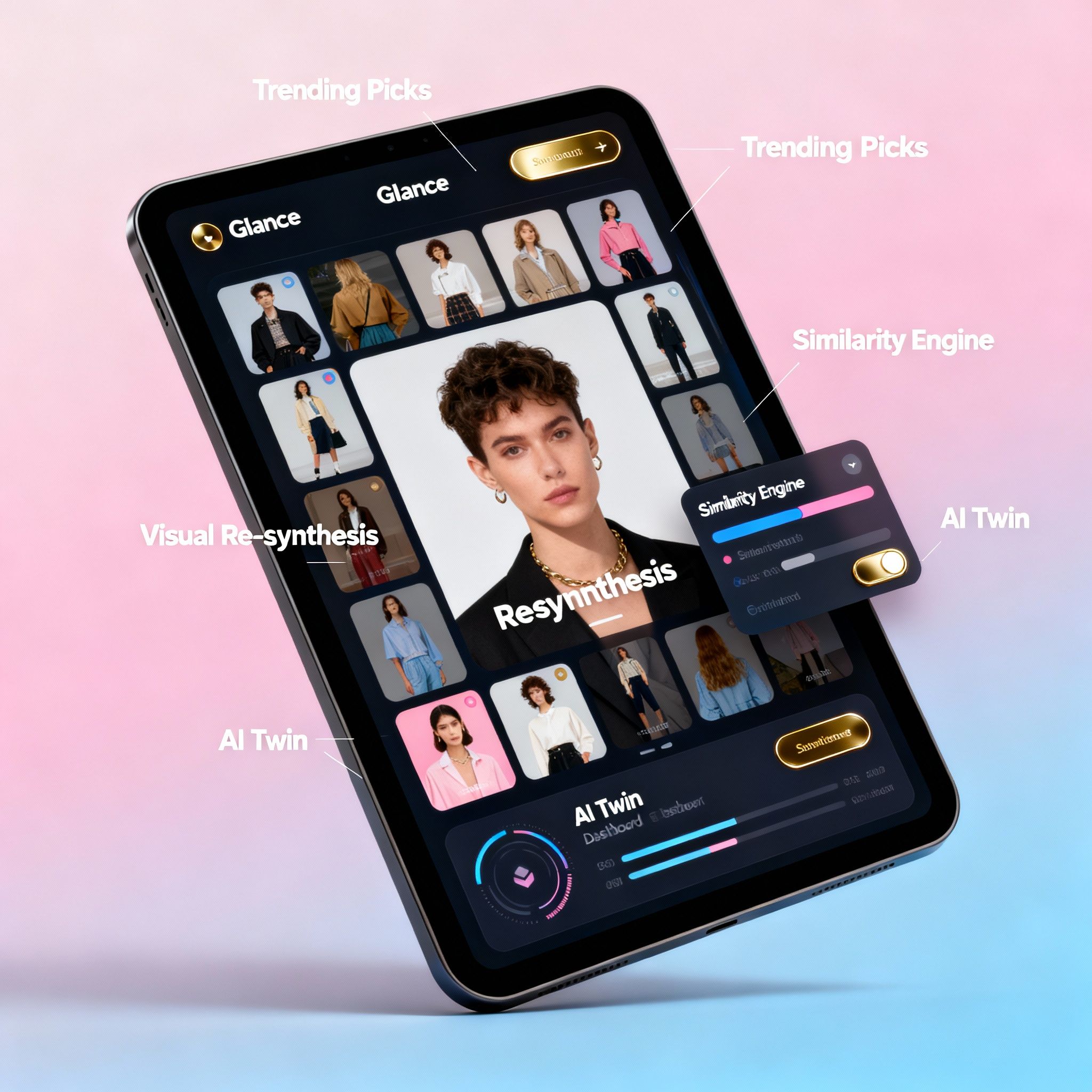
If discovery commerce is the category, Glance is what it looks like when built right from the ground up.
Glance is an AI-first agentic shopping platform — and its intelligent shopping agent works differently from anything built on a search-first foundation.
Feature | What It Does | Why It Matters |
Proactive Discovery | Glance's intelligent shopping agent serves "trending for you" looks directly — no app-opening, no browsing required | Discovery commerce comes to you. The search bar is removed from the equation entirely |
Style Twin — AI Avatar | Upload one selfie and Glance builds your Style Twin: an AI avatar that shows how clothes fit your actual body type and skin tone | You stop imagining and start seeing. Agentic shopping takes on the visualization work so you don't have to |
Behavioral Style Feed | The intelligent shopping agent reads your dwell time and swipe speed in real time, adapting your feed as your style evolves | Moving from casual to formal? The discovery commerce feed shifts with you — no settings adjusted, no preferences typed |
Glance It — Shop It | Spot a look, tap once, shop similar items from trusted brands immediately | Discovery commerce closes the full loop: inspire → discover → purchase. No search bar anywhere in the chain |
City-Level Context | The agentic shopping system adjusts your feed based on local weather, season, and upcoming events | Your Chicago November feed looks nothing like your Miami November feed. Same person, completely different intelligence |
The result is a feed that functions as a complete discovery commerce engine: proactive, contextual, personalized, and zero-search. Every look features you as the model, rendered in editorial-quality AI-styled images. No keyword required.
Discovery Shopping vs. Search Shopping: The Full Comparison
Here's the honest breakdown of what each model actually delivers:
Dimension | Search Shopping | Discovery Shopping |
Starting point | Your keyword | Your behavior + intelligent shopping agent |
Effort required | High — you filter and scroll | Low — system curates for you |
Personalization | Generic results, limited filtering | Individual-level, behavioral |
Color intelligence | You search a color | System surfaces colors that work for your undertone |
Context awareness | None | Weather, location, events, time of day |
Outfit thinking | Individual items | Complete styled looks |
Learning over time | None | Gets smarter with every interaction |
Conversion rate | ~3.1% (standard browsing) | 12.3% with AI assistance (4x higher) |
The numbers alone tell the story. But the real shift is emotional: discovery shopping removes the cognitive load of fashion. You're not working to find something. Something that fits your life is already waiting.
Your Action Plan: How to Actually Shift to Discovery-First Shopping
Reading about discovery shopping is one thing. Here's how to actually put it into practice — right now.
Action 1: Stop typing vague keywords into search bars. Broad queries like "fall outfit" or "casual look" return volume, not relevance. If you're still starting your fashion shopping with a Google search, you're opting into the worst possible discovery experience.
Action 2: Spend 10 minutes on a genuinely discovery-first platform. Platforms designed around behavioral learning — where your feed evolves based on what you engage with, not what you type — show measurable results faster than you'd expect. TikTok's For You page does a rough version of this. Purpose-built fashion discovery platforms do it more accurately. Agentic shopping platforms like Glance do this more accurately than any social feed: upload a selfie, let the intelligent shopping agent build your feed, and see how different discovery commerce feels when it starts with you.
Action 3: Let behavioral signals do the work for you. Slow down on things you actually like. Don't rush through a feed. The longer you linger on something, the more accurately the system learns what you actually want. Your engagement is your preference signal.
Action 4: Look for color intelligence, not just product listings. The best discovery shopping experiences don't just show you what's trending — they show you what trends in colors and fabrics will work for you specifically, based on your personal color profile. If a platform isn't doing this, you're still doing the hard work yourself.
Action 5: Expect complete looks, not individual items. A product listing for a single blazer is search-era thinking. Discovery-era platforms surface the blazer, the trousers, the shoes, and the color story as a complete outfit — the way a good stylist would. If you're being shown isolated items without context, you're using the wrong tool.
The Future of Discovery Shopping: Where This Is All Heading
The trajectory is clear and it's moving fast.
Generative AI referrals to U.S. retail sites increased 4,700% year-over-year during the 2025 holiday season, according to new data from Adobe for Business. AI-influenced sales reached $229 billion globally in 2024. And 72% of consumers plan to use AI-powered search for shopping in the future — with 79% of current users saying it's better than traditional search, per HubSpot's 2025 Consumer Trends Report.
The search bar isn't disappearing overnight. But its dominance in fashion is ending. The shoppers who make the shift to discovery shopping now — learning how behavioral intelligence works, engaging with platforms that actually read their signals — will spend less time frustrated, find more things they love, and stop buying things they return three days later.
The future of fashion shopping isn't a better search engine. It's a system that already knows what you want before you type a single word.
Conclusion: You Shouldn't Have to Search for Your Style
Discovery shopping isn't just a product category or a tech trend. It's a recognition that the way most people shop for fashion today is genuinely broken — exhausting, imprecise, and designed around the needs of inventory systems rather than actual humans.
The shift that's happening is real: from search-led to discovery-led, from generic to behavioral, from individual items to complete styled looks. And the technology that makes it possible — ai product discovery systems, behavioral micro-signal intelligence, multi-agent context engines — is here now and getting more accurate every month.
Glance sits at the center of this shift — an AI-first platform where the intelligent shopping agent starts with your face, reads your city, tracks your behavior, and builds a discovery commerce feed that feels less like a catalog and more like a stylist who's been paying attention. You don't search. You don't filter. You just see yourself, already styled, already shoppable, already right.
You don't need to understand the tech to benefit from it. You just need to stop starting with the search bar and start using platforms that already know where to find you.
Frequently Asked Questions
- What is discovery shopping and how is it different from regular online shopping? Discovery shopping is a model where products find you — based on your behavioral signals, location, and context — rather than you hunting for them through search queries. Regular online shopping starts with a keyword you type. Discovery starts with who you are and what you've been engaging with. The result is a more personalized, less exhausting experience with dramatically higher relevance.
- Why is fashion search so frustrating compared to other product categories?
Because fashion intent is inherently fuzzy. You rarely know exactly what you want — you know a vibe, a feeling, an occasion. Search bars are built for precise, high-intent queries (like "size 9 Nike Air Max"). They break down when the query is "something cute but not try-hard for a Saturday dinner." Discovery-first platforms are built for exactly this ambiguity. - What is discovery commerce and how does it relate to AI?
Discovery commerce refers to the broader ecosystem of tools, platforms, and behavioral systems designed to proactively surface products to shoppers rather than waiting for a search. AI is what makes it scalable — specifically, behavioral signal analysis (dwell time, swipe speed, sequence patterns) and real-time context intelligence that makes recommendations genuinely personal rather than broadly demographic. - How does AI product discovery work in fashion specifically?
AI product discovery in fashion works by reading micro-behavioral signals — how long you pause on images, which colors you return to, what you browse before and after certain products — and combining that with context data like your location, weather, and upcoming events. Instead of returning search results, it surfaces complete styled looks that match your personal color profile, body type, and current life context. - What's the actual difference between discovery vs search shopping outcomes?
The data is stark: AI-powered discovery delivers conversion rates around 12.3% compared to 3.1% for standard browsing — a 4x difference, according to Envive research. Shoppers who engage with personalized discovery recommendations are 4.5x more likely to purchase. Discovery shopping doesn't just feel better. It measurably converts at a higher rate because it reduces the friction between interest and decision. - How do I start using discovery shopping instead of search?
Start by engaging more intentionally with platforms that learn from your behavior rather than your keywords. Slow down on images you actually like — dwell time is a signal. Engage with complete looks rather than individual products. And seek out platforms that surface color and style recommendations based on your personal attributes rather than trending lists. The more you engage, the smarter the system gets. And seek out agentic shopping platforms — like Glance — that build your discovery commerce feed from your personal attributes rather than trending lists. Upload a selfie, let the intelligent shopping agent do its work, and compare what you find versus what a search bar ever surfaced. - Does discovery shopping work for all generations, or just Gen Z?
It works across generations — the underlying benefit (less effort, more relevance, less decision fatigue) is universal. The entry point varies: Gen Z tends to discover through social platforms first; millennials often encounter it through curated subscription or styling services; Gen X and Boomers respond well to personalization once they experience it. According to Deloitte, Gen Z is 2.7x more likely to receive AI product recommendations, but 82% of consumers across all ages want AI to reduce their research time. - What is discovery commerce and how does it relate to AI?
Discovery commerce is a modern retail model where products are proactively surfaced to consumers through personalized, AI-driven experiences rather than keyword searches. It transforms "appointment shopping" — where you go looking — into an always-on, high-relevance feed that creates serendipitous, high-conversion interactions. AI is what makes it scalable — specifically, intelligent shopping agents that run behavioral signal analysis, real-time context intelligence, and sequence-based recommendation logic simultaneously.
Download the Glance app now




Your intelligent
shopping agent.







Your intelligent
shopping agent.