

AI Fashion Stylist App: Free vs Paid — What Actually Works for US Shoppers in 2026
TL;DR
• Free AI fashion stylist apps like StyleSnap are fast and frictionless — ideal for one-off visual searches with no commitment
• Paid apps like Fits and GRWM offer structured guidance and outfit refinement, suited to frequent shoppers who want consistent help
• Glance sits outside both categories — no subscription, no setup, no style quiz, and personalisation that sharpens the more you use it
• The real question in 2026 isn't free vs paid — it's reactive vs proactive: does your tool wait for you to search, or does it already know what to surface?
• This guide compares all three models with a US budget and lifestyle lens
Introduction: The Closet Problem Has Not Gone Away
Most U.S. shoppers do not struggle to find clothes. They struggle to choose. By 2026, the average American encounters hundreds of fashion options per week across apps, social feeds, and retail sites — and still ends up with items that do not quite work together.
AI fashion stylist apps were built to close exactly this gap. These tools use artificial intelligence to suggest outfits, analyse preferences, and reduce the cognitive load of getting dressed or shopping with confidence.
But not all AI fashion tools solve the same problem — and in 2026, the most important distinction isn't price. It's architecture. Some tools wait for you to search. Others learn from how you actually behave. The difference between those two starting points determines everything about what you get out of them.
This guide compares three models available to US shoppers right now: free tools that answer single questions fast, paid apps that build structured guidance over time, and Glance — which operates on a third model entirely, one that requires no payment, no profile setup, and no search query to start working.
What Is an AI Fashion Stylist App?
An AI fashion stylist app uses machine learning or behavioral analysis to help users make faster, more confident clothing decisions. Depending on the platform, these tools can:
• Identify visually similar items from an uploaded photo
• Suggest complete outfits based on stated preferences or past behavior
• Refine a look already in progress
• Learn browsing patterns to improve recommendations over time
In simple terms, these apps try to answer questions like:
- “Does this go together?”
- “What should I wear today?”
- “What styles fit my vibe without endless scrolling?”
In 2026, these tools span a wide range of sophistication. Some are essentially reverse image search tools with fashion labels. Others are full behavioral systems that operate quietly in the background of your shopping activity.
In 2026, that distinction is the difference between a tool that answers your question and one that already knows what to show you.
Free AI Fashion Stylist Apps: StyleSnap and Similar Tools
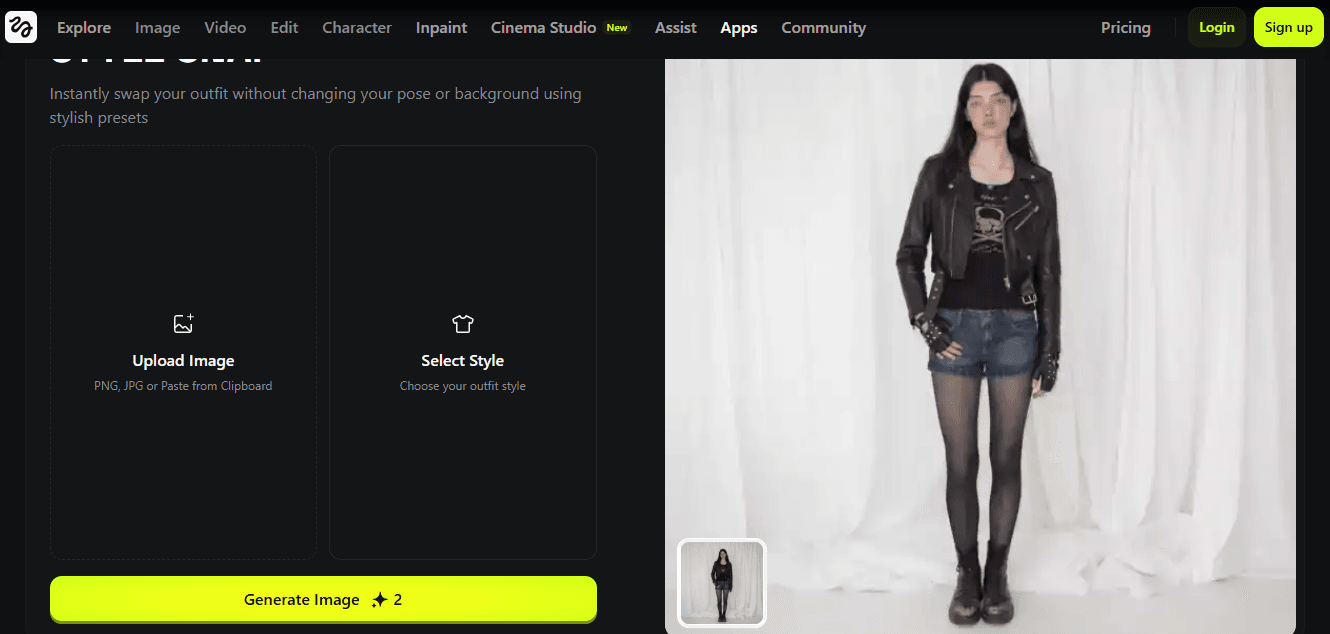
Free AI fashion stylist apps typically require no account creation, no payment, and no onboarding. StyleSnap, Amazon's visual search tool, is one of the most widely used examples in the U.S. market.
Free tools generally excel at:
• Visual item matching from uploaded photos
• Instant outfit inspiration with no setup
• Low-friction discovery for casual browsers
• Surfacing similar items across retailers
For U.S. shoppers who browse occasionally or want a fast answer — 'Where can I find that jacket?' — free tools deliver immediate value.
Where Free Apps Fall Short
Free AI fashion tools are built for single-session utility. They typically do not:
• Retain memory of your preferences across sessions
• Account for body type, lifestyle, occasion, or budget
• Learn from hesitation or repeated browsing patterns
• Explain why a combination works or does not work
StyleSnap, for example, answers 'What looks like this?' — not 'What suits you based on how you dress?' That distinction defines the ceiling of free tools in 2026.
According to a 2025 Statista consumer survey, 67% of US online fashion shoppers have returned an item because it looked different on them than they expected — a confidence gap that free tools, focused on visual matching rather than personal fit, consistently fail to close. The tool finds the item. The uncertainty about whether it works for you specifically is still entirely yours to resolve.
Did you know? Free AI fashion tools process your query and forget it. The next time you open the app, it has no memory of what you liked, what you skipped, or what your colouring actually is. Every session starts from zero.
Paid AI Fashion Stylist Apps: Structure, Personalization, and Cost

Paid AI fashion stylist apps typically move beyond visual matching into guided decision-making. Two well-known examples in the U.S. market represent different approaches: Fits and GRWM.
For U.S. shoppers willing to pay, these tools are less about discovery and more about confidence.
Full Outfit Assembly: The Fits Approach
Apps like Fits aim to eliminate the 'what do I wear?' question entirely, relying on detailed onboarding, occasion-based outfit generation, and curated brand selections. For shoppers who know their style and want it codified, Fits delivers. The friction is upfront — the onboarding is detailed — but once it's done, the outputs are structured and consistent. The ceiling is flexibility: the system is built around what you told it at the start, which means it takes time to adjust when your taste evolves. It decides for you, which is valuable until your taste moves faster than its memory.
According to the Business of Fashion State of Fashion 2025 report, 82% of customers want AI to reduce the time they spend researching what to buy — and 50% of fashion executives have identified AI-driven product discovery as their primary use case for the year. For paid apps, structured guidance that reduces that research burden is exactly what the subscription is paying for.
Outfit Refinement: The GRWM Approach
GRWM takes a lighter approach — a real-time confidence check rather than full outfit assembly. Take a selfie of what you are already wearing, and the app suggests small upgrades: a different accessory, a shoe swap, a layer adjustment. It is best understood as a finishing tool — valuable in a specific window of the getting-dressed experience, not a comprehensive styling system.
Together Fits and GRWM illustrate the two dominant paid models in 2026: one removes the decision, the other validates it. Both still start with you doing the work of defining what you want. That's the ceiling of the paid model, not its flaw.
Did you know? Paid AI fashion apps typically require 3–5 sessions before their recommendations become meaningfully personalised. For shoppers who open a styling app once a month, that learning curve can take the better part of a year.
Where the Glance Intelligent Shopping Agent Fits
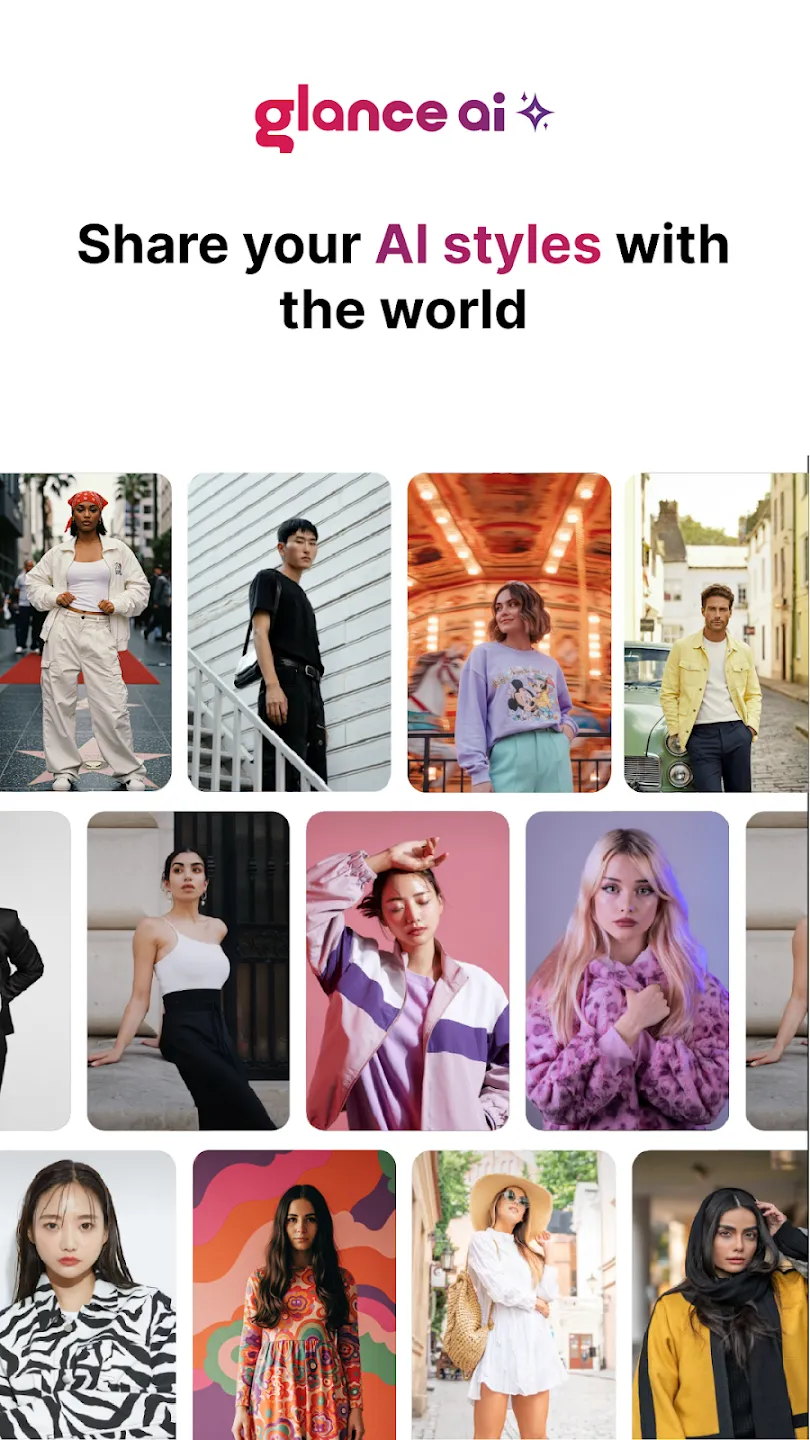
The Glance Intelligent Shopping Agent is not an AI fashion stylist app — and the distinction matters more than it might sound. Traditional tools, free or paid, share the same starting point: you. You search, you upload, you fill out a profile, you tell the system what you like. Glance starts somewhere else entirely. It reads context before you express intent —this is what no search shopping actually means in practice. This is the model that defines agentic shopping — intelligence that acts before you search.
That's not a feature upgrade on the free vs paid model. It's a different model of commerce altogether.
How Behavioural Intelligence Works
Free tools read one signal — a photo you upload in the moment. Paid tools read the signals you consciously provide — a style quiz, a body type selection, a stated preference during onboarding. Glance reads signals you're already generating without meaning to: how long you paused on an image, which colours you returned to across sessions, what you browsed before and after certain items. No input required. No form to fill. The system builds your picture from behaviour, not declaration.
The output reflects this difference directly. Where free tools return a product list and paid tools return a curated selection, Glance generates one complete styled look — visualised on your actual body, not a generic model's — built from five intelligence streams running simultaneously: your physical features, live weather, regional micro-trends, upcoming occasions, and your behavioural patterns over time. The result is your personal AI fashion lookbook — updated in real time, built around who you actually are.
Free and paid tools cannot replicate this because finding products and styling a person are structurally different problems. The architecture has to be different entirely
The decision facing you isn't "which of these jackets?" It's "yes or no to this specific look, built for me right now." That's a fundamentally different cognitive experience — and the reason Glance sits outside the free vs paid comparison rather than sitting within it.
This is also what makes the cold start problem irrelevant for Glance in a way it isn't for paid apps. Paid tools need several sessions of stated input before they generate meaningful output. Glance reads your physical features and live context from the very first session — no browsing history required to get a personally relevant result.
Available free across Samsung Galaxy, Motorola, iOS and Android — no subscription, no download required on compatible devices. It's already there before you look for it.
AI Fashion Tools That Learn Without a Quiz
Most free and paid AI fashion apps share one structural dependency: they need you to tell them who you are. A style quiz during onboarding. A body type selector. A preference screen. The quiz is the tool's only way to understand you — and when your taste shifts, the quiz is stale before you know it.
Glance is an intelligent shopping agent that skips this step entirely. It reads your face shape, skin tone, hair colour, and body proportions directly from a selfie — no quiz, no form, no profile to maintain. Your physical features are the input. The system builds your picture from what it can observe and from how you engage over time, not from what you describe.
Lynk, Glance's intelligent shopping assistant for AT&T Android customers, works the same way — a selfie and your browsing context are all it reads. No quiz, no setup, no form. It sits on your home screen as a floating button, available on top of any shopping app you are already using.
The images you provide are used to generate personalised outfit looks. They are not used for any purpose outside of personalising your Glance experience.
Why This Model Matters for U.S. Shoppers in 2026
Three factors make behavioural intelligence particularly relevant to the US market right now.
Subscription fatigue is real. According to Deloitte's 2025 Digital Media Trends survey, 47% of US consumers say they pay too much for the subscription services they currently use — a figure that has risen year on year. A tool that delivers improving personalisation without a monthly fee doesn't just save money. It removes the psychological friction of committing to another paid service before you know whether it works for you.
Fashion preferences also move faster than static profiles can track. Seasons change, life events shift your wardrobe needs, trends cycle through faster than ever. A system built around what you told it six months ago during onboarding is always slightly behind. Behavioural learning adapts continuously — not because you updated your preferences, but because your actual engagement did.
And onboarding itself is a barrier most shoppers don't clear. The drop-off rate on multi-step style quizzes is significant precisely because effort upfront feels like a bet on a product you haven't seen work yet. The Glance Intelligent Shopping Agent requires no onboarding. It starts from your first interaction and improves from there.
For US shoppers who have tried free tools and found them shallow, or tried paid tools and found them rigid — this is the third option. And it requires nothing to start.
Comparing Free vs Paid AI Fashion Stylist Apps (2026)
The table below compares the three primary models available to U.S. shoppers in 2026.
| Feature | Free (StyleSnap) | Paid (Fits / GRWM) | Glance |
| Cost | Free | $10–30/month | Free |
| Setup Required | None | Full onboarding profile | Selfie only |
| Personalisation | None — session only | Stated preferences | Behavioural — learns from actions |
| Learning Over Time | No | Slow — quiz-based | Yes — continuous from real signals |
| Outfit Completeness | Single items | Complete outfits | Complete looks on your body |
| Visualisation | Product on generic model / flat lay | Outfit on avatar or uploaded photo | Complete look on your actual body from selfie |
| Cold Start | Fully functional — no history needed | Requires onboarding before useful output | Functional session one — context signals generate relevant output immediately |
| Best For | Casual one-off searches | Frequent shoppers wanting structure | Anyone who wants personalisation without payment or setup |
Which AI Fashion Stylist App Is Right for You?
There’s no single “best” AI fashion stylist app—only what fits your needs.
Choose a free tool if:
- You shop occasionally and want quick visual inspiration
- You do not need long-term personalization
- You are experimenting with a specific item or look
Choose a paid app if:
- You shop frequently and want consistent outfit guidance
- You struggle with decision fatigue at the point of checkout
- You want a structured system that improves with repeated use
- Reducing returns is a priority
Consider the Glance Intelligent Shopping Agent if:
- You dislike subscriptions or onboarding flows
- Your style preferences shift often and resist rigid categorization
- You want a tool that adapts to real behavior rather than stated preferences
- You browse frequently but want discovery to feel less like work
What the Best AI Fashion Tools Have in Common in 2026
- Across free, paid, and behavioral platforms, the most effective AI fashion stylist apps in 2026 share four traits:
- Low friction: They do not ask users to work hard to receive value.
- Contextual relevance: Suggestions reflect real-world variables — occasion, season, budget — not just aesthetic preference.
- Adaptive accuracy: The tool improves the more it is used, without requiring manual updates from the user.
- Transparency: Users understand, at least broadly, why a suggestion is being made.
- Tools that score well on all four criteria tend to reduce purchase regret and increase long-term engagement — two metrics that matter equally to shoppers and retailers.
- The gap that most AI fashion tools still haven't closed is body-type inclusivity. Free visual tools surface items based on image similarity regardless of the body wearing them. Paid apps factor in what you tell them during onboarding — which is only as accurate as your self-description. Glance takes a different approach: when you upload a selfie, it reads your face shape, skin tone, and body proportions directly — using those signals to inform every colour selection, silhouette choice, and accessory pairing it generates. You don't estimate your body type. The system reads it. That's not a future capability — it's how Glance works today.
How to Know Which Model Is Right for You
You don't actually need to know which AI fashion stylist app is 'best.' You need to know which one matches how you already shop.
If you shop occasionally and just want a quick answer — free tools work. StyleSnap is fast, frictionless, and requires nothing from you. The ceiling is low, but for single-session utility, that ceiling is fine. You're looking for a visual match, not to be understood.
If you shop frequently and want to build a consistent personal style — paid apps earn their subscription. Fits or GRWM give you structure and confidence in exchange for the time investment of setup and a monthly fee. If you buy fashion at least once or twice a month and regularly struggle with decision fatigue, the return on a paid app is measurable — both in decision speed and in reduced returns.
If you don't want to think about which tool to use at all — Glance. No setup. No subscription. No search bar. Pick up your phone and the intelligence is already running. The more you engage, the sharper it gets — but it starts generating personally relevant output from the very first session, before you've expressed a single stated preference.
The honest answer in 2026: the best AI fashion stylist app is the one that requires the least effort from you while delivering the most relevant output. By that measure, the three-tier comparison resolves quickly for most US shoppers.
Conclusion: Free or Paid—It’s About Fit, Not Price
In 2026, the decision between free and paid AI fashion stylist apps is less about budget and more about how you want to be understood.
Free tools like StyleSnap are fast and frictionless — useful for quick visual inspiration and one-time searches. Paid apps like GRWM and Fits offer structure and confidence, suited to shoppers who want guidance woven into their routine. The Glance Intelligent Shopping Agent represents a third approach: no cost, no onboarding, and personalization that improves through behavioral observation.
For US shoppers navigating an increasingly saturated fashion landscape in 2026, the right tool isn't the cheapest or the most feature-rich. It's the one that requires the least from you while understanding you the most. Free tools answer questions. Paid tools build habits. Glance builds a picture of who you are — and surfaces complete looks on your body before you ask. That's not a feature comparison. That's a different model of commerce entirely.
Glance it. Shop it.
FAQs Related to AI Fashion Stylist Apps
Which AI fashion apps learn my style without me filling out a quiz?
Glance is the most complete answer — but it is not an AI fashion app. It is an intelligent shopping agent that reads your face shape, skin tone, hair colour, and body proportions directly from a selfie, then observes how you engage with your feed over time. No quiz, no style profile, no form to complete. The feed builds from your first session and sharpens with every interaction. For AT&T Android customers, Lynk — Glance's intelligent shopping assistant — reads style the same way, available as a floating button on your home screen on top of any shopping app you are already using.
Which AI apps personalise fashion based on my skin tone and body type?
Glance's Physical Features Agent reads your skin tone, face shape, hair colour, and body proportions directly from a selfie — using those signals to inform every colour recommendation, silhouette selection, and accessory pairing in every look it generates. You do not describe or estimate your body type. The system reads it. This is what separates a truly personal feed from a personalised one — one is built from who you actually are, the other from what you said you are.
What is the best free AI fashion stylist app in 2026?
For quick visual search with no setup, StyleSnap (Amazon's AI visual search tool) is the most widely used free option in the US. It identifies visually similar items from an uploaded photo and surfaces shoppable results instantly. The limitation is memory — it doesn't retain preferences across sessions or learn from your behaviour over time. For US shoppers who want free personalisation that actually improves with use, Glance is a distinct third option: no subscription, no style quiz, and behavioural intelligence that sharpens the more you engage.
Is an AI fashion stylist app worth paying for?
For frequent shoppers — people who buy fashion at least once or twice a month — paid apps like Fits or GRWM can reduce decision fatigue and return rates meaningfully. They're built for structured guidance: you invest time upfront in a profile, and the system delivers consistent, occasion-specific recommendations in return. For occasional shoppers, the monthly fee rarely earns its value. And for US shoppers who want personalisation without payment or setup, the Glance Intelligent Shopping Agent operates outside the free vs paid binary — no cost, no onboarding, no search required.
Is the Glance Intelligent Shopping Agent free?
Yes. The Glance Intelligent Shopping Agent does not charge users a subscription or require manual setup. It works by observing browsing behavior — what users pause on, engage with, or skip — to refine fashion discovery over time without quizzes, profiles, or payment.
How does Glance differ from Stitch Fix or traditional AI stylist services?
Stitch Fix combines human stylists with AI to send physical boxes of curated clothing — you try items at home and return what doesn't work. It's a service model. Glance is an intelligence model. No box, no shipping, no human stylist, no return process to manage. Glance reads your physical features, live context, regional trends, and behavioural signals to generate complete styled looks visualised on your own body — across one of the largest shoppable fashion catalogues available to US shoppers.
Do AI fashion stylist apps work for all body types?
The better ones do — but the mechanism varies. Free visual tools like StyleSnap surface items regardless of body type. Paid apps like Fits factor body type into onboarding but rely on what you tell them rather than what they can see. Glance analyses your selfie directly — reading face shape, skin tone, hair colour, and body proportions — and uses those signals to inform colour selection, silhouette choices, and accessory pairing in every look it generates. You don't describe your body type. The system reads it.
Download the Glance app now





Your intelligent
shopping agent.







Your intelligent
shopping agent.