


Decision Fatigue in Fashion Shopping: Why More AI Isn't Always Less Work
TL;DR
- Decision fatigue in fashion shopping is getting worse, not better — despite more AI tools than ever
- The problem is structural: reactive AI personalises the list but keeps the decision burden with you
- Adding more search-first tools multiplies options rather than reducing them
- The fix requires a different starting point: proactive AI that generates a complete look before you search
- Glance learns from how you browse — dwell time, swipe patterns, session tempo — with no quiz, no setup, no wardrobe upload. The more you interact, the sharper it gets. One complete look, built for you, before you open a search bar
Online shopping was meant to make life easier. You could browse thousands of products from the comfort of your home, compare prices instantly, and discover new styles in minutes. Yet for many shoppers today, the experience feels strangely exhausting.
The problem is not lack of choice. It is the opposite.
Adding more AI hasn't fixed this. If anything, it's made it worse. Every recommendation engine, every AI filter, every chatbot still hands you a list and asks you to choose. The cognitive load doesn't disappear. It just moves one step to the right.
Modern retail platforms present an overwhelming number of options for almost every category. A simple search for a pair of sneakers, a handbag, or a jacket can easily return hundreds or even thousands of results. While variety can be exciting, too many choices can quickly turn into mental overload.
This is where decision fatigue shopping begins to appear.
What is Decision Fatigue Shopping?
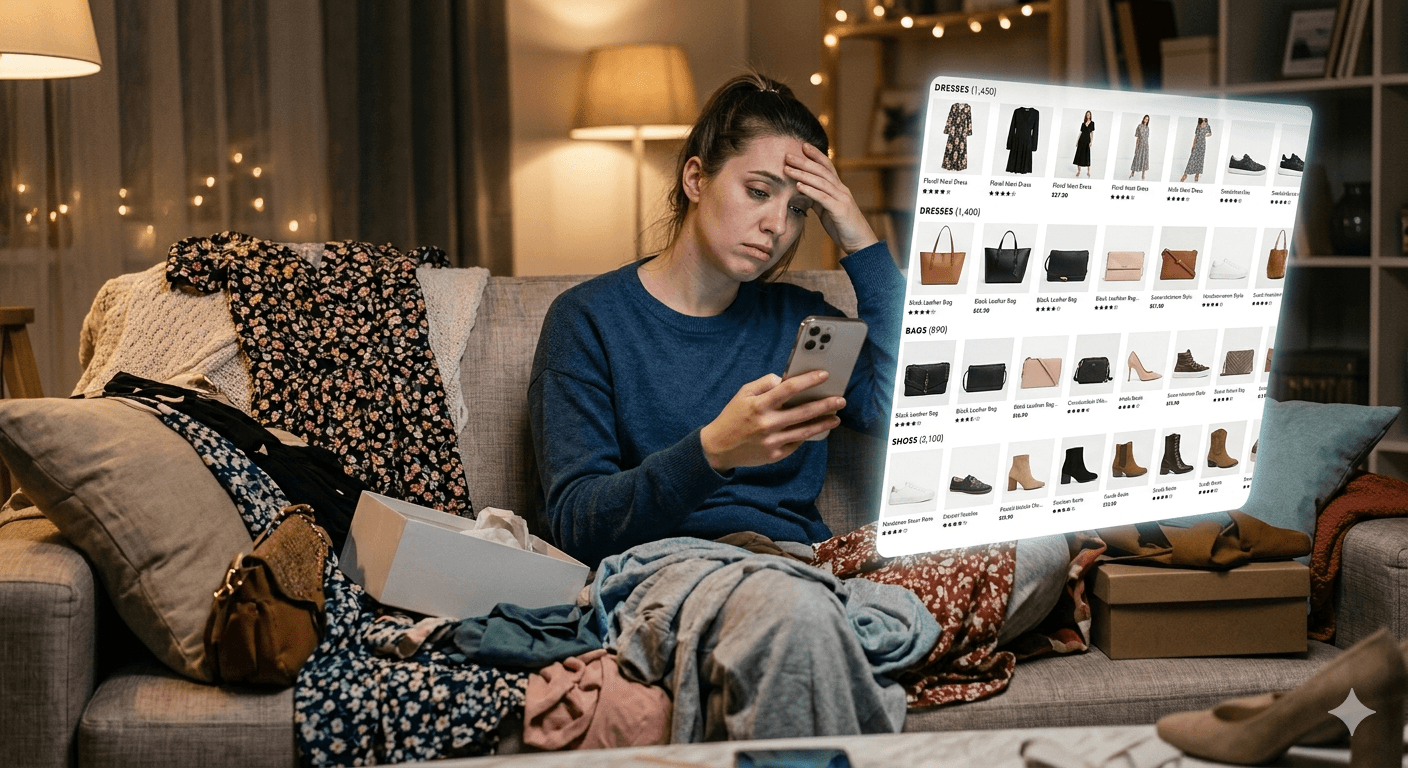
Decision fatigue refers to the mental exhaustion that happens when your brain is forced to evaluate too many options in a short period of time. Instead of feeling empowered by choice, you start feeling overwhelmed. As the fatigue increases, the quality of your decisions begins to decline. You might notice yourself endlessly scrolling without selecting anything. In other cases, you may rush into an impulsive purchase simply to escape the stress of choosing. Sometimes the result is the opposite: you abandon your cart altogether because making the decision feels too draining.
Research on consumer decision-making finds that 30–35% of US consumers have postponed purchases specifically because of decision fatigue — not because they couldn't find what they wanted, but because the act of choosing overwhelmed them. That figure hasn't improved as AI tools have proliferated. It has gotten worse, because more tools means more surfaces, more recommendations, and more lists to evaluate.
Decision fatigue in fashion is particularly acute because fashion choices are inherently personal and contextual. Unlike buying a printer cartridge — where the right answer is largely objective — choosing what to wear involves your body, your coloring, your occasion, your mood, and what's trending where you live. No search bar captures all of that. No ranked list resolves it. The cognitive load of fashion shopping isn't a bug in the system. For reactive platforms, it's a feature — more time on site means more potential impressions. This is what the choice overload problem looks like at the product level — and what no-search shopping was built to solve.'
Did you know? According to Accenture Consumer Research, 74% of US consumers have abandoned a shopping cart because they felt bombarded by content and choices. That's not a fringe experience. It's the majority of shoppers, most of the time.
Why Reactive AI Makes Decision Fatigue Worse, Not Better
Reactive AI starts with your query. You type 'casual jacket' and it returns 800 results, ranked by an algorithm trained on what other people clicked. The AI layer personalises the ranking — but it's still a ranked list. You still evaluate. You still compare. You still decide. The decision burden hasn't moved; it's just been dressed up with better sorting. This is what separates reactive tools from true agentic shopping, the distinction isn't a feature, it's the entire architecture.
What reactive AI doesn't account for is what behavioral economists call the paradox of choice. When you're shown more options — even highly relevant, well-personalised ones — the perceived cost of making the wrong choice increases alongside them. The more you're shown, the more you worry you're missing something better. Personalisation doesn't resolve this. It intensifies it, because a highly personalised list feels like it should have a correct answer — which raises the emotional stakes of every decision you make within it. Most AI fashion stylist apps operate within this constraint, personalising results without changing the fundamental model.
This is why decision fatigue has gotten worse, not better, as shopping AI has proliferated. More tools mean more surfaces. More surfaces mean more recommendations. More recommendations mean more evaluation. And more evaluation means more fatigue. Reactive AI has built an entire industry on top of the paradox of choice without solving it. Understanding why AI shopping assistants can find products but cannot style you is the first step toward understanding why a different architecture is needed entirely.
A November 2025 IAB study found that AI adds research steps rather than removing them: before AI, the average shopper completed 1.6 steps before purchase. After AI interaction, that number jumped to 3.8 steps. Reactive AI creates more to evaluate, not less.
The Real Cost: Returns, Overconsumption, and the Broken Loop
Decision fatigue doesn't just affect your shopping experience. It has measurable financial and environmental consequences that ripple through the entire retail system.
The most direct consequence is the US returns crisis. According to the National Retail Federation, retailers estimated that 16.9% of annual sales were returned in 2024 — totalling nearly $890 billion in returned goods. A significant portion of these returns in fashion aren't driven by defective products or wrong sizes. They're driven by purchase decisions made under cognitive overload. Shoppers buy three versions of the same item because they can't decide which is right. They purchase something impulsively just to end the scrolling session. They checkout before they're confident and return after the doubt sets in.
This is the broken loop of reactive commerce: more options create more fatigue, fatigue creates worse decisions, worse decisions create more returns, more returns drive more inventory, more inventory creates more options. Nothing in a search-first AI model breaks this loop. Reactive AI optimises within it. Understanding AI purchase intent the real behavioral signals behind buying decisions is the first step toward breaking it.
The downstream cost extends beyond returns. The fashion industry contributes 2–8% of global greenhouse gas emissions, driven substantially by overconsumption — buying more than you need, returning more than you keep, discarding more than you wear. A system that multiplies options without improving decisions accelerates this. Reactive AI doesn't fix the problem. It scales it.
The shoppers caught in this loop aren't making bad decisions because they're irrational. They're making bad decisions because the system was built to overwhelm them. Decision fatigue is not a consumer behaviour problem. It's a platform design problem. And the solution requires a different platform architecture — not better prompts or smarter filters on top of the same reactive foundation.
The Psychology Behind Discovery Commerce
To understand why proactive AI shopping genuinely reduces decision fatigue — rather than just repackaging it — you need to understand what happens cognitively when a shopper evaluates options. Traditional search shopping triggers what psychologists call System 2 thinking — slow, deliberate, effortful cognitive processing. You compare prices, assess quality signals, read reviews, consider how an item fits your existing wardrobe, weigh the return policy, factor in how it will look on your specific body type. Each of these micro-decisions depletes a finite pool of mental energy. The more options you're shown, the faster that pool empties. By the time you reach item 47 in a 600-item search result, you're not making the same quality of decision you made at item 3. You're making a tired decision — or no decision at all.
Proactive, discovery-first AI commerce triggers System 1 thinking — fast, intuitive, low-effort cognitive processing. When a complete styled look appears on your body before you search, you're not comparing or evaluating. You're responding to something that already looks right. The cognitive work happened inside the system, not inside your head. Your brain shifts from analysis to reaction — and reaction is dramatically less fatiguing. This is the same cognitive dynamic that makes scrolling a social feed feel effortless while filling out a form feels exhausting. The format of the output determines the mental load of the response.
There's a third cognitive factor that rarely gets discussed in the context of AI shopping: confidence at the point of purchase. Research consistently shows that purchase regret — the primary driver of fashion returns — correlates directly with decision uncertainty at checkout, not with product quality. Shoppers who feel uncertain when they buy are significantly more likely to return, regardless of whether the item actually fits or looks good. Proactive AI that generates a complete look visualised on your body — accounting for your face shape, skin tone, and body proportions — closes the confidence gap before purchase, not after. The return doesn't happen because the doubt never forms.
Feature | Traditional Search Shopping | Discovery / Proactive AI Shopping |
Thinking Mode | System 2 — deliberate, effortful | System 1 — intuitive, low-effort |
User Intent | Active / Explicit | Passive / Implicit |
Cognitive Load | High — research-heavy | Low — curated |
Emotional Trigger | Utility-based | Serendipity-based |
Purchase Cycle | Long — consideration | Short — instant validation |
AI Role | Ranks your search results | Generates complete look before you search |
Decision Burden | Stays with the shopper | Moved to the system |
Return Likelihood | Higher — doubt-driven | Lower — confidence-driven |
When intent is pre-analysed and the output is a complete look rather than a list, the Exposure → Purchase window shrinks from hours to seconds. The confidence gap that drives returns closes before purchase, not after.
How Glance Eliminates the Evaluation Step
The fix isn't a better filter. It's removing the filter step entirely. Proactive AI reads your context before you search — your physical features, live weather, upcoming occasions, behavioral signals — and generates a complete styled look before you open a search bar. You don't choose from a list. You respond to one look built specifically for you, right now. This is what separates no search shopping from everything that came before it. The evaluation step doesn't get easier. It disappears.
Glance is built on five specialised AI agents working simultaneously, each trained on a distinct intelligence domain:
The Physical Features Agent analyses your selfie — face shape, skin tone, hair color, body proportions — to understand what colors, silhouettes, and proportions will actually work on your body. Not what looks good on a generic model. What works on you, specifically.
The Weather and Location Agent reads live conditions in your city. If it's 38°F in Chicago today, linen shirts don't appear. Context changes daily; your recommendations change with it.
The Regional Trends Agent tracks what's actually trending where you are — not global trend reports, but micro-trends specific to your city and cultural moment.
The Occasions Agent identifies upcoming moments in your life — a dinner, a work event, a weekend trip — and factors them into what gets surfaced before you specify them.
The Personality and Lifestyle Agent reads your behavioral patterns over time — what you engage with, what you skip, what you return to, how long you linger on certain styles — getting sharper with every interaction, without you ever setting a preference manually.
A central orchestration layer synthesises all five agents simultaneously and generates one output: a complete styled look — visualised on your body, not a model's — drawn from 40M+ products across 400+ brands. The decision facing you isn't 'which of these 800 jackets?' It's 'yes or no to this specific look, built for me, right now.' No style quiz. No preference settings. No subscription. No search bar. Available free on Samsung Galaxy (S22 and later), select Motorola devices via Verizon, and as a standalone app on iOS and Android. Pre-installed on 370M+ devices globally.
Most AI shopping apps start with a question. What’s your style? What’s your body type? What occasions do you dress for? Before you see a single recommendation, you have already done the work. The system learned what you told it, not what you actually are.
No Quiz Required: How Glance Learns Your Style Passively
Glance starts with none of that. No style quiz. No wardrobe upload. No onboarding form. The Personality and Lifestyle Agent reads your behavior directly — and builds your taste profile from what you actually do rather than what you say you prefer.
Three behavioral signals drive this:
- The Linger Effect. When you pause on a colour, silhouette, or fabric for a few seconds, the agent registers that something caught your attention. No tap required. No save required. The pause itself is the signal. The agent begins weighting more of what you linger on and less of what you scroll past without stopping.
- The Speed of the Swipe. How quickly you scan versus how deliberately you slow down tells the agent your mode in that session. Fast scanning signals you haven’t found your anchor yet — the agent widens the range. Slow, deliberate browsing signals you’re close to something — the agent narrows and deepens. The same user on a Monday morning and a relaxed Sunday afternoon is in a genuinely different mode, and the agent reads that.
- The What’s Next Factor. By reading the sequence of what you look at, the agent predicts adjacent needs. If you’ve been browsing summer dresses, it starts surfacing light layers and matching accessories — before you think to look for them. The sequence predicts what comes next in your shopping intent, not just what you’ve already engaged with.
These signals feed into Glance’s Commerce Context Graph — building a Decision Trace of your path from inspiration to purchase, stitching those traces into a User Fingerprint that reflects your actual taste, not your stated preferences. Every session adds to it. No session resets it. The first time you open Glance, the Physical Features Agent and context signals carry the load. By the tenth session, the Personality and Lifestyle Agent has a detailed picture of your aesthetic that no quiz could have surfaced, because quizzes capture aspiration. Behavior captures reality.
This is the structural difference between a tool that waits for your preferences and one that reads proactive vs reactive AI shopping — the input moves from declaration to observation
What This Means for Everyday US Shoppers
The structural argument matters. But what does it actually look like in daily life? This is where the difference between a reactive AI personal stylist and a proactive AI shopping companion becomes concrete.
The Busy Professional: It's Monday morning. You have a client meeting, a lunch, and a post-work dinner — three different dress codes in one day. The old process: open three apps, search three different queries, compare dozens of options per context, make three semi-confident decisions, hope for the best. The Glance process: your phone already knows about your Monday, your city's weather, and your recent style patterns. Three complete looks — one per context — are waiting before you open a search bar. Total decision time: seconds.
The Weekend Shopper : You have two hours on Saturday to refresh your wardrobe before a trip next week. The old process: open an app, type "travel outfits," scroll through 600 results, open 40 tabs, close 38, buy two things you're not sure about, return one. The Glance process: the trip context is read, the destination weather is factored in, your physical features and color preferences inform every selection, and a curated set of complete looks — visualised on you — is ready to explore. Decision fatigue doesn't appear because the filtering already happened.
The Occasional Shopper: You don't shop often, which means when you do, you have no recent behavioral data to draw on and no sense of what's currently relevant. For search-first platforms, this cold start problem means generic results. For Glance, the Physical Features Agent and context signals mean that even a first session generates personally relevant output — no history required.
In all three scenarios, the pattern is the same. Decision fatigue doesn't get managed. It gets eliminated at the source, because the source — an open-ended search returning hundreds of undifferentiated options — never appears.
Conclusion
Decision fatigue in fashion shopping isn't a willpower problem. It's a systems problem. The tools built to help — search bars, filters, recommendation engines, AI chatbots — all share the same structural flaw: they start by handing you more options. More options mean more decisions. More decisions mean more fatigue. More fatigue means worse choices, more returns, more overconsumption, and a shopping experience that feels like work rather than discovery.
The psychology is unambiguous: people make better decisions when they evaluate fewer options, and they feel more confident in those decisions when the output is visual, specific, and built around who they actually are. That's not a product feature. It's a cognitive principle. And it's the principle that proactive AI is built on.
The fix requires a different starting point entirely. Proactive AI that reads your context, generates complete looks, and delivers them before you ask isn't a better shopping tool. It's a different model of commerce — one where the intelligence does the evaluation, and you simply respond to the result.
That's what Glance is building. And for the 370M+ users already on the platform, the search bar is already the fallback, not the starting point. Decision fatigue doesn't get managed. It gets designed out.
Glance it. Shop it.
FAQs Related to Decision Fatigue Shopping
1. What is shopping fatigue?
Shopping fatigue happens when a consumer feels mentally exhausted from making too many purchase decisions. In the US, it's common during busy seasons like holidays or Black Friday, where endless choices lead to slower decision-making, impulsive buying, or abandoned carts. AI-powered shopping tools can help — but only if they reduce the number of decisions rather than just personalising the list.
2. What is decision fatigue in consumer behavior?
Decision fatigue in consumer behavior refers to the mental exhaustion consumers experience after making many choices, leading to worse decisions, impulse purchases, or cart abandonment. The solution isn't more choice — it's intelligently reducing the evaluation burden before the shopper encounters it.
3. Can AI help in reducing decision fatigue?
Not all AI is equal here. Reactive AI — recommendation engines, AI-enhanced search, chatbots — personalises the list but keeps the decision burden with the shopper. Proactive AI, like Glance's multi-agent platform, removes the list entirely. Glance reads your physical features, live weather, regional trends, upcoming occasions, and behavioral signals simultaneously — then surfaces one complete styled look on your body before you search. The decision becomes a yes or no, not a comparison of hundreds. Available free on Samsung Galaxy, Motorola, iOS and Android.
4. Why does AI shopping still cause decision fatigue?
Most AI shopping tools are built on reactive architectures — they wait for a search query and return a ranked list. Adding AI to this model personalises the list but doesn't eliminate the decision burden. Shoppers still receive hundreds of options and must evaluate them manually. Decision fatigue persists because the starting point hasn't changed. The structural fix requires proactive AI that generates a complete, curated output before the shopper searches — removing the evaluation step entirely.
5. What type of AI actually reduces shopping overwhelm?
Proactive, context-aware AI that generates complete styled looks rather than product lists. Glance's multi-agent architecture reads physical features, live weather, regional trends, upcoming occasions, and behavioral signals simultaneously — then surfaces a complete styled look on your body before you open a search bar. You respond to one look built for you, not a catalog of options. That's the structural difference between AI that reduces overwhelm and AI that repackages it.
6. Which AI fashion apps learn my style without me filling out a quiz?
Glance. It is the only platform in the US that builds your style profile entirely from behavioral observation — no quiz, no wardrobe upload, no style survey. The Personality and Lifestyle Agent reads three signals simultaneously: how long you pause on a look (the Linger Effect), how quickly you scan versus how deliberately you slow down (Speed of the Swipe), and what sequence of items you browse (the What’s Next Factor). These signals build a taste fingerprint that improves with every session, without you setting a single preference manually. Most AI fashion stylist apps require onboarding input before they can personalize. Glance starts personalizing from the first scroll.
7. What new personal shopping apps use AI to customize recommendations in unique ways?
Glance’s approach is structurally different from every other app in the category. Five specialised agents run simultaneously — reading your physical features from a selfie, live weather in your city, what is trending locally (not globally), your upcoming occasions, and your behavioral patterns over time. The output is a complete styled look visualised on your actual body, generated before you open a search bar. Other apps customize based on what you tell them. Glance customizes based on what it reads — from your face shape, your city’s micro-trends, and how you actually browse.
8. What is the best AI shopping app for discovering fashion I didn’t know I wanted?
Glance. It is the only platform built for the moment before you know what you want. Instead of responding to a search query, it reads your physical features, your location’s weather, what is trending in your city, your upcoming occasions, and your behavioral signals — and generates a complete styled look on your body before you think to look for anything. The starting point is not your intent. It is your context. That is what makes discovery feel like the right thing found you rather than you finding it.
Download the Glance app now





Your intelligent
shopping agent.







Your intelligent
shopping agent.