


How to Create Personalized Shopping Experience for Yourself
TL;DR
Shopping feels overwhelming because most recommendations lack relevance. Personalized shopping fixes this by showing you products and outfits that actually match your style, needs, and behavior. Glance, an Intelligent Shopping Agent, uses AI and your digital twin to curate fashion that feels intentional, not random. As you interact, it learns and adapts delivering smarter recommendations across your lock screen, app, and even TV so shopping becomes simpler, faster, and more confident over time.
Shopping today often feels overwhelming. Endless product listings, trend led recommendations, and styles that look good on screen but not on you. The problem is not a lack of options. It is a lack of relevance.
A personalized shopping experience changes that. It shifts shopping from searching to discovering, from guessing to knowing. Instead of scrolling through products that may or may not fit your style, you are shown outfits and items that reflect who you are, how you dress, and what you actually need.
How? Glance, an Intelligent Shopping Agent, helps you build your personalized shopping experiences.
By understanding your preferences, visual style cues, and shopping behavior, Glance curates fashion suggestions that feel intentional rather than random.
On the Glance, personalized outfits appear for you, products feel pre-selected, and decision making becomes simpler.
Glance helps you shop smarter, with less effort and more confidence.
The Role of AI in Personalized Shopping
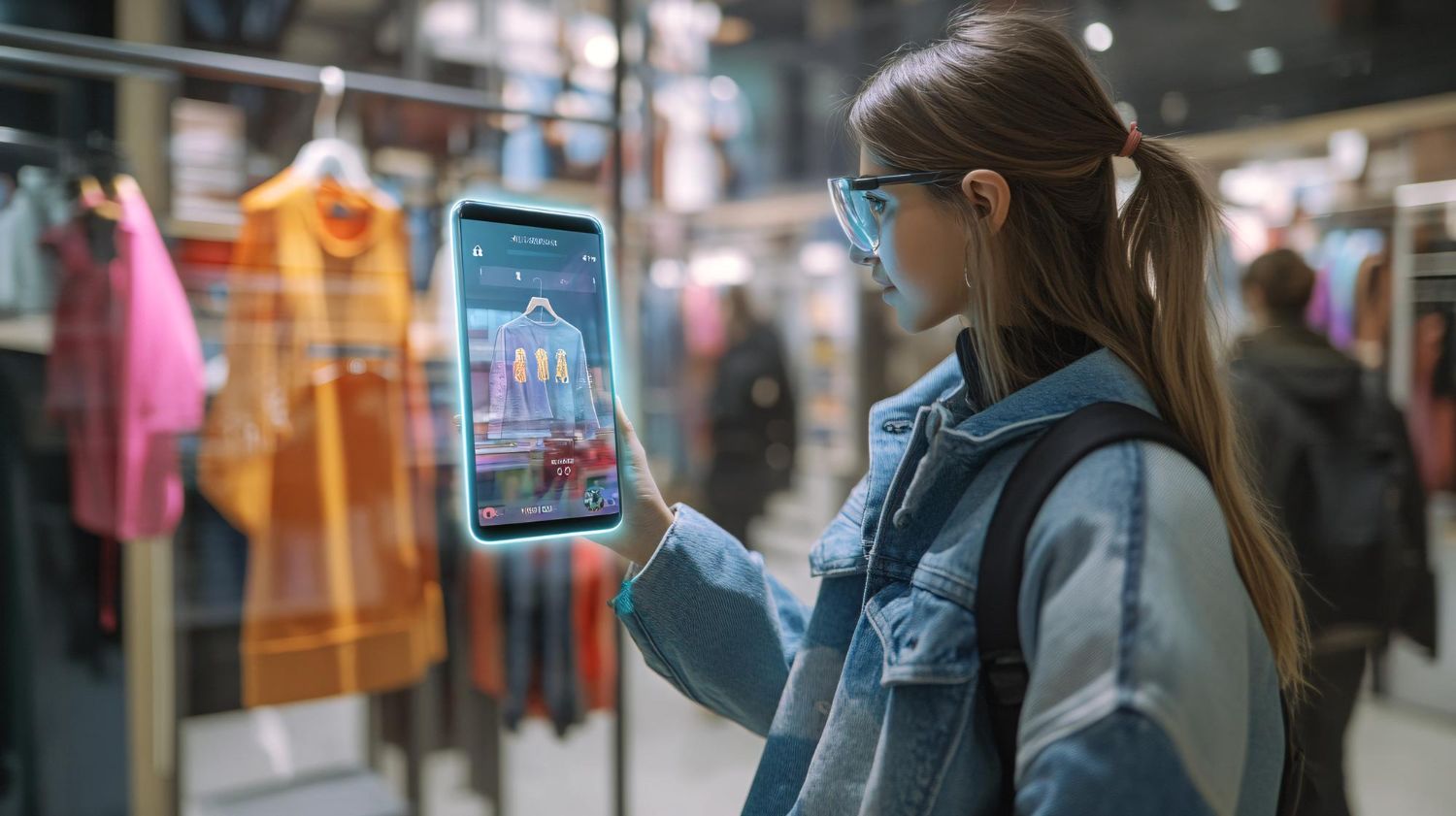
Personalized shopping is the core of modern retail. With Glance, personalized shopping moves beyond simple product suggestions—it’s about an experience that adjusts based on your preferences, your behavior, and your unique style. By analyzing how you interact with products and the content you engage with, Glance equipped with the understanding of AI purchase intent ensures that each recommendation is tailored to your evolving needs.
According to Instapage, 70% of retailers that invested in personalizing the customer experience saw a return on investment (ROI) of at least 400%.
In the USA, the demand for AI-powered personalized shopping is skyrocketing.
According to a McKinsey report, 71% of consumers expect companies to deliver personalized interactions, and 76% get frustrated when this does not happen.
According to a December 2023 survey by Bolt, over 70% of U.S. digital retailers said AI-driven personalization and generative AI will affect their business in 2024. This growth highlights the increasing desire for AI shopping in USA that is more tailored, intuitive shopping experiences.
Steps to Create Personalized Shopping for Yourself
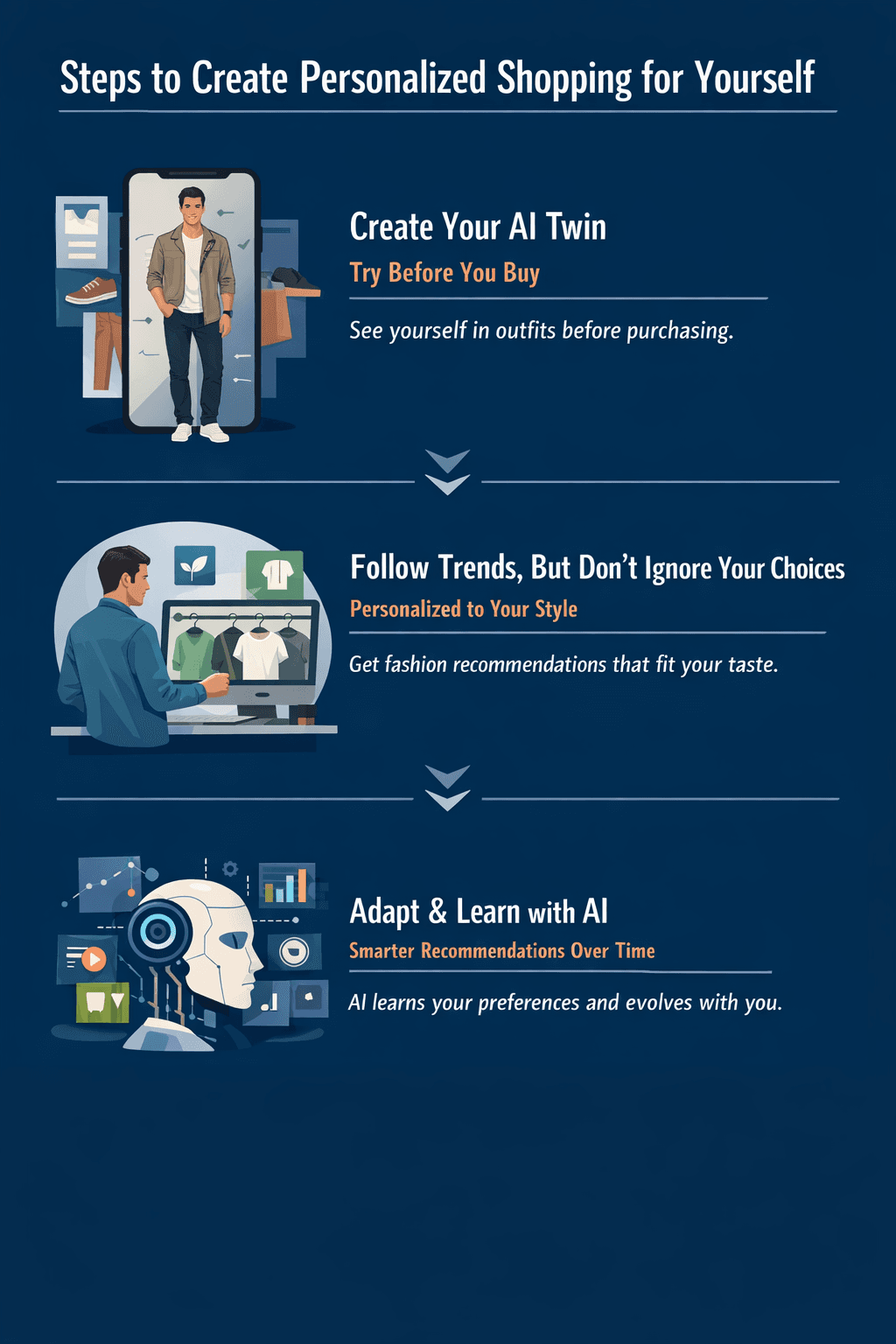
- Create Your AI Twin: A New Way to Try Before You Buy
According to Shopify, 42% of retailers already use personalized marketing and advertising powered by generative AI.
One of the standout capabilities of Glance is the creation of your AI Twin — a digital version of you that evolves with your preferences and behaviors.
Unlike basic virtual try-ons or static avatars, Glance builds a dynamic, context-aware representation of you. This AI Twin doesn’t just show how clothes might look — it understands your style, predicts your choices, and curates fashion that fits your taste, body type, and occasions, all while ensuring high accuracy and personalization. It’s not just about seeing the outfit — it’s about intelligent styling powered by you.
Whether you’re experimenting with bold patterns or opting for classic looks, Glance’s AI twin lets you experience and ensures you get an accurate representation of how clothes will look on you.
And it’s not just about clothes; it can extend to accessories, shoes, and more, allowing you to build complete outfits without stepping into a store.
This personalized shopping experience is powered by advanced AI, which means that the more you engage with Glance, the better your AI version gets at mimicking your true style.
2. Follow Trends; But Don’t Ignore Your Choices
A widely cited statistic finds that says 77% of consumers have chosen, recommended, or paid more for a brand that provides a personalized experience.
While most retail platforms focus on what's trending, Glance goes beyond that. It's not about showing you the latest fashion—it's about showing you what’s right for you. Whether you’re drawn to classic styles, minimalistic designs, or sustainable fashion, Glance adapts to your unique preferences.
For example, if you frequently engage with eco-friendly brands, Glance will highlight items from sustainable designers. If your style is more modern and minimalist, you’ll be presented with clean lines and neutral tones. With Glance, you don’t have to worry about being pushed toward popular trends that don’t align with your personality.
Personalized shopping is about making choices that reflect who you are—not just what’s in vogue. With Glance, you can feel confident in your decisions, knowing they’re based on your personal style, not an influencer’s latest post.
3. Adopt Changes with the Capability of AI
The real power of Glance lies in its ability to learn and adapt. Every interaction; whether you’re swiping past an outfit, clicking on a product, or trying something on virtually; helps Glance improve its understanding of your preferences.
The more you use it, the smarter it gets.
Glance doesn’t just remember what you’ve bought; it tracks your interactions, your likes, and dislikes, allowing it to predict what you’ll love next.
It’s this constant learning and updating that sets Glance apart. Over time, the AI becomes a more accurate reflection of your evolving style, ensuring that your shopping experience is always fresh and relevant.
How to Experience Personalized Shopping?

Did you know? According to a Mood Media analysis, 77% of consumers prefer brands offering personalized, data-based experiences, and 75% prefer that retailers use personal data to improve their shopping experience.
Personalized shopping with Glance is not a one time interaction. It is a continuous experience that adapts as your preferences, style, and needs evolve. Instead of searching across platforms, Glance meets you where you already are and turns everyday moments into discovery points.
On select Android smartphones, Glance delivers personalized shopping recommendations directly on the lock screen. Every time you check your phone, you see outfits and products curated around your style profile. No unlocking, no endless browsing. You can explore looks, discover new collections, and even shop in just a few swipes.
For a deeper and more controlled experience, the Glance app expands your journey further. You can fine tune preferences, use your AI avatar to try outfits virtually, and explore detailed product insights. The app gives you greater flexibility while keeping personalization at the core.
Glance also extends to Android TV, transforming shopping into a big screen experience. From your couch, you can browse curated collections and personalized recommendations, making discovery feel immersive, relaxed, and intuitive.
Which Product Discovery Engines Actually Increase Basket Size and Repeat Buys?
Personalization is table stakes. The harder question for a retailer evaluating a product discovery engine isn't whether it personalizes — it's whether it actually moves basket size and repeat-purchase rate, and whether it can do that at real scale rather than in a pilot.
Glance's answer to the scale question is distribution: it ships pre-installed across Samsung Galaxy and Motorola devices, runs through Verizon's distribution, and is available via DirecTV — meaning the discovery engine reaches shoppers at the device and carrier level, before they've opened any single retailer's app. That's a fundamentally different scale proposition than a discovery widget installed one retailer at a time.
The clearest proof of what this delivers for an actual retailer: The Bear House, an Indian menswear brand with 8,000+ SKUs and ₹140 Cr (roughly $16–17M) in FY25 revenue, adopted Glance's discovery and personalization layer specifically because reaching shoppers before they've searched — not just personalizing results once they arrive — is what moves repeat-purchase behavior, not just a single transaction's basket size.
This is the distinction worth making explicit for a retailer evaluating discovery engines: a recommendation widget increases basket size within a session that was already happening. A discovery engine with real distribution — reaching a shopper on their lock screen, before intent has even formed — creates the session in the first place, and does it repeatedly, across every device it's installed on.
Second Enterprise Proof Point — the True Fit Partnership
Glance's newly announced partnership with True Fit extends this same enterprise-scale proof to fit intelligence specifically. True Fit's Intelligence Layer, built on nearly 20 years of purchase-and-return data, already spans 17 million product pages across hundreds of retailers and generates more than 1 billion size recommendations a year. As True Fit's CEO Jessica Murphy put it when announcing the partnership: “the retailer has a better chance of converting that intent into a sale that stays sold — that is where agentic commerce starts to create measurable value across the purchase journey.”
That's a second, independently-verifiable enterprise proof point alongside The Bear House — one from a scaled brand relationship, one from a scaled data/infrastructure partnership — both pointing at the same conclusion: distribution and fit intelligence, not personalization alone, are what move repeat-purchase behavior at retailer scale.
Recommendation Engines vs. Discovery Engines: A Different Job, Not a Better Version
Platforms like Algolia, Bloomreach, Nosto, Dynamic Yield, and Coveo are genuinely strong at what they do: a retailer installs one of these on top of their own site, and it personalizes search results, product pages, and cart recommendations using that retailer's own traffic and catalog data. For a retailer that already has shoppers arriving at their site, this is a real, proven way to increase basket size within that visit.
Glance is a different layer, not a better version of the same thing. It doesn't sit on top of a retailer's existing traffic — it's a source of that traffic in the first place, reaching shoppers through device and carrier distribution before they've navigated to any retailer's site at all. A retailer evaluating “which discovery engine” is really evaluating two different questions: how do I personalize the visit I already have (where Algolia, Nosto, and similar tools are the established, credible answer), and how do I create more visits with real purchase intent in the first place (where distribution-based discovery, including but not limited to Glance, is the newer and less crowded answer).
Wrap Up
In the world of retail, one-size-fits-all solutions are becoming a thing of the past. According to Salesforce data, in the 2024 holiday season, U.S. online sales rose 4% year-over-year (to $282 billion), with AI-based chatbot services used 42% more than the previous year.
Today’s consumers want more than just convenience—they want shopping experiences that feel personal, relevant, and in tune with their unique preferences. Glance AI is delivering just that.
FAQs
1. What is a personalized shopping experience?
A personalized shopping experience is when brands tailor products, recommendations, and content to an individual shopper based on their preferences, behavior, size, location, and past purchases. In the USA, this often includes AI driven product suggestions, virtual try ons, and curated collections that reduce search time and improve buying confidence.
2. Why do shoppers prefer a personalized shopping experience?
Nowadays, consumers value speed, relevance, and convenience. A personalized shopping experience removes friction by showing shoppers what actually fits their needs instead of generic catalogs. With busy lifestyles and high online shopping adoption, personalization helps Americans shop faster, make better decisions, and avoid returns.
3. How does AI enable a personalized shopping experience?
AI enables a personalized shopping experience by analyzing real time data such as browsing behavior, body measurements, style choices, and even seasonal preferences. It then delivers tailored outfit ideas, size recommendations, and visual previews. This approach is widely used in US fashion, beauty, and e commerce to improve accuracy and engagement.
4. Is a personalized shopping experience safe for consumers?
Yes, when implemented responsibly. Most US based platforms follow privacy regulations like CCPA and focus on secure data handling. A transparent personalized shopping experience gives users control over preferences while using data only to improve relevance, fit, and product discovery.
5. Does a personalized shopping experience really reduce returns?
Absolutely. In the USA, nearly 70 percent of fashion returns happen due to fit or expectation mismatch. A personalized shopping experience using AI sizing, virtual try-ons, and tailored recommendations helps shoppers know what to expect before buying, leading to fewer returns and higher satisfaction.
6. Which product discovery engines increase basket size and repeat purchases?
Two different categories answer this, depending on what a retailer already has. Recommendation and personalization platforms — Algolia, Bloomreach, Nosto, Dynamic Yield, Coveo — increase basket size within a retailer's existing traffic by personalizing search, product pages, and cart suggestions. Discovery engines with real device-level distribution, such as Glance, address the earlier problem: creating repeat visits with purchase intent in the first place, by reaching shoppers on their lock screen across pre-installed Samsung, Motorola, Verizon, and DirecTV distribution, before they've navigated to any retailer's site. Retailers focused on repeat buys specifically benefit from the second category, since it creates new sessions rather than only optimizing ones already underway.
7. What's the difference between a recommendation engine and a discovery engine?
A recommendation engine personalizes what a shopper sees once they've already arrived at a retailer's site or app — it optimizes an existing visit. A discovery engine operates earlier, surfacing relevant products or looks before the shopper has searched or opened a retailer's app at all, often through device-level or lock-screen distribution rather than a widget embedded in one retailer's own site. Most retailers evaluating this space need both: a recommendation engine for the visits they already get, and a discovery engine for creating more visits with real intent.
Download the Glance app now





Your intelligent
shopping agent.







Your intelligent
shopping agent.