


Context-Aware Shopping: The AI That Reads Weather, Location and Trends at Once
TL;DR
In 2026, online shopping has shifted from a manual chore to a personalized conversation. Context aware shopping moves beyond the search bar, using your local weather, personal calendar, and physical features to filter the noise of the internet. With Glance acting as your intelligent shopping agent, the friction of endless browsing is gone—replaced by a curated feed that understands exactly what you need, right where you are.
Think about the difference between a massive, cold warehouse and a small neighborhood shop where the owner actually knows your name. In the warehouse, you’re on your own, wandering through endless aisles of stuff that doesn't fit. But in the local shop, the owner sees you walk in and says, "Hey, I actually have a jacket in the back that would look great on you, and it’s perfect for the rain we’re having today."
That feeling of being "understood" is exactly what context aware shopping is bringing to the internet in 2026. For years, shopping online has felt like a chore—typing in keywords and hoping for the best. Now, technology is finally learning to "read the room." It’s moving away from just being a search bar and becoming an intelligent shopping agent that knows your style, your local weather, and what’s already in your closet. We aren't just clicking anymore; we’re finally getting the personal touch we’ve been missing.
Reading context is what makes the difference between an AI that waits and one that acts. A system that responds to your search query is reactive — it needs your prompt to exist before it can help. A system that reads your context is proactive — it works before you know you need it. That is the structural distinction at the heart of agentic shopping — and it starts with understanding what context actually means.
The Behavioral Science of Context-Aware Shopping
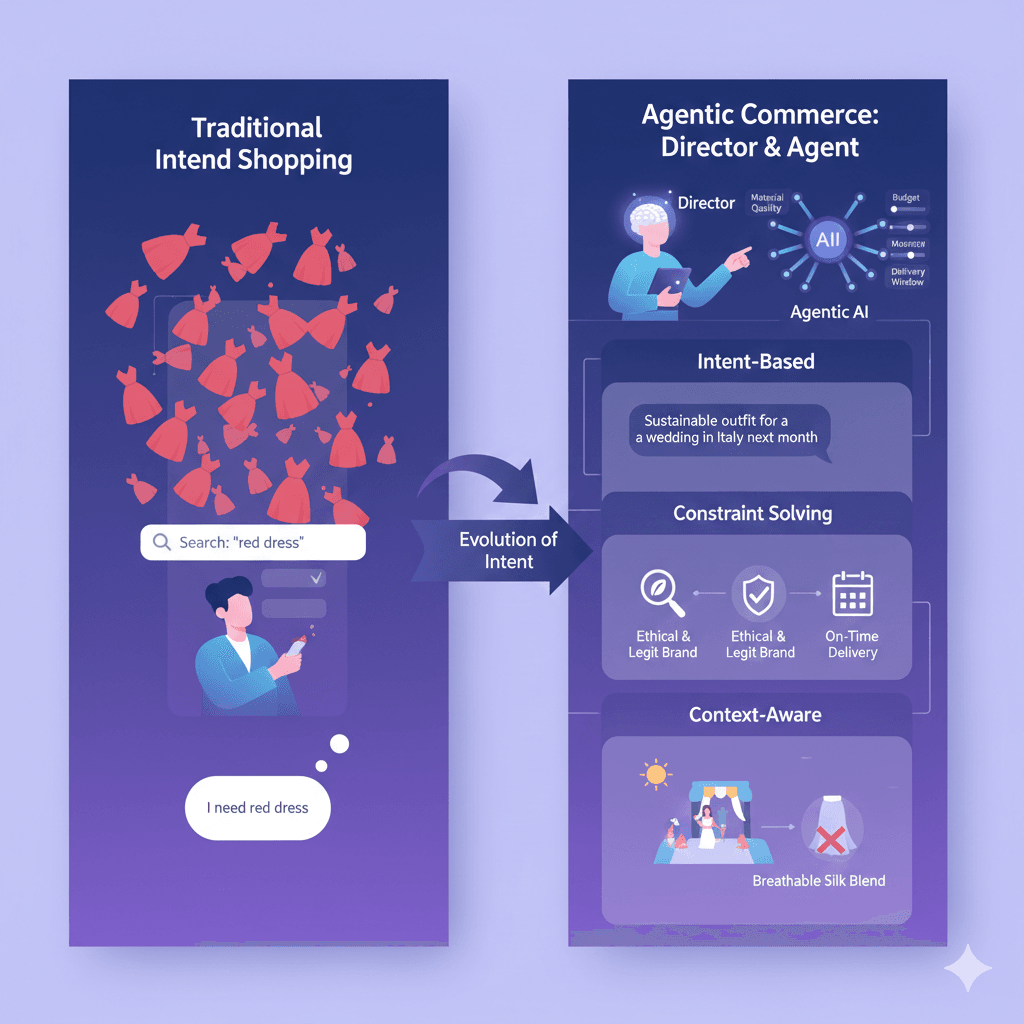
In the past, shopping was a series of manual hurdles. You’d search, you’d filter, you’d compare. This created a massive amount of "Cognitive Load"—the mental energy required to make a decision. Behavioral scientists have noted that by 2026, the average consumer is experiencing decision fatigue." When we are overwhelmed, we don't choose the best thing; we usually choose the easiest thing, or we choose nothing at all.
Context aware shopping solves this by acting as a biological and environmental filter. It’s not just about what you type; it’s about the "Silent Signals" you send.
The Three Dimensions of "Invisible Context"
- Environmental Context: Real-time data integration. If the system knows your local UV index is spiking, it prioritizes high-SPF skincare and lightweight linens in your feed without you asking.
- Predictive Intent: Analyzing your calendar and habits. If you’ve booked a flight to a ski resort, the system understands the "intent" is warmth and safety, not just "winter clothes."
- Visual Reality: This is where the tech gets deeply personal. By using a single selfie, an intelligent shopping agent can analyze your proportions and skin tone to ensure that every recommendation is a "guaranteed win" for your physical frame.
From Search to Delegation: How Context-Aware Commerce Works
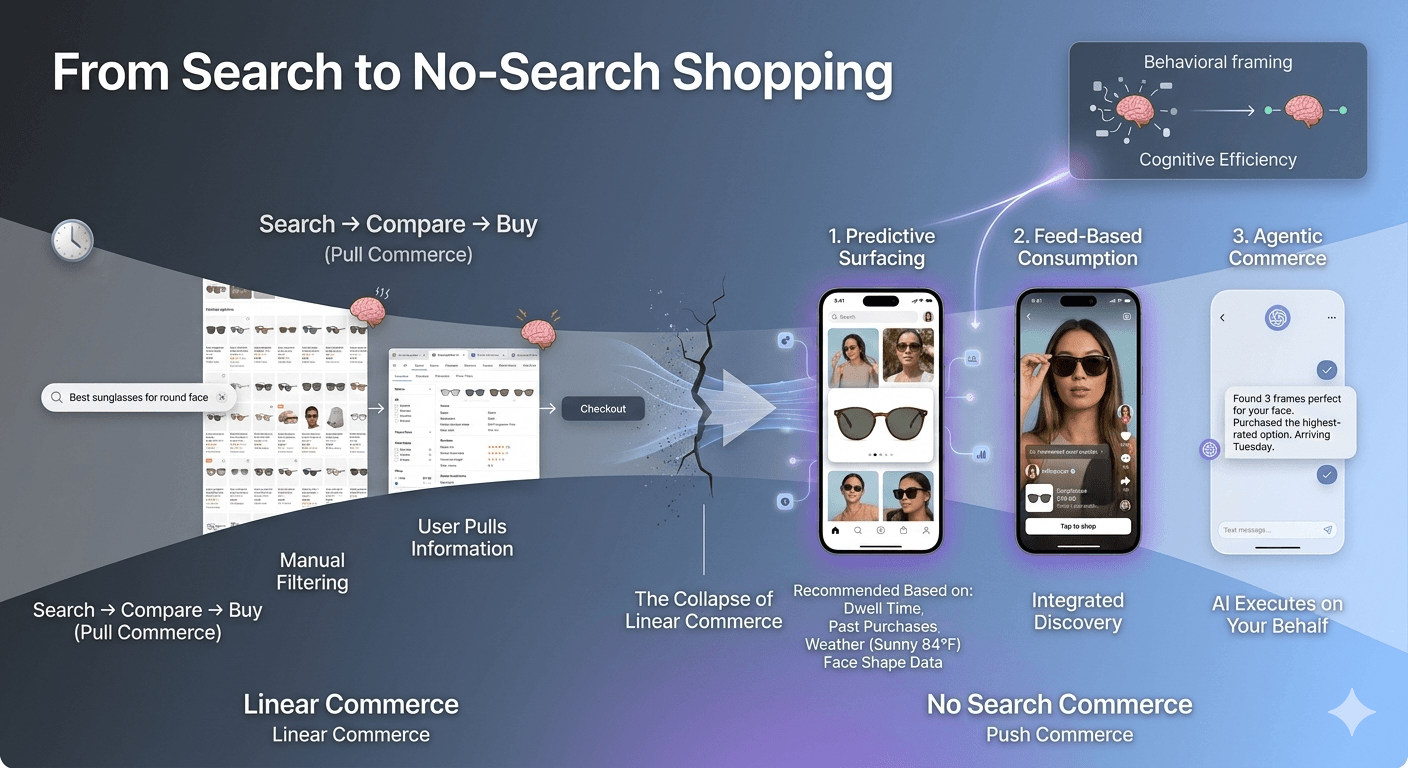
We are currently witnessing the death of the search bar. According to McKinsey research, 71 percent of consumers now expect personalised interactions, and companies that excel at personalisation generate 40 percent more revenue than average players.
This is the shift from Automation (pre-set rules) to Agency (autonomous decision-making). In this new landscape, your intelligent shopping agent, like the one from Glance, does the "messy middle" work for you. It interrogates "dirty data" from retailers—checking if an item is actually in stock at the local warehouse—before it even shows it to you. This reduces the heartbreak of the "out of stock" notification at checkout.
Comparison: The Evolution of Consumer Intent
The Keyword Era (2015) | The Algorithm Era (2022) | The Contextual Era (2026) |
User Action: Types "Black Boots" | User Action: Scrolls a social feed | User Action: Delegates a goal ("Outfit for London") |
Logic: Exact phrase matching | Logic: Browsing history / Liked posts | Logic: Weather, Closet Inventory, & Biometrics |
Interface: Search Result Pages | Interface: Infinite Vertical Feed | Interface: Curated, Contextual Moodboard |
Effort: High (Manual Filtering) | Effort: Medium (Passive Consumption) | Effort: Zero (Reviewing a Proxy's Choice) |
Most shopping tools today are still reactive — they wait for your query and respond to it. Context-aware shopping is built on a different model. For a deeper look at why this distinction matters, see Five Signals, One Look: How Multi-Agent Fashion AI Works.
Why One Signal Is Never Enough
Most weather-based shopping tools stop at temperature and precipitation. That is one signal. A wardrobe app that reads your calendar stops at occasion. That is one signal. A recommendation engine that tracks your purchase history stops at past behaviour. That is one signal.
The problem is that every fashion decision involves multiple simultaneous variables. What the weather is. Where you are going. What the occasion demands. What colours work with your skin tone. What silhouettes suit your proportions. What you have responded to before. A system reading only one of those variables will get it right occasionally. It will miss the rest of the time.
This is what separates context-aware shopping from weather-aware shopping. Research from Retail Systems Research found that 58 percent of retail professionals agree that location data positively impacts revenue — but location alone is still one signal. What makes the difference is synthesising all relevant signals simultaneously into one coherent output.
Glance reads five signals at once: your weather and location, regional trends in your city, upcoming occasions, your physical features from your selfie, and your evolving lifestyle preferences. Each one informs the output in a way no other signal can replicate. Together they produce a look that is right for you, right now. For the full breakdown of how these five agents work together, see Five Signals, One Look: How Multi-Agent Fashion AI Works.
Zero-Click Commerce: The New Retail Frontier
The ultimate goal of context aware shopping is "Zero-Click Commerce." This is the idea that the most efficient shopping trip is the one you didn't have to take. In 2026, brands are no longer optimizing for "Search Engine Optimization" (SEO); they are moving toward "Answer Engine Optimization" (AEO).
If a brand's data isn't "machine-readable"—meaning an AI agent can't instantly verify the fabric weight, the return policy, or the ethical sourcing—that brand becomes invisible. The "customer" is no longer the human browsing a website; the customer is the AI agent acting on that human’s behalf. This forces a level of transparency in retail that we’ve never seen before.
Why Context is the Secret to Sustainable Style
One of the most human benefits of this tech-heavy shift is its impact on the planet. The "Return Crisis" has plagued e-commerce for years, with return rates for apparel hitting nearly 25% in early 2026. Most of these returns happen because the item "didn't look like the picture" or "didn't fit right."
Context aware shopping targets the root causes of waste:
- Eliminating the "Size Guess": When an agent knows your exact measurements, the habit of ordering three sizes to "see which fits" disappears.
- Harmonizing with Current Wardrobe: By referencing your "Inventory Context," the agent prevents you from buying redundant items that will just sit in a drawer.
- Visualizing Reality: Tools like Glance allow you to see the item on your own digital twin, styled with items you already own. This removes the "Post-Purchase Regret" that drives the return cycle.
. For a closer look at how weather signals specifically shape outfit recommendations, see AI Weather Fashion: Smarter Shopping with Climate Data.
The "Human-in-the-Loop" Security Standard
Of course, the more "context" we give our technology, the more we have to think about privacy. In 2026, the industry has shifted toward On-Device Intelligence. This means your most sensitive data—your body measurements, your private calendar, your home location—never actually leaves your phone.
The intelligent shopping agent acts as a protective layer. It looks out at the world of retail, filters the noise based on your private context, and only brings you the results. You get the luxury of a personalized experience without the privacy concern of a third-party server tracking your every move.
How to Lean into the Contextual Era
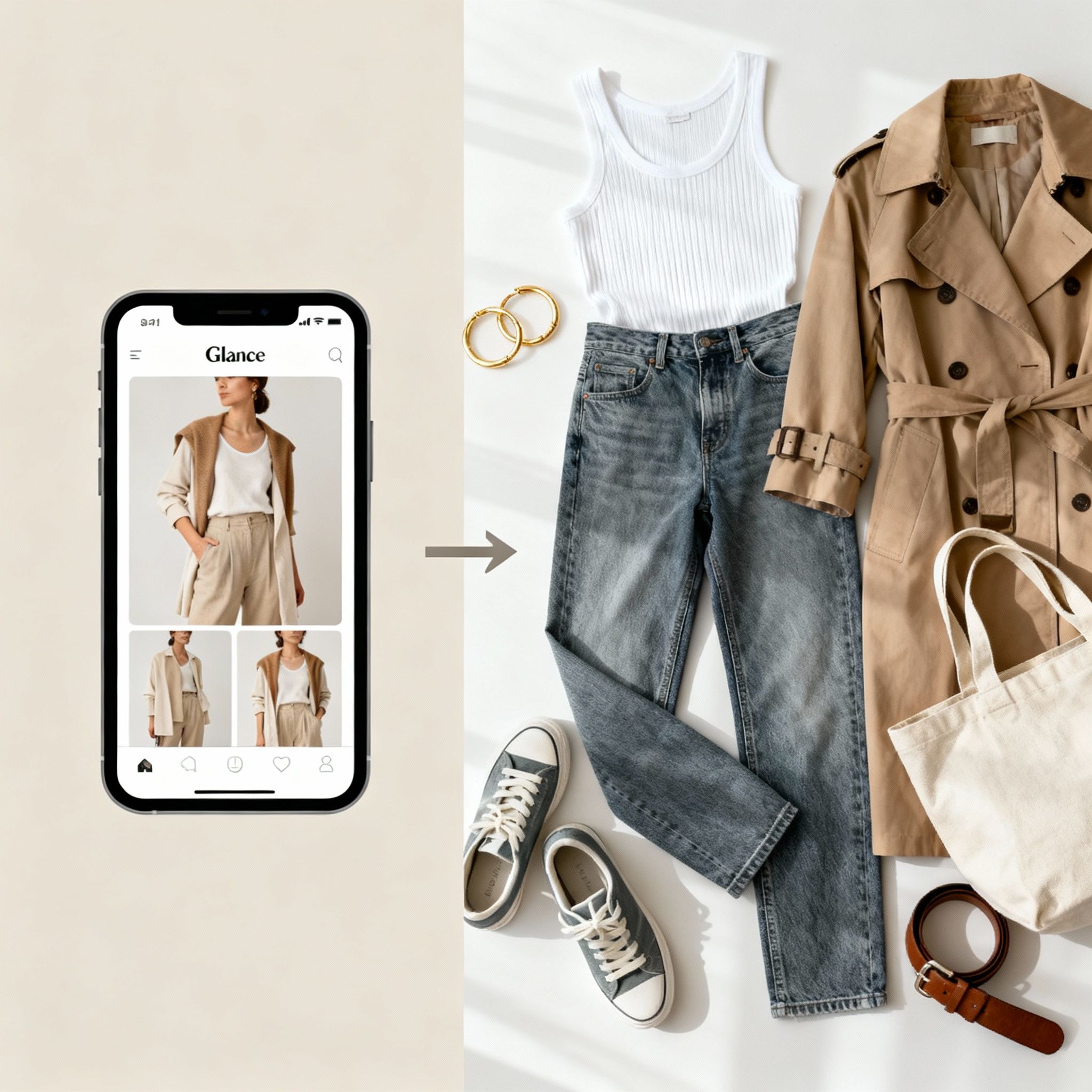
Getting the most out of context aware shopping requires a small shift in how you interact with your devices:
- Trust the Proxy: Allow your agent to see "Low-Resolution" data, like your city’s weather or a general category of your calendar (e.g., "Formal Event"), to unlock more relevant results.
- Give Quality Feedback: AI agents learn from "No" faster than they learn from "Yes." If an agent suggests something that doesn't fit your vibe, explain why (e.g., "too high-waisted" or "too bright").
- Curate, Don't Hunt: Use platforms like Glance that prioritize context aware shopping to do the heavy lifting. Let the agent build the collection, and you simply act as the final "creative director" of your look.
Conclusion: Reclaiming Your Attention
We’ve spent two decades serving the internet—spending our limited time and attention to help algorithms figure out what we might want to buy. Context aware shopping is the moment the tables turn.
By utilizing your real-world environment, your physical features, and your future plans, technology is finally moving from being a "distraction" to being a "utility." The future of retail isn't about more tabs, more ads, or more scrolls; it's about a world that finally understands you, right where you are.
FAQs About Context Aware Shopping
- What does context aware shopping mean?
Context-aware shopping is a retail technology that reads real-world signals — your location's weather, your upcoming calendar events, your physical features, and regional trends — and uses them to surface relevant products or outfits before you search. Rather than waiting for a query, a context-aware system acts on the information it can already read about your situation. - How is an intelligent shopping agent different from a regular app?
A regular app waits for you to search and filter. An intelligent shopping agent, like Glance, proactively curates options for you by "reading the room." It acts as a proxy, doing the research and verification so you only have to make the final decision. - Does context aware shopping help reduce clothing returns?
Yes. By using precise physical features and "wardrobe" context, these systems ensure the item fits your body and your existing wardrobe before you buy it. This targets the root causes of the e-commerce return crisis. - Is my personal data safe with these AI shopping agents?
In 2026, top-tier agents use "On-Device Intelligence." This means your measurements and personal schedules are processed locally on your smartphone and are not stored on external company servers, providing a personalized yet private experience.
5. How does AI know what the weather is where I am?
Glance’s Weather and Location Agent reads your device’s location data and cross-references it with real-time weather conditions for your specific area — not a city-wide average, but conditions at your exact location. It uses this to filter out weather-inappropriate options before they reach your feed.
Download the Glance app now





Your intelligent
shopping agent.







Your intelligent
shopping agent.